Introduction
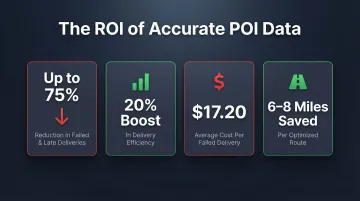
Failed deliveries cost U.S. retailers an average of $17.20 per order, and roughly 8% of domestic first-time deliveries fail. Routes that looked perfect in planning software collapse during execution — not because the algorithm is wrong, but because the data feeding it is incomplete.
Point of Interest (POI) data is the structured, location-based dataset of real-world places — customer addresses, depots, fuel stops, restricted zones, and service points — that route optimization engines use to calculate constraint-aware delivery paths.
Unlike a plain address list, POI data carries attributes like operating hours, access types, service time estimates, and vehicle restrictions. Those attributes are what make the difference between a route that looks efficient and one that actually runs.
This guide is written for logistics managers, 3PL operators, last-mile delivery teams, and fleet dispatchers. If your optimization engine is producing routes that fall apart on the road, POI data quality is likely where the problem starts.
TLDR
- POI data includes attributes like operating hours, access type, and service time that define how stops behave within an optimization engine
- Address errors contribute to up to 41% of failed deliveries, making POI quality a direct cost driver
- Routing pipelines span data ingestion, attribute enrichment, constraint mapping, and execution — errors at any stage carry forward
- 20-25% of B2B POI records become stale annually, requiring systematic refresh cycles
- Last-mile, field service, and 3PL operations each demand distinct POI types and update cadences
What Is POI Data in Delivery Route Optimization?
POI data in routing is any location-linked record of a real-world location that a delivery or field service operation interacts with. This includes customer addresses, warehouses, depots, fuel stations, restricted zones, parking areas, and service hubs.
What separates POI data from a plain address list is attributes. A POI record carries operating hours, access types (loading dock vs. front entrance), loading constraints, service time estimates, contact information, and special handling requirements. These attributes allow a routing engine to treat each stop as a business rule, not just a coordinate. An address tells you where something is; a POI record tells the engine how to service that location.
POI data is also distinct from road network data. Road data defines how vehicles can travel between stops—turn restrictions, speed limits, road closures. POI data defines the stops themselves and the conditions under which they can be served. Both are required inputs to route optimization, but they solve different problems.
Delivery-Relevant POI Categories
Route optimization engines consume several POI categories:
- Customer delivery points - Residential and commercial addresses where goods are delivered, each with unique access and timing requirements
- Origin depots and fulfillment centers - Starting locations for routes, with operating hours and loading capacity constraints
- Intermediate waypoints - Fuel stops, rest areas, and vehicle charging stations that support route execution
- Restricted or no-go zones - Areas with access limitations, traffic restrictions, or security requirements
- Competitor or partner facilities - Used in network planning and capacity analysis
Industrial and commercial POIs carry additional attributes that directly affect routing. Manufacturing plants and warehouses may have dock availability windows, receiving hours, vehicle weight limits, height restrictions, and specific entrance requirements.
A distribution center might accept 53-foot trailers only between 6 AM and 2 PM at Dock C, while smaller vehicles can use Dock A until 6 PM. Missing these attributes sends drivers to the wrong entrance at the wrong time—triggering rejected deliveries and driver overtime.
Key Attributes That Drive Routing Decisions
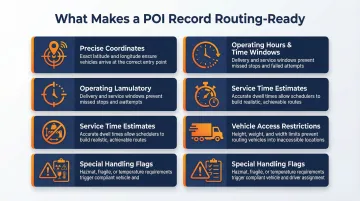
Route optimization engines directly consume these POI attributes:
- Precise coordinates - Rooftop or parcel-level geocoding (not just street-level), placing stops at actual access points
- Operating hours and time windows - When the location accepts deliveries or services
- Service time estimates - How long the driver will spend at each stop (unloading, paperwork, customer interaction)
- Vehicle access restrictions - Weight limits, height clearances, vehicle type requirements (no trailers, commercial vehicles only)
- Special handling flags - Refrigeration required, signature needed, white-glove service, hazmat restrictions
Missing or defaulted attributes force the optimization engine to make assumptions—and those assumptions produce routes that look optimal in software but fail in the field.
A stop without a time window may be scheduled outside the customer's receiving hours. A missing service time estimate throws off every downstream ETA, driving customer complaints and missed SLAs.
Why POI Data Matters for Delivery Route Optimization
Route optimization engines are mathematically sound, but only as good as their inputs. The algorithm optimizes against the constraints it receives—no more, no less. POI data quality directly caps the quality of output routes.
The Operational Cost of Poor POI Data
Without accurate POI data, operations break down:
- Wrong access points and closed locations cause failed first attempts — 74% of businesses report bad address data causes up to 25% of their deliveries to fail
- Missing service time estimates blow up ETAs, pushing every downstream stop behind schedule
- Incorrect access points and restricted-zone routing add unnecessary miles and fuel cost
- Stops that run long or require unplanned detours make customer ETAs unreliable
- Address correction surcharges can reach $23.50–$24 per package, eroding margins at scale
How Rich POI Data Enables Constraint-Aware Optimization
When stop-level attributes are complete, a routing engine can enforce both hard constraints (delivery time windows, vehicle access restrictions) and soft constraints (driver preferences, priority stops) at the same time. The result is routes that are feasible, not just fast.
NextBillion.ai's Route Optimization API handles 50+ hard and soft routing constraints — including delivery windows, shift timings, load capacity, service levels, and vehicle types — translating complete POI inputs into route plans that hold up in real-world operations.
The Competitive Advantage of Strategic POI Data
Companies that maintain accurate, enriched POI datasets can:
- Offer customers precise delivery windows backed by realistic schedules
- Absorb demand surges more efficiently by optimizing against real operational constraints
- Reduce cost-per-stop metrics over time
High-resolution geocoding data has been shown to reduce failed or late deliveries by up to 75% and boost delivery efficiency by 20%. UPS's route optimization system reduced driver routes by 6-8 miles per route, saving 100 million miles driven and $300-400 million annually.
How POI Data Powers Delivery Route Optimization
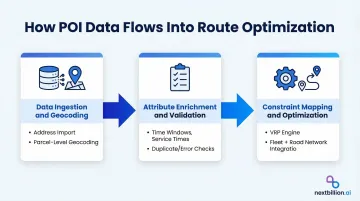
POI data enters the optimization workflow as the stop-level input layer. The engine cross-references it against road network data, vehicle constraints, and business rules to compute feasible, sequenced routes. Raw location records become structured delivery stops → constraint-mapped nodes → optimized route sequences.
Step 1: Data Ingestion and Geocoding
Raw POI data—addresses from spreadsheets, CRM exports, or order management systems—must be ingested and geocoded to precise coordinates before routing can occur.
Street-level geocoding places a point on a road segment. Rooftop or parcel-level geocoding, by contrast, anchors the point at the actual property access point. This distinction matters for last-mile accuracy, particularly in dense urban or industrial areas.
Street geocoding has a median error of 41 meters, with a 95th percentile of 137 meters. In dense urban areas, errors of 50-100 meters can place a stop on the wrong side of a divided highway or inside a facility rather than at its access gate. High-resolution geocoding can improve average navigation time by nearly a minute per stop.
Step 2: Attribute Enrichment and Validation
After geocoding, each POI must be enriched with routing-relevant attributes:
- Time windows derived from customer data or historical delivery patterns
- Service time estimates from historical actuals or operational defaults
- Vehicle access flags based on facility type, regulations, or customer requirements
- Special handling requirements for refrigeration, signatures, or equipment needs
Validation checks catch data quality issues before they propagate into the optimization run:
- Duplicate stops at the same coordinates
- Implausible coordinates (ocean, desert, or impossible locations)
- Conflicting time windows (end time before start time)
- Missing mandatory attributes
Step 3: Constraint Mapping and Optimization Execution
The enriched POI dataset is fed into the optimization engine alongside vehicle fleet data (capacity, working hours, start/end locations) and road network data. The engine solves a variant of the Vehicle Routing Problem (VRP), using POI attributes as the constraint set that governs stop sequencing, vehicle assignment, and schedule feasibility.
VRP variants the engine handles include:
- Capacitated VRP (CVRP) - Vehicles have limited carrying capacity
- VRP with Time Windows (VRPTW) - Service must start within specific time windows
- VRP with Pickup and Delivery (VRPPD) - Handling both pickup and delivery stops
NextBillion.ai's Route Optimization API allows teams to pass custom POI attributes directly into the constraint framework across 50+ hard and soft constraints. The result is routes calibrated to actual operational conditions — not just the shortest path on a map.
Key Factors That Affect POI Data Quality and Routing Outcomes
Several factors determine whether your POI data enables or undermines route optimization:
- Data freshness — POI records go stale as businesses change hours, relocate, or close. 20-25% of B2B records decay annually, and nearly 60% of pre-2020 POI records are already outdated — with an average 53-meter displacement between listed and actual coordinates.
- Geocoding precision — Errors of 50-100 meters can place a stop on the wrong side of a divided highway or inside a facility rather than at its access gate. Street-level vs. parcel-level geocoding directly determines whether drivers find the right entrance.
- Attribute completeness — Missing service time or time window data forces the routing engine to fall back on defaults. 37% of last-mile delivery issues trace back to missing gate codes or critical delivery details.
- Data source reliability — Third-party POI aggregators are convenient but frequently less accurate than first-party CRM data or field-validated records your drivers collect on the ground.
- Scale and update cadence — Across many regions, data quality problems compound quickly. Manual spot-checking can't keep pace; automated validation pipelines are the only approach that holds up at scale.
That last point matters especially for multi-region operations. NextBillion.ai's custom map and road attribute editing capabilities let logistics teams override POI-level data directly at the map layer — so routing decisions stay grounded in what's actually on the road, not what a third-party database last recorded months ago.
Common Misconceptions About POI Data in Route Optimization
"A Delivery Address and a POI Record Are the Same Thing"
This is the most common and costly misconception. An address tells you where a location is. A POI record tells the routing engine how to service that location—what time, with what vehicle, with what dwell time, under what access conditions.
Routing with bare addresses produces the same mathematical output as routing with full POI attributes only when all defaults happen to match reality. At scale, this never happens.
"POI Data Is a One-Time Setup"
POI data must be treated as a live asset with a refresh cycle tied to the volatility of your delivery network. Customer churn, seasonal operating hours, new access restrictions, and facility changes all degrade POI accuracy over time.
Teams that configure POI data at implementation and never revisit it will see route quality erode silently. The signal arrives late — failed deliveries climbing, drivers abandoning suggested routes, and no obvious explanation pointing back to the source.
"Route Optimization Problems Are Algorithm Problems"
Operations teams often diagnose routing failures as algorithm problems — wrong stop order, infeasible schedules — when stale or incomplete POI data is the actual cause. Before touching the optimization engine, check:
- POI attribute completeness: Are time windows, dwell times, and access constraints populated?
- Geocoding precision: Are coordinates placing stops at the correct entrance or dock, not the street centroid?
- Data freshness: When were these records last validated against current operating conditions?
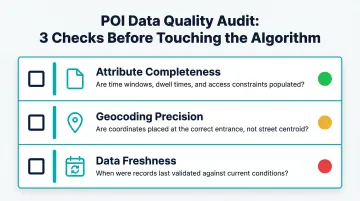
This audit resolves the majority of real-world routing discrepancies faster than any algorithm adjustment will.
Frequently Asked Questions
What types of POI data are most important for delivery route optimization?
The most critical attributes are precise coordinates (rooftop or parcel-level), operating hours, delivery time windows, service time estimates, and vehicle access restrictions. A routing engine needs this full picture to produce feasible, constraint-aware routes—an address alone isn't enough.
How does inaccurate POI data affect delivery routes?
Inaccurate POI data triggers a chain reaction: wrong coordinates cause failed first-attempt deliveries, missing service time estimates distort ETAs across the entire route, and incorrect access points force driver detours. Each failure compounds the next, directly increasing cost-per-stop.
What is the difference between POI data and standard address data in routing?
An address locates a place. A POI record describes how that place behaves as a delivery stop—including operating hours, required dwell time, access constraints, and handling requirements. Route optimization engines need POI-level attributes to enforce constraints, not just addresses to plot coordinates.
How does real-time POI data improve last-mile delivery performance?
Real-time POI updates allow routes to adapt mid-execution rather than failing silently. For example, a customer flagging a closed gate or live traffic triggering stop reordering can prevent missed deliveries and keep customer ETA notifications accurate.
Can route optimization software use custom or proprietary POI data?
Yes. Modern route optimization APIs allow organizations to ingest their own proprietary POI datasets—first-party customer records, custom depot locations, and internally maintained facility attributes—rather than relying solely on third-party providers. NextBillion.ai's platform supports custom data ingestion, including time windows, vehicle capacities, and other business-specific constraints.
How often should POI data be updated to remain effective for routing?
Update frequency should match the volatility of your delivery network. High-churn B2C networks may need weekly refreshes, while stable B2B routes with fixed commercial clients may need monthly or quarterly audits. Stale POI data is one of the most common silent causes of declining route optimization performance over time.