Introduction
Customers now expect same-day delivery as standard, not premium. Yet 53% of total shipping costs now go to last-mile delivery, and failed first-attempt deliveries cost an average of $17.78 each. The businesses that make same-day delivery profitable share one common capability: dynamic route optimization that adapts in real time.
This guide is a practical blueprint covering:
- What same-day delivery actually means operationally
- Why route optimization is its backbone
- The components of an effective system
- How to implement it without bleeding money
TLDR
- Same-day delivery requires real-time route optimization, not static planning
- Route optimization cuts delivery costs by 15–30% in year one
- Key components: live traffic data, dynamic re-optimization, constraint handling
- Implementation requires baseline metrics, API integration, and continuous iteration
- Per-vehicle pricing scales more predictably than per-API-call models as delivery volume grows
What Is Same-Day Delivery and Why Has It Become a Business Imperative?
Same-day delivery means orders placed and received on the same calendar day, typically within a 2-6 hour window. It differs from same-day shipping, where items ship the same day but may arrive later. This distinction matters operationally—same-day delivery compresses every step from order placement to doorstep arrival into hours, not days.
Consumer expectations have shifted fast. A few key numbers show how far:
- 80% of consumers now expect retailers to offer same-day delivery, yet over 90% will abandon carts if shipping costs are too high
- The global same-day delivery market reached $9.90 billion in 2024
- By 2030, that figure is projected to hit $29.82 billion — a 20.6% annual growth rate
That demand isn't evenly distributed. Four verticals account for the bulk of same-day volume:
- E-commerce and retail (53% of US market share)
- Food and grocery delivery
- Pharmaceutical and medical supplies (Amazon Pharmacy is expanding to 20 cities in 2026)
- On-demand service platforms
Each vertical has unique route optimization requirements: grocery needs refrigerated vehicles and tight time windows, pharmaceuticals require priority routing, and retail demands high stop density to control costs.
Why Route Optimization Is Non-Negotiable for Same-Day Delivery
Manual Routing Fails Under Compression
Consider a dispatcher manually assigning 20 stops across 3 drivers for a 6-hour delivery window. One wrong stop sequence, one missed traffic alert, one unbalanced driver workload—and deliveries cascade into failures. With same-day delivery, there's no next-day fallback.
Route optimization means dynamically calculating the best sequence and assignment of orders across a fleet based on dozens of live variables: traffic, driver location, vehicle capacity, time windows, and incoming orders. The shortest path is rarely the right one.
Static vs. Dynamic Routing
- Static route planning: Done in advance, fixed, assumes stable conditions
- Dynamic route optimization: Adjusts continuously as orders arrive and conditions change
Same-day delivery demands the latter. Orders arrive throughout the day. Traffic shifts. Customers reschedule—and static plans can't adapt.
Business Outcomes That Matter
Route optimization directly enables:
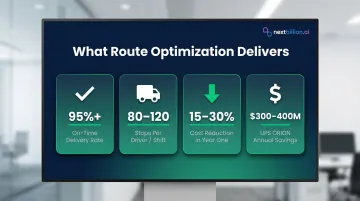
- Higher on-time delivery rates (95%+ is the benchmark)
- More deliveries per driver per shift (80-120 stops)
- Reduced fuel and mileage costs
- Ability to absorb late-arriving orders without disrupting routes
UPS's ORION system saves 100 million miles and $300-400 million annually. Across the industry, operations deploying advanced routing software commonly report 15-30% delivery cost reductions within the first year.
Order-to-Dispatch Latency
Those cost gains connect directly to one often-overlooked metric: order-to-dispatch latency — the time between when a customer places an order and when a driver is dispatched. Optimization software with sub-second response times compresses this gap, making tight delivery windows achievable. Every minute saved in planning is a minute gained on the road.
Core Components of a Route Optimization System Built for Same-Day Delivery
Real-Time Traffic and Road Data Integration
Same-day delivery route optimization must ingest live traffic feeds, road closures, and historical speed patterns. Using generic mapping APIs without live data creates consistent delays and missed ETAs.
AI-driven ETAs utilizing real-time traffic achieve 84-92% accuracy within ±15 minutes, compared to just 38-48% for static morning estimates. This accuracy directly reduces customer support calls and failed deliveries.
Constraint Handling for Complex Scenarios
Effective route optimization must support:
- Hard constraints (cannot be violated): time windows, vehicle weight limits, driver hours-of-service
- Soft constraints (flexible but penalized): customer preferences, priority orders, zone restrictions
NextBillion.ai's route optimization engine handles 50+ constraints simultaneously — a threshold that distinguishes purpose-built logistics APIs from basic routing tools that collapse under real-world complexity.
Dynamic Re-Optimization and Intra-Day Order Insertion
Constraint enforcement only solves the plan-at-dispatch problem. The harder challenge is what happens when new orders arrive after routes are already running — the system must absorb them without rebuilding the entire plan or rerouting every driver.
Key mechanisms:
- Locked stops: Completed or in-progress stops stay fixed; only future stops can be adjusted
- Lookahead windows: New orders slot into available gaps without triggering a full re-optimization
Driver and Fleet Assignment Logic
Route optimization must match orders to the right driver or vehicle based on:
- Current location and remaining shift time
- Vehicle type (refrigerated van for groceries, motorcycle for small parcels)
- Capacity — weight, volume, and special equipment like liftgates
Poor assignment logic is a leading cause of failed same-day deliveries.
ETA Accuracy and Customer Communication
Route optimization systems should produce accurate, continuously updated ETAs that surface to customers via tracking links or notifications. About 50% of customers actively track orders to ensure on-time delivery.
When ETAs are wrong, two costs stack up: redelivery attempts and inbound support volume. Both are avoidable with a system that updates ETA calculations continuously as conditions change.
How to Implement Same-Day Delivery with Route Optimization
Step 1: Assess Your Delivery Operation Baseline
Before deploying route optimization, document:
- Average delivery time per stop
- On-time delivery rate
- Cost per delivery (target: $8-12)
- Stops per driver per shift
Also map where inventory is held relative to delivery zones. Distributed local fulfillment centers are a prerequisite for same-day coverage.
Step 2: Define Your Constraint Model
Work out which hard and soft constraints matter for your use case:
- 2-hour delivery windows for grocery
- Driver shift end times
- Order priority tiers (premium vs. standard)
- Vehicle-specific restrictions (refrigerated, liftgate-equipped)
Ensure your route optimization solution can be configured to enforce them. 76% of logistics transformations fail to meet critical performance metrics, often because constraint models are too vague or incomplete.
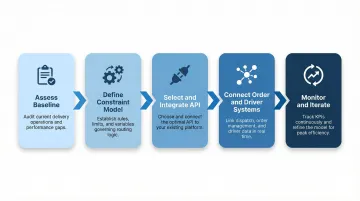
Step 3: Select and Integrate a Route Optimization API
Choose a solution offering:
- Real-time dynamic routing (not just batch planning)
- Response latency under 1-2 seconds
- Constraint flexibility (50+ constraints)
- Scalability for demand surges
Pricing model matters. Per-API-call pricing becomes prohibitively expensive at scale for same-day operations, where re-optimization happens continuously. Per-vehicle or per-order pricing — the model NextBillion.ai uses — provides cost predictability as delivery volumes grow.
Step 4: Connect Order Management, Dispatch, and Driver Apps
Route optimization works best when integrated into the full delivery stack:
- Orders flow in automatically from your OMS
- Optimized routes push to driver apps
- Status updates flow back in real time
Connecting these systems requires APIs and webhooks between each layer. A solution with 24x7 engineering support accelerates this integration and reduces downtime during deployment.
Step 5: Monitor, Measure, and Iterate
After going live, track weekly:
- On-time delivery rate (target: 95%+)
- Cost per delivery (target: $8-12)
- Driver utilization (target: 80-120 stops/day)
- Failed delivery rate
Use delivery data to refine constraint settings, adjust fulfillment center inventory positioning, and improve order cut-off time policies. Route optimization requires continuous tuning — the data from each week's deliveries should feed directly back into your configuration.
Overcoming the Biggest Challenges in Same-Day Delivery Operations
High Operational Cost
Same-day delivery has a higher cost structure than standard delivery due to smaller load sizes, faster dispatch cycles, and overtime risk.
Strategies to control cost:
- Batch orders by zone to increase stops per route and improve delivery density
- Set cut-off times around 1-2 PM to give the system enough orders for efficient route fills
- Consolidate stops with out-of-home drop-offs — they cost 30-40% less than doorstep delivery
Demand Surges and Unpredictable Order Volume
Cost control gets harder when volume is unpredictable. Flash sales, weather events, and peak hours create sudden spikes that strain routing systems unable to scale on demand. Up to 20% of packages fail during peak seasons.
Mitigation:
- Use a cloud-scalable route optimization engine that handles large increases in simultaneous optimization requests without degrading response time
- Pre-position drivers in high-demand zones using predictive analytics
- Deploy micro-fulfillment centers in urban cores to reduce transit times
Micro-fulfillment centers can save 40% of personnel costs and reduce emissions by 16-54% compared to traditional warehousing.
Failed Deliveries and Last-Mile Exceptions
Failed deliveries — customer not home, wrong address, access issues — are especially costly in same-day operations. Unlike standard shipping, there's no next-day window to recover. Address errors alone account for 45% of failed deliveries.
Mitigation:
- Real-time driver-to-customer communication via SMS or app notifications
- Accurate ETA notifications that tell customers exactly when to be home
- Address verification tools integrated into order capture
- Proof-of-delivery capture (photo, signature) that closes the loop operationally
The Future of Same-Day Delivery and Route Optimization
Emerging Trends Shaping the Next Phase
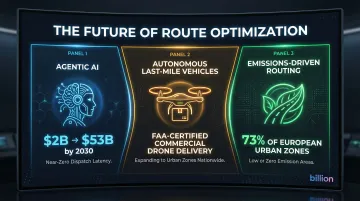
Three forces are converging to redefine what route optimization must do:
- Agentic AI will pre-position inventory and pre-plan partial routes before orders even arrive. Gartner projects supply chain software with agentic AI will grow from $2 billion in 2025 to $53 billion by 2030, reducing order-to-dispatch latency to near zero.
- Autonomous last-mile vehicles are moving from pilots to production. DroneUp recently became the sixth US operator to receive FAA Part 135 certification for commercial drone delivery — a signal that urban micro-fulfillment paired with autonomous vehicles will compress delivery windows further.
- Emissions-driven routing is becoming a compliance requirement, not just a preference. In Europe, 73% of Urban Vehicle Access Regulations are low or zero emission zones, meaning route optimization software must now weigh emissions alongside speed.
Companies that build scalable, data-driven route optimization infrastructure now will hold a structural advantage as same-day delivery becomes the baseline expectation. Those still relying on manual dispatch or generic routing tools will face compounding costs and customer churn — because the gap between leaders and laggards in last-mile logistics narrows a little more each quarter.
Frequently Asked Questions
What is the same-day delivery concept?
Same-day delivery means orders placed by a customer are received on the same calendar day, typically within a 2-6 hour window. It requires tightly coordinated order processing, inventory proximity to customers, and dynamic route optimization to execute reliably.
How does route optimization make same-day delivery possible?
Route optimization automatically calculates the fastest, most efficient stop sequences for drivers in real time, accounting for traffic, order time windows, vehicle capacity, and new incoming orders. This cuts delivery cycle time from hours to under 60 minutes in well-optimized operations.
What are the biggest operational challenges of same-day delivery?
High per-delivery cost due to smaller load sizes, handling intra-day demand surges, managing failed deliveries without a fallback window, and the complexity of assigning the right driver to each order in real time are the primary challenges.
What data does a route optimization system need for same-day delivery?
Key inputs include real-time traffic and road conditions, GPS location of drivers, order details (location, time window, priority), vehicle capacity and type, driver shift hours, and historical delivery duration data for accurate ETA generation.
How is same-day delivery different from next-day delivery operationally?
Same-day delivery requires dynamic, real-time route optimization since orders arrive throughout the day and must be dispatched within hours. Next-day delivery allows batch route planning the night before with more time to optimize.
What role does pricing model play when choosing a route optimization API for same-day delivery?
Per-API-call pricing becomes expensive as delivery volume and re-optimization frequency increase — both unavoidable in same-day operations. Per-vehicle or per-order pricing models offer predictable costs at scale and align better with how same-day delivery businesses grow.