Introduction
Inefficient routing creates one of the most expensive operational drags in lawn care. Crews crisscross service territories, dispatchers manually rebuild routes every morning, and customers wait in vague arrival windows. Meanwhile, fuel costs climb and daily service capacity stays flat. Manual scheduling alone wastes an average of 15 hours per week for dispatchers, translating to over $30,000 in lost productivity annually per dispatcher. Poor route optimization adds 25% to vehicle operating expenses through unnecessary mileage and backtracking.
For many operators, those costs are self-inflicted. Generic tools like Google Maps cap routes at 10 stops and ignore the operational complexity of lawn care — recurring schedules, technician licensing, multi-service-line coordination, and seasonal volume swings.
Specialized route optimization tools built for field service operations now exist at every price point. This guide compares the best options in 2026, organized by business scale so you can find the right fit without wading through tools designed for someone else's operation.
TL;DR
- Route planning software sequences daily stops automatically — cutting drive time, fuel costs, and maximizing stops per crew
- Fleets using connected routing technology report an average 12% fuel cost reduction and 15.9% less idling time
- Google Maps can't handle recurring schedules, technician licensing, or multi-crew coordination
- Top platforms in 2026 range from green-industry-specific (RealGreen) to enterprise API-grade engines (NextBillion.ai)
- Crews running 15–20+ daily stops gain the fastest ROI from dedicated route optimization software
What Is Lawn Care Route Planning Software?
Lawn care route planning software automatically sequences daily service schedules to minimize drive time, reduce fuel costs, and maximize the number of properties a crew can service. Unlike general-purpose navigation apps that simply map point-to-point directions, these platforms optimize the entire day's workload — accounting for drive time, service duration, crew availability, and geographic density.
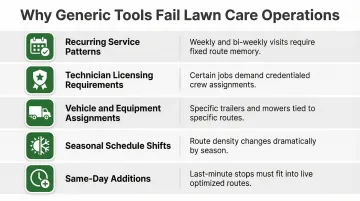
Generic tools fall short because lawn care has unique operational constraints that consumer apps cannot handle:
- Recurring service patterns - Weekly mowing, bi-weekly fertilization, and seasonal treatments require standing schedules that update automatically
- Technician licensing requirements - The EPA requires commercial applicators to hold certification for restricted-use pesticides, and state-level credentials vary — so only qualified techs can be assigned chemical treatments
- Vehicle and equipment assignments - Specific properties require specific truck beds, mowers, or treatment equipment
- Seasonal schedule shifts - Service frequencies change throughout the year based on growth patterns and customer contracts
- Same-day additions - New service requests need to slot into live routes without triggering a full reschedule
Google Maps caps routes at 10 stops and offers no workload balancing, territory logic, or skill-based job matching. That makes it a non-starter for any operation running more than one crew.
Best Lawn Care Route Planners in 2026
These tools were selected based on routing algorithm depth, operational fit for lawn care constraints, scalability, pricing transparency, and documented customer outcomes. Each serves a different segment — match your current scale and growth trajectory before evaluating features.
NextBillion.ai
NextBillion.ai is an AI-powered, API-first route optimization platform built for enterprises and software developers who need advanced routing logic embedded in their own systems. With 50+ hard and soft constraints, sub-second response times, and per-vehicle pricing (rather than per-API-call billing), it suits mid-to-large lawn care operations and field service software builders that have outgrown rigid, off-the-shelf tools.
Why it stands out: NextBillion.ai's constraint-based Vehicle Routing Problem (VRP) solver handles crew skill matching, recurring service windows, and real-time traffic integration — making it viable for multi-crew lawn care fleets with complex scheduling requirements. Its fixed-fee pricing model also eliminates the per-call billing surprises common with mapping APIs.
Google Maps Platform charges per element (origins × destinations), which has resulted in documented instances of unexpected bills reaching $25,000 for high-volume users. NextBillion.ai integrates with fleet telematics platforms including Samsara, Geotab, and Motive, allowing optimized routes to dispatch directly to driver apps without manual re-entry.
| Key Features | 50+ routing constraints, VRP solver, large distance matrix, real-time traffic, fleet telematics integration, API-first deployment |
| Best For | Mid-to-large lawn care fleets, field service software companies building routing into their own platforms |
| Pricing Model | Per-vehicle or per-order fixed-fee pricing (not per-API-call); contact NextBillion.ai for current rates |
RealGreen
RealGreen (by WorkWave) is a green industry-specific platform with a proprietary Dynamic Routing algorithm built exclusively for lawn care businesses. It combines routing with CRM, scheduling, invoicing, and mobile field execution in one system. RealGreen reports it's used by nine of the top ten lawn care franchises — a vendor-sourced claim, not independently verified.
The key difference: Its algorithm accounts for technician licensing, recurring service frequencies, vehicle capacity, and same-day additions without dispatcher intervention. A documented case study shows Barefoot Grass reduced daily route-building time from two hours to 20 minutes after implementing RealGreen's Dynamic Routing.
| Key Features | Proprietary green-industry routing algorithm, real-time GPS, CRM integration, mobile app (offline capable), property measurement tool |
| Best For | SMB to mid-market lawn care businesses (10–100+ employees) seeking an all-in-one platform |
| Pricing Model | Quote-based; modular pricing by business size and features. Contact RealGreen for current rates |
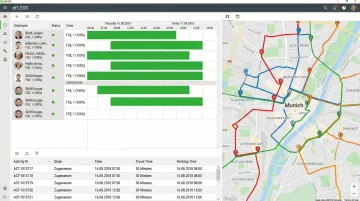
Jobber
Small lawn care businesses with fewer than 10 employees tend to outgrow spreadsheets before they're ready for enterprise software. Jobber sits squarely in that gap — a multi-industry field service platform with GPS route optimization, client self-service, automated quoting, and invoicing built for fast onboarding rather than deep configuration.
Where it excels: Jobber's interface is intentionally simple and learns quickly. It suits businesses prioritizing ease of use and customer communication over deep routing sophistication. However, its multi-industry focus means it lacks green-industry-specific constraints like technician skills, certifications, or equipment requirements. Users report that per-user pricing becomes expensive once teams reach 10-15 people.
| Key Features | GPS route optimization, client hub, automated invoicing, two-way client messaging, scheduling integration |
| Best For | Small businesses (2–10 employees) prioritizing ease of use and client communication |
| Pricing Model | Core: $29/mo, Connect: $149/mo, Grow: $299/mo, Plus: $529/mo (annual billing). See current rates at Jobber.com |
Service Autopilot
Service Autopilot is a field service platform targeting established lawn care and landscaping businesses with high-volume recurring schedules. It offers Smart Maps for visual route building, automated dispatching, and two-way client texting.
What to know: It's highly customizable for stable, recurring schedule structures. Best suited for businesses where route patterns are largely set in advance. However, reviews note a steep learning curve and dense user interface, and the rigid scheduling architecture limits real-time flexibility for same-day changes.
| Key Features | Smart Maps (powered by NextBillion.ai), automated dispatching, recurring schedule management, two-way texting, reporting |
| Best For | Established businesses (20+ employees) with complex, high-volume recurring service schedules |
| Pricing Model | Startup: $49/mo, Pro: $199/mo, Pro Plus: $499/mo. Smart Maps pricing available by quote. See current rates at ServiceAutopilot.com |
WorkWave RouteManager
For operations that already have CRM and billing covered, adding another all-in-one platform is redundant overhead. WorkWave RouteManager addresses this directly — a standalone route optimization tool within the WorkWave ecosystem that layers logistics-grade routing on top of whatever systems you're already running.
The trade-off: Strong logistics optimization engine, real-time GPS tracking, and driver dispatching make it effective for operations that already have separate CRM and billing systems and need routing only. The trade-off is that managing customer data, service history, and invoicing requires separate tools or integrations. Great Lakes Ace Hardware increased deliveries from 50 to 200 per week using RouteManager.
| Key Features | Multi-stop route optimization, real-time GPS tracking, driver dispatching, fleet reporting |
| Best For | Businesses with existing CRM/billing systems seeking a dedicated routing layer |
| Pricing Model | Starting at $54/month per vehicle (minimum 4 vehicles). See current rates at Route-Manager.com |
Key Features to Look for in a Lawn Care Route Planner
Dynamic Optimization vs. Static Planning
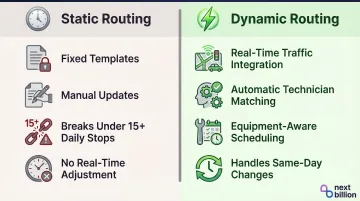
Confirm the software uses real-time data to adjust routes continuously — not just a fixed template updated manually. Ask vendors specifically whether the system handles same-day service additions, technician substitutions, and traffic-driven rerouting without dispatcher intervention.
Static routing works for very small, stable operations but becomes a full-time manual burden above 15-20 daily stops per crew. Dynamic routing continuously recalculates the most efficient stop sequence using:
- Live traffic patterns and road conditions
- Technician availability and skill matching
- Equipment requirements per job
- Last-minute customer requests and cancellations
Constraint Handling Depth
Lawn care routing must account for constraints that generic tools ignore:
- Technician licensing and certifications (vary by state and service type)
- Recurring service frequencies (weekly mowing, bi-weekly fertilization)
- Property-specific equipment requirements
- Multi-service-line complexity (mowing, fertilization, pest control, irrigation)
Research how many hard and soft constraints each platform supports. Enterprise engines like NextBillion.ai (50+ constraints) differentiate from consumer-grade apps by handling crew skill matching, vehicle capacity, time windows, and custom operational rules simultaneously.
Scheduling and CRM Integration
Routing software that does not connect with your scheduling and customer data system creates double-entry overhead and data inconsistencies. The most effective platforms treat routing and scheduling as a single integrated function. Customer data informs routing; field execution data feeds back into the CRM automatically.
Mobile App Reliability (Including Offline Functionality)
Field crews need reliable access to route information and job details regardless of cellular coverage. Before committing to a platform, verify:
- Offline mode works without any active data connection
- Route and job details are pre-loaded before crews leave the depot
- Data syncs automatically once connectivity is restored
This is a make-or-break capability for crews working in rural or spotty-coverage service areas.
Scalability and Pricing Model
Choose software that supports the business you plan to build, not just today's operation. Ask vendors directly how the platform performs at 500 customers, 2,000 active jobs, and multiple branch locations.
Scrutinize pricing models carefully:
- Per-API-call billing (common with generic mapping providers) can produce unpredictable costs at scale
- Per-vehicle or per-order pricing provides cost predictability as route volume grows
- Per-user subscription models can become expensive as teams expand beyond 10-15 people
How We Chose the Best Lawn Care Route Planners
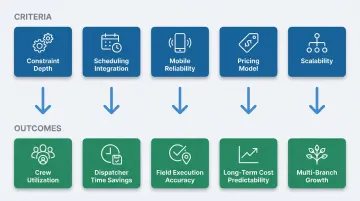
Each tool was evaluated across five criteria directly tied to how lawn care operations run in the field:
- Routing algorithm sophistication (dynamic vs. static, constraint handling)
- Integration depth with scheduling and CRM systems
- Mobile field execution capability
- Pricing model transparency
- Scalability for growing operations
A common buyer mistake: Choosing based on feature lists alone rather than testing how the routing engine performs under your specific operational conditions — technician mix, service territory density, and scheduling complexity.
Outcome-tied criteria: Each factor was tied to a measurable business outcome:
- Constraint depth → crew utilization
- Scheduling integration → dispatcher time savings
- Mobile reliability → field execution accuracy
- Pricing model → long-term cost predictability
Tools that scored well on ease-of-use but failed on recurring schedule complexity or offline mobile capability were ranked lower — because usability without operational depth doesn't hold up at scale.
Matched by business size: Rather than naming a single "best" tool, this list segments by business profile — because a two-person startup and a 50-crew multi-branch operator have very different routing requirements. Use the tier that reflects where your operation is today, not where you hope to be in three years.
Conclusion
Routing inefficiency is one of the most expensive and most fixable operational problems in lawn care. The right route planner reduces fuel costs, increases daily service capacity, and frees dispatchers from manual planning entirely. Industry data shows route optimization can yield 20–25% fuel savings by reducing unnecessary mileage and avoiding traffic. Choosing a tool that aligns with your operational complexity (not just your current size) determines how quickly those gains scale — more stops per crew, lower cost per job, fewer last-minute reschedules.
Before committing, assess any candidate platform against three criteria:
- Does it handle your specific constraints (recurring schedules, crew certifications, multi-service lines)?
- Does it integrate with your existing CRM and billing systems?
- Does its pricing model stay predictable as your route volume grows?
If those criteria matter to your operation, NextBillion.ai is worth evaluating. Its constraint-rich optimization and per-vehicle pricing model are built for lawn care operators and field service software builders who need flexibility without unpredictable API costs. A free trial and hands-on support from solution engineers are available to help you configure it for your specific service workflows.
Frequently Asked Questions
What is the best route optimization software?
There is no single "best" — the right tool depends on business size, operational complexity, and whether you need an all-in-one platform or a dedicated routing engine. Purpose-built green-industry tools (RealGreen), enterprise API engines (NextBillion.ai), and SMB-friendly platforms (Jobber) each lead for different use cases.
What is the best landscape management software?
Landscape management software combines CRM, scheduling, invoicing, and routing in one platform — distinct from standalone route planners. RealGreen and Service Autopilot are strong choices for end-to-end landscape management, while NextBillion.ai is the stronger choice for routing-specific needs within larger or more complex operations.
Can lawn care route planners handle recurring service schedules?
Yes. Advanced platforms allow businesses to set recurring master schedules (weekly mowing, bi-weekly fertilization) and automatically incorporate them into daily route optimization. Same-day additions are handled without disrupting standing route patterns.
What is the difference between static and dynamic route planning?
Static routing uses fixed pre-set routes updated manually. Dynamic routing uses real-time data — traffic, schedule changes, crew availability — to continuously recalculate the most efficient stop sequence without dispatcher intervention.
How does route optimization reduce fuel costs for lawn care businesses?
Optimized routing eliminates backtracking, cuts idle time, and groups nearby jobs. Fleets using connected routing technology report a 12% reduction in fuel costs and 15.9% less idling time, with some studies citing 20-25% savings through reduced mileage and traffic avoidance.
How much does lawn care route planning software cost?
Pricing ranges from $29/month for entry-tier SMB tools to several hundred dollars per month for comprehensive platforms. Enterprise solutions like NextBillion.ai use per-vehicle or per-order pricing — more predictable at scale than per-API-call billing. Contact vendors directly for quotes based on fleet size.