Introduction
On a typical morning, a dispatch coordinator juggles 40 open service calls, a whiteboard full of technician locations, and zero visibility into who actually has the right certification for a commercial HVAC job across town. That decision — made in under two minutes — determines whether the job gets done right the first time or triggers a costly callback.
The pressure is only growing. The U.S. Bureau of Labor Statistics projects 300,000 new electrician and plumber positions needed by 2031 amid ongoing retirements, while job complexity keeps climbing. Manual dispatch has hit a hard ceiling.
AI-powered technician assignment optimization doesn't just speed up scheduling — it changes the underlying logic entirely. Instead of sequential best-guess decisions, AI evaluates every possible job-technician combination at once, weighing skills, certifications, proximity, job complexity, and customer history in seconds.
The result: fewer callbacks, less windshield time, higher utilization, and technicians finishing shifts on schedule.
TLDR
- AI technician assignment weighs skills, certifications, proximity, job complexity, and customer history — going well beyond simple availability checks
- Manual dispatch causes skill mismatches, excess drive time, low first-time fix rates, and technician burnout
- Trades-specific constraints like licensing compliance and truck tool loadouts require more than generic routing tools
- Businesses implementing AI assignment see measurable gains in utilization rates, SLA compliance, and cost per job
- Successful rollout depends on clean data and integration planning before any tool is chosen
Why Manual Technician Assignment Fails Trades Businesses
In trades like HVAC, plumbing, electrical, and pest control, assignment decisions are vastly more complex than booking an appointment. A dispatcher must simultaneously cross-reference:
- EPA 608 certification for refrigerant work
- State electrical licenses by jurisdiction
- Specialized tool availability (pipe cameras, voltage testers, thermal imaging)
- Historical job duration for this exact failure type
- Customer preferences from past visits
- Real-time traffic conditions
- Current workload across 15+ technicians
Manual dispatch can't process this at scale. Dispatchers default to heuristics: "Joe's closest," "Sarah handled this customer before," "Mike's been sitting idle." These shortcuts sound reasonable but break down quickly — and the operational damage compounds across every shift.
Three failure modes show up consistently:
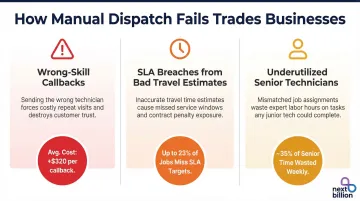
- Callbacks from wrong-skilled assignments: Sending a junior tech to a complex commercial HVAC diagnostic wastes two trips — one for the initial failed visit, one for the senior tech who should've gone first
- SLA breaches from bad travel estimates: "20 minutes away" becomes 45 in rush-hour traffic, cascading delays across the day's schedule
- Underutilized senior technicians: Master electricians sent to outlet replacements that apprentices could handle at half the labor cost
The stakes are higher now than they've ever been. Skilled trades face workforce shortages of 650,000 workers by 2027, driven by retirements outpacing new entrants. Teams cannot afford to waste experienced technician hours on preventable inefficiencies. Every misassigned job burns capacity that can't be recovered.
What AI-Powered Technician Assignment Actually Does
Skill-Based Matching at Scale
AI builds detailed technician profiles from live operational data — not a static certification list. The system continuously tracks:
- Certifications and license expirations
- Past job performance on specific equipment types (Carrier vs. Trane HVAC units, PEX vs. copper plumbing)
- First-time fix history by job category
- Customer satisfaction scores by technician
- Completion time variance (does this tech consistently finish drain cleanings in 45 minutes or 90?)
When a job enters the queue, the AI matches these profiles against job requirements automatically — no dispatcher guesswork. A service call tagged "Carrier 16 SEER heat pump, intermittent cooling, commercial building" gets routed to technicians with proven Carrier experience and commercial HVAC certification. High first-time fix rates on similar failures seal the match.
Machine learning sharpens this over time. If a technician consistently resolves a specific failure pattern (say, faulty reversing valves on Trane XR models) on the first visit, the AI strengthens that association and prioritizes them for similar jobs in the future.
Dynamic Routing and Travel Time Optimization
AI-powered routing does more than find the fastest path between two points. The optimization engine builds entire daily route sequences by incorporating:
- Real-time traffic conditions
- Historical travel patterns by time of day
- Job duration variability
- Technician current location and schedule
- Service territory boundaries
- Vehicle type and capacity
The goal: minimize non-productive drive time across the entire dispatch board, not just for individual technicians.
NextBillion.ai's Route Optimization API supports 50+ hard and soft constraints, enabling field service platforms to encode trades-specific rules directly into the assignment algorithm:
- Territory restrictions (don't cross county lines unless necessary)
- Overtime limits (keep technicians under 10 hours unless emergency)
- Vehicle capacity (truck must carry 200+ lbs of tools)
- Shift timing constraints (no jobs scheduled past 5 PM for part-time techs)
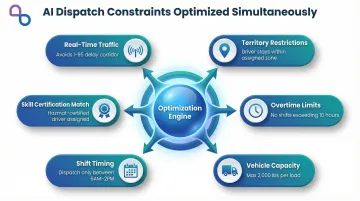
This level of precision allows far more accurate job-technician matching than generic mapping tools like Google Maps, which optimize for individual routes but can't orchestrate an entire fleet's daily workflow.
Real-Time Replanning
Disruptions happen constantly: technicians call out sick, jobs run 90 minutes over estimate, emergency calls come in. Manual dispatchers spend 20-30 minutes on the phone shuffling assignments, calling customers, and redrawing routes on a whiteboard.
AI handles this in seconds. When a disruption occurs, the system:
- Re-evaluates the full day's schedule against current constraints
- Proposes the least-disruptive reassignments
- Automatically notifies affected customers with updated arrival windows
- Sends new route sequences to technician mobile apps
Dispatchers stop firefighting schedules and start managing relationships — which is where their attention belongs.
Trades-Specific Constraints AI Must Optimize For
Certification and Licensing Compliance
Many trades jobs carry legal requirements that can't be violated:
- EPA 608 certification for refrigerant handling (HVAC)
- State electrical licenses by jurisdiction (electricians can't cross certain state lines)
- Plumbing endorsements for backflow prevention or medical gas systems
- Pesticide applicator licenses by state and category
AI must enforce these constraints at the assignment level, not after dispatch. Sending an unlicensed technician creates liability exposure, regulatory fines, and customer trust damage. The optimization engine filters out ineligible technicians before proposing any assignment.
Truck Inventory and Tool Loadout Matching
Trades assignment differs from delivery routing: the right technician must arrive with the right parts and tools for the job.
Example: A water heater replacement requires a specific model in stock. If the assigned truck doesn't carry it, the technician must:
- Drive to the job site
- Assess the situation
- Drive back to the warehouse
- Load the correct water heater
- Return to the customer
This "arrive and backtrack" scenario collapses daily utilization rates and creates angry customers.
AI can cross-reference job-type parts requirements against real-time truck inventory records. If a job requires a 50-gallon electric water heater and only Truck 7 has one loaded, the algorithm factors that into the assignment decision, not just proximity.
Job Duration Variance by Trade and Complexity
Unlike parcel delivery with predictable 2-minute stops, trades jobs have high duration variance:
- Simple drain cleaning: 30–45 minutes
- Whole-home repipe: 6–8 hours
- HVAC tune-up: 60 minutes
- Full system replacement: 4–6 hours
AI uses historical job-type duration data and technician-specific completion rates to build accurate time windows. If Technician A averages 50 minutes on drain cleanings while Technician B averages 75 minutes, the AI accounts for this when sequencing their daily routes. This prevents schedule collapse from jobs that consistently run long.
Customer History and Preference Matching
Customers remember good technicians. Beyond repeat requests, some customers have site-specific requirements a dispatcher must track:
- Gate codes that only certain techs know
- Large dogs requiring technicians comfortable with pets
- Elderly customers who prefer familiar faces
Manual dispatchers track this informally ("Mrs. Johnson loves Dave"). AI encodes it systematically, factoring customer-technician familiarity, preferred time windows, and site access requirements into assignment logic. The result is better customer satisfaction without relying on a dispatcher's memory.
Territory and Zone Management
AI optimizes technician-to-territory alignment over time, reducing cross-territory dispatching and the travel cost that comes with it. But it maintains flexibility to break zone rules intelligently:
- During demand surges (summer AC failures)
- When a technician calls out sick
- For emergency calls with no in-territory availability
The system distinguishes when violating a territory rule makes business sense — say, serving a premium customer on deadline — versus when it's pure waste, like routing a tech 40 minutes out when a closer option sits idle.
The Business Case: What AI Assignment Optimization Delivers
Fewer Callbacks, Better First-Time Fix Rates
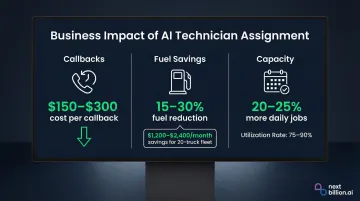
When the right technician arrives with the right tools and information, callbacks drop. Industry data shows callbacks cost field service businesses $150-$300 per incident when factoring in fuel, labor, and lost opportunity cost. A 10% reduction in callbacks delivers real margin improvement — and for most trades operations, that's achievable within the first few months of AI-assisted dispatch.
Fuel and Overtime Savings Add Up Fast
Fuel represents 28-35% of total fleet operating costs. AI route optimization typically cuts fuel consumption by 15-30% — which translates to $1,200-$2,400 in monthly savings for a 20-truck operation spending $8,000/month. Those same routing improvements also compress daily schedules, reducing overtime exposure.
Beyond fuel, smarter routing converts windshield time into billable work. High-performing field service teams target 75-90% utilization rates (billable hours divided by total paid hours). AI-powered scheduling can increase daily service capacity by 20-25% without adding headcount — critical during demand surges when hiring can't keep pace.
Customer Retention Follows Operational Performance
Accurate arrival windows, right-skilled technicians, and fewer reschedules directly affect how customers experience your service. Research links 31% less travel time and 38% more jobs completed per day to higher customer satisfaction scores. Over time, that performance gap compounds: better SLA compliance protects existing contracts and reduces the cost of winning new ones.
How to Roll Out AI Technician Assignment Optimization
Start with a data audit and cleanup phase before selecting any tool. The prerequisite for AI assignment is clean, structured data:
- Technician certification records must be current (no expired licenses)
- Job type definitions must be standardized (not "misc service call")
- Historical job duration data should cover at least 12 months to enable reliable pattern learning
- Truck inventory records must be real-time or near-real-time
Without this foundation, AI optimization produces garbage outputs.
Once your data is ready, integration architecture becomes the critical decision. For FSM software companies building AI assignment into their products, an API-first approach allows embedding an optimization engine (like NextBillion.ai's Route Optimization API) directly into existing dispatch workflows without a full platform rebuild.
Modern optimization APIs connect with existing FSM, CRM, or scheduling platforms via standard REST interfaces — preserving current workflows while adding intelligence. This means quicker deployment and the flexibility to customize constraint rules for specific verticals (HVAC vs. pest control vs. electrical).
Adopt a phased rollout approach:
- Start with a controlled pilot — choose one job type (HVAC maintenance) or service zone (north territory) as a test case
- Establish baseline KPIs — measure current utilization rate, first-time fix rate, average drive time per job, and SLA compliance percentage
- Run AI-assigned jobs in parallel — let the AI assign jobs but have dispatchers review assignments before dispatch (safety net)
- Measure outcomes against baseline — after 30-60 days, compare AI-assigned metrics to historical performance
- Expand gradually — roll out to additional job types, territories, or technician groups based on proven results
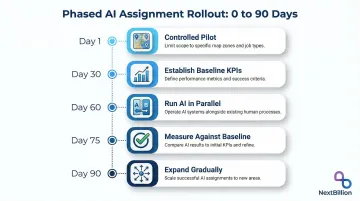
This phased approach eases technician and dispatcher adoption. Most teams reach confident, full deployment within 90 days — starting from a single zone pilot where early wins are visible and measurable.
Frequently Asked Questions
Which AI tools are best for technician assignment optimization in the trades?
It depends on whether you're building software or running operations directly. FSM platforms like ServiceTitan embed optimization natively, while route optimization APIs like NextBillion.ai let software builders add AI capabilities without rebuilding core systems — the right fit comes down to which layer of the dispatch workflow needs improvement.
How does AI technician assignment differ from standard route optimization?
Standard route optimization focuses on sequencing stops efficiently based on geography. Technician assignment optimization matches jobs to technicians based on skills, certifications, tools, and performance history — then optimizes routing as one variable in a much more complex decision.
What data does AI need to optimize technician assignments effectively?
Core data inputs include technician certification and skill profiles, historical job durations by type, real-time location data, job requirements (parts, tools, customer preferences), and truck inventory records. Data quality directly determines output quality — incomplete or outdated profiles will produce poor assignments regardless of how sophisticated the algorithm is.
How does AI handle last-minute changes like emergency jobs or technician callouts?
AI continuously re-optimizes the day's schedule when disruptions occur, evaluating available technicians against job requirements and current locations to propose the least-disruptive reassignment. What takes dispatchers 20-30 minutes happens in seconds, with automatic customer notifications and updated route sequences pushed to mobile apps.
Can AI technician assignment software integrate with existing FSM platforms?
Most modern AI optimization solutions are API-based, allowing them to embed into existing FSM, CRM, or scheduling platforms without replacing core systems. For trades software companies, this means faster deployment and no disruption to current dispatcher workflows.