AI in Field Service Is No Longer Optional
Field service operations face relentless pressure: technicians stuck on inefficient routes, vehicles breaking down mid-shift, SLAs missed by minutes, dispatchers firefighting instead of planning. According to recent industry data, 46% of field service organizations struggle to meet their Service Level Agreements, while the average company wastes 14% of all truck rolls on unnecessary visits.
These failures share a common cause: static planning tools that cannot keep up with real-world complexity.
AI has shifted from competitive advantage to operational necessity. This article examines how AI powers two specific, high-impact capabilities—route optimization and predictive maintenance—and how together they help field service organizations cut costs, hit SLAs, and stop losing time to preventable failures.
TLDR:
- AI route optimization recalculates technician routes in real time throughout the shift—not just once at the start of the day
- Predictive maintenance flags equipment failures 30–90 days out, avoiding $448–$760 per vehicle per day in breakdown costs
- Together, these tools cut miles driven by up to 25% and reduce maintenance costs by 18–25%
- First-time fix rates improve when technicians arrive prepared—with working vehicles and the right parts
- Successful rollouts start with data integration (telematics, FSM, work orders) before scaling to full deployment
Why Traditional Field Service Approaches Fall Short
Static route planning—building schedules at the start of the day and hoping nothing changes—fails the moment a job runs long, traffic spikes, or an urgent call comes in. The financial impact is real: when a technician fails to complete a job on the first visit, it triggers an average of 2.7 total visits, adds 13 days to resolution time, and inflates total resolution costs by 44% over the initial work order cost. The performance gap between best-in-class and bottom-tier organizations is stark: top performers maintain just a 3% avoidable dispatch rate, while low performers absorb 24% unnecessary truck rolls.
Preventive maintenance—servicing equipment on a rigid calendar schedule—creates its own inefficiencies. Time-based servicing either over-maintains healthy equipment (wasting technician hours and parts) or misses failures that occur between scheduled intervals. Field service teams need to know a part is failing before the technician arrives on-site, not after the equipment has already stopped working.
The root cause is fragmented tooling. When GPS, scheduling software, CMMS platforms, and CRM systems operate in silos, every layer of operations degrades:
- Dispatchers make decisions on stale data
- Technicians arrive unprepared or at the wrong location
- Managers have no real-time visibility into what's actually happening in the field
Only around 60% of enterprises had implemented dedicated field service software by 2023, leaving the rest coordinating through spreadsheets and manual handoffs. That data gap is precisely what AI-driven platforms are built to close.
AI Route Optimization in Field Service: How It Actually Works
AI route optimization is a continuous engine that recalculates the best job sequence for every technician as conditions shift throughout the day—traffic, job overruns, urgent calls, technician availability. Legacy tools compute once at 6 AM and stop there. AI routing never stops recalculating.
What AI Factors Into Field Service Routes
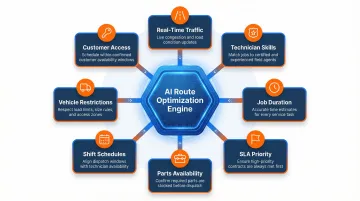
Powerful field service routing requires simultaneously optimizing across multiple variables that human dispatchers cannot process at speed:
- Real-time traffic and road conditions — routing adjusts to accidents, congestion, and construction delays
- Technician skill sets and certifications — matches the right tech to jobs requiring specific qualifications (HVAC certified, electrical licensed, etc.)
- Job duration estimates — accounts for realistic service times based on historical data, not generic averages
- SLA windows and priority levels — prioritizes urgent jobs and ensures on-time arrival for committed time slots
- Parts and equipment availability — routes technicians who have the necessary parts or can pick them up en route
- Shift schedules — respects start times, break windows, and overtime limits
- Vehicle type and restrictions — considers commercial vehicle height/weight limits, access constraints, and load capacity
- Customer access constraints — factors in appointment windows, gate codes, and location-specific entry requirements
Dynamic Job Insertion and Real-Time Re-Optimization
When an urgent service call arrives mid-day—common in pest control, HVAC, and medical equipment service—AI doesn't just squeeze the new job into one technician's route. It re-optimizes the entire dispatch board, redistributing jobs across all active routes to minimize total disruption.
The system might reassign existing jobs to different technicians, adjust sequences, or delay lower-priority work to accommodate the emergency while maintaining SLA compliance across the board.
Research validates this approach. A peer-reviewed study published in INFORMS Journal on Applied Analytics evaluated Waste Management's dynamic routing deployment and found that AI-generated routes were 11.6% more efficient in miles per haul and 10.3% better on hours per haul compared to manually created routes.
Key finding: Manual routes violated time-window requirements over 11% of the time and maximum route time constraints over 28% of the time — gaps that AI routing eliminates systematically.
Precision Routing and the Last 50 Meters Problem
Generic address-level routing fails field service teams at the last critical moment: which entrance to use, where to park a service van, whether the route includes height restrictions that prohibit box trucks, or if the address sits within a geofenced hazardous area.
Solving this requires map data layers that go well beyond standard street-level navigation:
- Entrance and access points — directs technicians to service entrances, not front doors
- Parking and loading zones — identifies legal parking for commercial vehicles
- Height/weight/width restrictions — prevents routing trucks through underpasses or weight-restricted bridges
- Geofenced zones — avoids hazardous areas, low-emission zones, or restricted access areas
- Curb-side rules — accounts for one-way streets and loading zone regulations
NextBillion.ai's route optimization platform supports 50+ soft and hard constraints with sub-second response times, enabling this level of precision. The platform integrates with telematics providers like Samsara and Geotab, allowing field service teams to layer real-time vehicle location data with optimized routing decisions.
AI-Powered Predictive Maintenance: Moving From Reactive to Proactive
Three maintenance paradigms exist: reactive (fix after failure), preventive (service on a calendar schedule), and predictive (service based on actual asset condition data). Predictive is superior because it prevents failures before they cause downtime while avoiding unnecessary servicing of healthy equipment. AI makes predictive maintenance scalable across an entire fleet, transforming maintenance from a cost center into a strategic advantage.
How AI Collects and Analyzes Equipment Data
Predictive maintenance relies on continuous data streams from multiple sources:
- IoT sensors embedded in equipment and vehicles measure vibration, temperature, pressure, and engine performance
- Telematics devices track vehicle location, fuel consumption, idling time, hard braking events, and diagnostic trouble codes
- Historical maintenance logs provide context on past failures, parts replaced, and service intervals
- Technician service reports capture qualitative observations and real-world equipment behavior
AI ingests and cross-references these streams to build performance baselines for each asset. Machine learning models learn the normal operating signature of each vehicle or piece of equipment, then flag deviations that correlate with impending failures — for example, unusual engine temperature patterns that precede a breakdown.
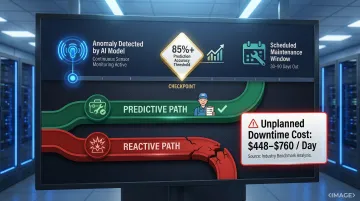
Accuracy improves over time as models process more historical data. Advanced systems can achieve prediction accuracies exceeding 85% for major component failures, providing lead times of 30 to 90 days — enough to turn an emergency repair into a scheduled maintenance window.
The Practical Output: Alerts, Work Orders, and Pre-Ordering
When the models detect risk, that signal flows directly into operations:
- Maintenance alerts with estimated time-to-failure — "Vehicle 14 needs brake service within 48 hours"
- Auto-generated work orders — maintenance tasks flow directly into dispatcher queues
- Recommended service actions — specific guidance on what to repair or replace
- Parts pre-ordering triggers — automated inventory management ensures parts availability before service
The result is that maintenance tasks slot into dispatch schedules like any other planned job — no scrambling, no emergency parts orders.
Reducing Specific Field Service Risks
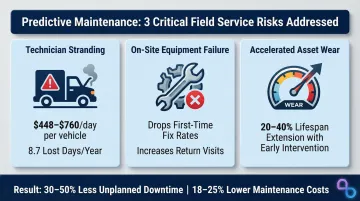
Predictive maintenance addresses three critical field service risks:
Technician stranding: A vehicle breakdown mid-route disrupts remaining jobs and forces emergency dispatch of a replacement. Unplanned downtime costs commercial fleets between $448 and $760 per day per vehicle, and fleets average 8.7 lost days per vehicle annually.
On-site equipment failure: When a technician's tools fail during a customer visit, first-time fix rates drop and return visits increase. Predictive maintenance keeps tools operational before they reach the job site.
Accelerated asset wear: Without proactive intervention, fleets replace assets sooner than necessary. Addressing wear early extends asset lifespans by 20% to 40%, directly reducing total fleet ownership costs.
Across these three risk areas, the compounding impact is measurable: predictive maintenance reduces unplanned downtime by 30–50% and cuts maintenance costs by 18–25% compared to preventive calendar-based approaches.
How Route Optimization and Predictive Maintenance Work Together
Route optimization and predictive maintenance deliver their best results not in isolation, but as an integrated system — each capability feeding the other in a continuous loop.
Maintenance Alerts Drive Routing Decisions
When predictive maintenance generates an alert—"Vehicle 14 needs brake service within 48 hours"—the route optimization engine factors this into scheduling. The AI automatically routes that vehicle to a service bay at the right time, avoiding peak dispatch hours and minimizing disruption to active jobs. Rather than leaving a dispatcher to manually reconcile maintenance needs with job assignments, the system handles it automatically.
Routing Data Improves Maintenance Predictions
The data flow works in reverse, too. Route and telematics data collected during daily operations — mileage, idling time, hard braking events, fuel consumption per route — feeds directly into predictive maintenance models, improving their accuracy. The more efficiently a fleet is routed, the cleaner the performance baselines become, making anomaly detection more reliable.
The Self-Healing Schedule
Integrated AI dispatch handles the full lifecycle of an urgent maintenance event. When a failure alert fires, AI re-optimizes the active dispatch board to reassign the affected technician's remaining jobs to others, accounting for skill requirements and proximity. Manual dispatch simply cannot do this at scale — the re-optimization happens in seconds, not hours.
NextBillion.ai's platform, integrated with fleet telematics providers, enables this real-time routing response to maintenance events, creating a closed loop between vehicle health monitoring and dispatch optimization.
Compounding Returns
Field service teams running both AI route optimization and predictive maintenance together see compounding returns:
- Fewer emergency service calls disrupt routing (because failures are prevented)
- More jobs completed per technician per day (through efficient routing and vehicle uptime)
- Improved SLA compliance (on-time arrivals with functional vehicles)
- Decreased total cost of fleet ownership (lower fuel, maintenance, and downtime costs)
A Forrester Total Economic Impact study on Microsoft Dynamics 365 Field Service calculated that integrated FSM platforms delivered $42.65 million in benefits over three years to a composite organization, resulting in a 346% ROI.
Measurable Benefits and KPIs for Field Service Teams
Route Optimization KPIs
AI route optimization directly moves these metrics:
- Vehicle utilization rate — percentage of shift time spent on productive work vs. driving or idle
- On-time arrival percentage — proportion of jobs where technician arrives within SLA window
- Jobs completed per technician per day — capacity increase without adding headcount
- Total miles driven — mileage reduction translates to fuel savings and lower vehicle wear
- Fuel cost per job — direct bottom-line impact
Field service managers should establish baselines for these metrics before deploying AI to track ROI. Real-world deployments show route optimization can reduce total miles driven by up to 25% and enable technicians to complete 1-2 more jobs daily.
Those capacity gains only hold, though, if the vehicles and equipment stay operational. That's where predictive maintenance metrics come in.
Predictive Maintenance KPIs
AI predictive maintenance impacts:
- Mean time between failures (MTBF) — how often unplanned equipment failures occur
- Unplanned downtime hours — total time vehicles or equipment are out of service
- Maintenance cost per vehicle — total spend on parts, labor, and emergency repairs
- Parts inventory efficiency — reduction in emergency parts orders and overstocking
- Technician time lost to vehicle breakdowns — productive hours lost to fleet failures
Fewer breakdowns mean more billable hours — and when technicians arrive on time with working equipment, that reliability shows up directly in customer experience metrics.
Customer-Facing KPIs
These operational improvements create downstream customer benefits:
- First-time fix rate (FTFR) — percentage of jobs resolved on the first visit
- Customer satisfaction (CSAT) and Net Promoter Score (NPS) — measures customer loyalty and likelihood to recommend, both tied to on-time arrival and resolution quality
- SLA compliance rate — percentage of jobs meeting committed time windows
Industry benchmarks reveal significant performance gaps. The average FTFR hovers around 75%, but best-in-class organizations achieve 87% while bottom-tier companies fall to 59%. Organizations that meet 80% of their customer service requirements for issue resolution times retain 12% more customers than those meeting only half.
For leadership making the case for AI investment, these numbers translate directly: every percentage point gained in FTFR or SLA compliance reduces churn and compounds across the customer base.
Best Practices for Implementing AI in Field Service
Start with Data Readiness
AI route optimization and predictive maintenance are only as good as their data inputs. Before deploying either capability:
- Audit your data sources — telematics feeds, work order systems, maintenance logs, job duration records, technician skills databases
- Check for completeness and consistency — missing data fields, inconsistent formats, and data silos will undermine AI accuracy
- Establish API integrations — connect your FSM software, GPS/telematics platform, and route optimization engine so data flows automatically
- Verify data quality — ensure addresses are geocoded accurately, job durations reflect reality, and technician skill profiles are current
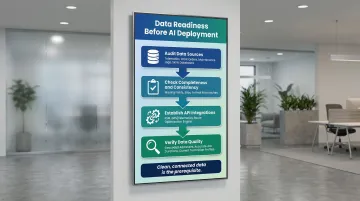
Clean, connected data is the prerequisite — get this right before any pilot begins.
Prioritize a Focused Pilot Over Full Rollout
Identify one high-volume route cluster or one vehicle class for the initial AI deployment:
- Measure baseline KPIs — document current performance (jobs per day, miles driven, fuel costs, FTFR) before go-live
- Run the AI-assisted operation for 60-90 days — allow sufficient time to collect performance data and refine configurations
- Compare outcomes — quantify improvements in concrete terms before scaling to the full fleet
This approach reduces change management friction, builds internal confidence in AI-driven decisions, and allows operational teams to learn the system before enterprise-wide deployment.
Address the Human Side of AI Adoption
Dispatchers and technicians need to trust and act on AI recommendations. This requires:
- Transparent dashboards — show why the AI made a given routing decision or maintenance recommendation
- Ongoing training — educate field teams on how the system works and how to interpret its outputs
- Feedback mechanisms — allow dispatchers and technicians to flag errors, exceptions, or local knowledge the AI should consider
Teams that can see the reasoning behind a recommendation — and push back when it's wrong — produce better training data. That feedback loop is what turns a decent AI model into one that actually fits your operation.
Frequently Asked Questions
Can AI perform route optimization in field service applications?
Yes—AI route optimization is purpose-built for field service. It continuously recalculates technician routes in real time, accounting for traffic, job priorities, technician skills, SLAs, and equipment constraints, unlike static GPS tools that compute once and can't adapt.
Can AI be used for predictive maintenance in field service applications?
AI predictive maintenance is widely used in field service. It uses IoT sensor data and machine learning to detect early signs of equipment or vehicle failure before a breakdown occurs, enabling teams to schedule repairs proactively rather than reacting to emergencies.
What is the difference between predictive and preventive maintenance in field service?
Preventive maintenance is calendar-based—service every X days or miles regardless of condition. Predictive maintenance is condition-based—service when sensor data signals an impending failure. Predictive is more efficient because it avoids both premature servicing and unexpected breakdowns.
How does AI route optimization improve first-time fix rates in field service?
AI matches the right technician, with the right skills and parts, to each job along an optimized route. Technicians arrive prepared and on time, which directly cuts repeat visits caused by missing equipment, skill gaps, or vehicle breakdowns.
What data does AI need to optimize field service routes?
Key inputs include real-time traffic, technician locations and schedules, job locations and durations, SLA windows, skill sets, vehicle type, and parts availability. Richer data produces more accurate route assignments and resource matching.
How do AI route optimization and predictive maintenance work together in field service?
The two capabilities share data: maintenance alerts inform the routing engine so flagged vehicles get scheduled for service, while routing and telematics data feeds the maintenance models. The result is a continuous feedback cycle that cuts both route inefficiency and unplanned downtime.