Introduction
Most fleet operators know fuel is expensive. Few realize how much of that cost is preventable. Fuel accounts for 25–35% of total fleet operating costs, making it the single largest controllable expense in transportation, according to the American Transportation Research Institute (ATRI). For a 50-vehicle fleet, a 5% reduction in fuel waste equals $125,000 in annual savings — money lost today across thousands of suboptimal routing decisions.
Fleet fuel costs are not fixed expenses tied solely to fuel prices. They are shaped by three controllable factors: the quality of route planning before vehicles move, the operational decisions made while routes run, and systemic inefficiencies like empty return miles and poor vehicle-route matching. This article breaks down how AI route optimization targets each factor — and what realistic savings look like when all three are working together.
TL;DR
- Most fleet fuel losses trace back to poor routing decisions, not fuel prices — excess miles, idle time, and reactive planning compound across every shift
- AI route optimization attacks costs at the planning layer, where inefficiencies are locked in before drivers leave the depot
- Multi-constraint route planning paired with dynamic rerouting delivers the largest measurable fuel reductions
- Telematics integration lets AI systems adjust routes in real time based on traffic, stops, and driver behavior
- Fleets that treat fuel reduction as a continuous, data-driven process consistently outperform those relying on periodic manual adjustments
How Fleet Fuel Costs Build Up
Fleet fuel costs don't appear as a single line-item crisis. They accumulate as the combined effect of hundreds of small routing inefficiencies, each invisible in isolation but material at scale.
The build-up is both gradual and compounding. A route that adds 10 unnecessary miles per day costs relatively little on day one. But multiply that across 50 vehicles over 250 working days, and the waste compounds fast — 125,000 excess miles annually, consuming roughly 18,750 gallons of fuel at $66,000+ in avoidable cost.
Most of these costs remain hidden until a CFO draws a line on year-over-year fuel spend growth. The triggers are usually margin pressure or quarterly variance reports, not daily operational visibility. By the time the numbers surface, months of preventable waste have already settled into the baseline — which is exactly what makes routing inefficiency so expensive to ignore.
Key Fuel Cost Drivers in Fleet Operations
The fuel cost profile of any fleet is shaped by three overlapping drivers. Each operates differently—and wastes fuel through a different mechanism.
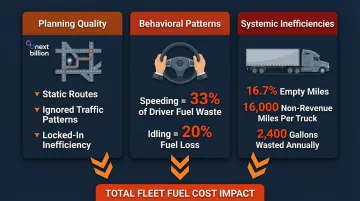
Planning quality determines how routes are designed before wheels turn. Poor upfront decisions—like static routes that ignore traffic patterns, vehicle restrictions, or time windows—lock in inefficiency regardless of driver skill or how well the operation is managed day-to-day.
Behavioral patterns reflect how vehicles are operated during a route. Research links excessive idling, hard acceleration, and sustained high-speed driving directly to fuel overconsumption: speeding alone accounts for 33% of driver-related fuel waste, while idling contributes 20%.
Systemic inefficiencies are the hardest to see and often the costliest. Empty return miles, vehicle-route mismatches, and unaccounted traffic congestion quietly drain margins at scale. In 2024, empty miles hit 16.7% of total commercial truck mileage—roughly 16,000 non-revenue miles per truck annually, burning approximately 2,400 gallons of diesel with nothing to show for it.
No single driver dominates universally. For some fleets, the majority of waste lives in initial route design; for others, it's operational behavior or empty backhauls. That distinction matters because the right fix depends on the right diagnosis—and this is precisely where AI-driven route optimization changes the equation.
Cost-Reduction Strategies for Fleet Fuel
Reducing fleet fuel costs through AI route optimization depends on which stage of the routing process the waste originates. Strategies that change planning decisions work differently from those that change real-time management, and both differ from strategies that fix the broader operating context.
Strategies That Reduce Costs by Changing Planning Decisions
These strategies address fuel waste at its source by improving the quality of route decisions made before a single vehicle moves. Poor planning decisions lock in inefficiency regardless of how well a fleet is managed on the road.
Strategy 1 — Replace static routes with AI-generated multi-constraint optimization
Static routes ignore time windows, road restrictions, vehicle capacity limits, and real traffic patterns. AI-generated routes incorporate 50+ hard and soft constraints at the planning stage, producing routes that are physically optimal rather than just geographically short.
NextBillion.ai's route optimization engine supports this multi-constraint approach, enabling fleets to enforce truck-specific road restrictions (height, weight, cargo-dependent limits), time windows for pickups and deliveries, and load parameters—all within a single optimization call. This eliminates planning-stage fuel waste before routes are dispatched.
UPS invested over $1 billion to build ORION, an AI-powered dynamic route optimization platform. Since full deployment, UPS has reduced 100 million miles driven annually and saved 10 million gallons of fuel, achieving $300–$400 million in annual savings.
Strategy 2 — Optimize stop sequencing and delivery clustering to minimize total miles
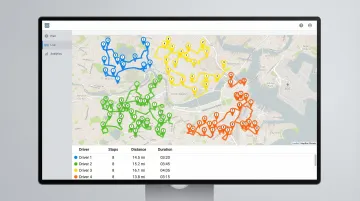
Poorly sequenced multi-stop routes often backtrack unnecessarily. AI clustering algorithms group stops by geographic proximity and delivery window compatibility, reducing the total distance traveled per vehicle per day.
Hardie's Fresh Foods replaced static planning with route optimization software and reduced mileage by 20% across its 160-truck fleet while increasing delivery capacity by 14%. A machine-learning-assisted parcel distribution system using clustering and nearest-neighbor routing algorithms decreased travel time and distance by up to 22.6%.
Strategy 3 — Apply vehicle-specific routing to match the right vehicle to the right route
Sending a heavy truck through a route with low bridges, weight-restricted roads, or urban corridors forces costly detours. Truck-compliant routing constraints ensure each vehicle travels the path it is physically suited for, eliminating avoidable fuel burn from rerouting on the road.
The cost of non-compliance is significant. New York State experiences approximately 200 bridge strikes annually by over-height trucks, with the average repair cost estimated at $180,000. A MnDOT-funded study noted that bridge load restrictions forced larger trucks to detour an extra 15 miles or more on congested roadways.
Strategies That Reduce Costs by Changing How the Fleet Is Managed During Routes
Well-planned routes still bleed fuel when management fails to respond to real-time conditions or driver behavior. The strategies below focus on maintaining efficiency once vehicles are moving.
Strategy 1 — Enable real-time dynamic rerouting to respond to traffic, accidents, and weather
A planned route that encounters a 45-minute accident delay wastes significant fuel through idling and detour miles if drivers aren't redirected. AI systems that ingest live traffic data can recalculate and push updated routes mid-trip, preventing one disruption from cascading into multiple stops running late.
AI-driven traffic analysis and dynamic rerouting typically delivers a 10–20% reduction in fuel usage based on industry-wide benchmarks. In one study, a council truck following unpredictable routes showed an 11% reduction in fuel consumption using route optimization.
Strategy 2 — Monitor and address driver behavior patterns that inflate fuel consumption
Telematics studies consistently identify excessive idling, aggressive acceleration, and sustained high-speed driving as primary behavioral fuel wasters. Increasing speed by one mile per hour reduces fuel economy by about 0.1 miles per gallon. A combination truck driving 55 mph uses up to 7% less fuel than a similar truck driving 65 mph.
Integrating AI routing with telematics data allows fleets to surface per-driver fuel efficiency scores and trigger behavior-specific coaching. A 2026 case study of a 180-vehicle logistics fleet in Nashville used AI driver behavior scoring and coaching to drop fleet-wide fuel consumption by 22% over 12 months, saving $412,000 annually.

Strategy 3 — Integrate AI routing with fleet telematics platforms to create a closed feedback loop
Routing decisions disconnected from live fleet data become stale within minutes of dispatch. When AI optimization platforms connect directly to telematics systems—such as Samsara, Geotab, Motive, or Netradyne—route updates, driver alerts, and ETA recalculations reflect real-world conditions continuously.
A Federal Motor Carrier Safety Administration (FMCSA) field study demonstrated that integrating telematics with driver feedback and coaching reduced severe unsafe driving events by 60% and improved fuel economy by 5.4% for sleeper cabs and 9.3% for day cabs. NextBillion.ai's integration with these platforms enables this closed-loop dynamic without requiring fleet managers to switch between disconnected systems. In a 2023 Samsara survey, 70% of physical operations leaders agreed that "our data is siloed, decreasing efficiency"—a direct drag on routing performance and fuel spend.
Strategies That Reduce Costs by Changing the Context Around Fleet Operations
In many fleets, the surrounding operational setup—not the routes themselves—is the primary cost driver. Empty return miles, poor demand timing, and vehicle-powertrain mismatches are systemic problems that AI optimization can address when applied at the fleet level.
Strategy 1 — Reduce empty return miles through backhaul scheduling and reverse logistics
Vehicles returning empty from delivery runs represent 100% fuel cost with zero revenue contribution. AI systems that model both outbound and return legs can identify opportunities to fill return trips, reducing the fleet's effective cost-per-revenue-mile significantly.
The FHWA's Cross-Town Improvement Project (C-TIP) simulated an intermodal move exchange application that eliminated 1,000 empty truck miles and saved 180 gallons of diesel fuel over four months in Kansas City. A 2021 ACEEE report documented that AI-powered freight matching software achieved an estimated 45% reduction in emissions by reducing empty miles.
Strategy 2 — Use time-of-day traffic modeling to avoid congested periods
Historical traffic pattern analysis allows AI systems to schedule routes during windows that avoid peak congestion, reducing fuel consumption through lower idling and stop-and-go driving.
A 2018 study using GPS data in New York City and São Paulo found that switching to off-hour deliveries between 7 PM and 6 AM reduced emissions by 45–67%. During a New York City off-hour delivery pilot, average travel speeds increased by over 70% from 11.8 mph to 20.2 mph, lowering average fuel consumption rates across the pilot fleet.
Strategy 3 — Apply powertrain-specific routing logic for mixed EV and ICE fleets
Electric vehicles lose range on steep inclines and in cold temperatures in ways that ICE vehicles do not. At 5°F, EVs drop to 54% of their rated range. Routing logic that accounts for these physical differences prevents range anxiety-driven detours and unnecessary energy consumption.
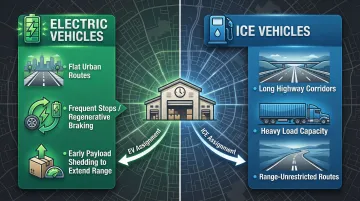
For mixed fleets, effective powertrain-specific routing means:
- Assigning EVs to flat, dense urban routes where regenerative braking recovers energy at frequent stops
- Sending ICE vehicles on longer highway corridors where EVs would drain range without recovery opportunities
- Sequencing EV deliveries to shed payload weight early in the route, extending range as the vehicle lightens
Conclusion
Fleet fuel costs are recoverable—but only when the intervention targets where the waste originates. Cutting fuel spend without diagnosing whether the source is poor planning, weak operational management, or systemic context produces incomplete results and missed savings that compound over time.
AI route optimization works best as a continuous strategy, not a one-time deployment. Fleets that treat it as a living system—feeding real operational data back into planning assumptions—consistently outperform those that install and ignore.
Sustained fuel savings depend on three conditions being met:
- Accurate planning inputs that reflect real road, vehicle, and load constraints
- Live operational responses that adjust routes when conditions shift mid-day
- Structural changes driven by pattern data from past routes and fleet performance
When all three are active, efficiency compounds. When any one is missing, gains stall.
Frequently Asked Questions
What is the main benefit of AI-powered route optimization in logistics?
AI route optimization reduces fuel consumption, miles driven, and idle time by generating routes that account for real-world constraints: traffic, vehicle type, time windows, and load. The result is a route built around real operating conditions, not just distance on a map.
How much fuel can AI route optimization realistically save for a fleet?
Most fleets see 10–25% fuel savings. McKinsey cites 15% reductions from AI-driven logistics optimization; HERE Technologies reports up to 20% lower fleet management costs. Actual results vary based on current routing inefficiency, fleet size, and whether real-time rerouting is in use.
What is the difference between static route optimization and dynamic AI route optimization?
Static optimization calculates a fixed plan before routes begin and doesn't adjust once vehicles are moving. Dynamic AI optimization continuously adjusts routes mid-execution based on live traffic, weather, cancellations, or new orders. This makes it far more effective at preventing real-time fuel waste and keeping deliveries on schedule.
Does AI route optimization work for mixed fleets that include electric vehicles?
AI optimization can apply powertrain-specific constraints—such as EV range limits, charging stop requirements, and terrain sensitivity—to assign each vehicle the route it is best suited for. This reduces both range-related detours and unnecessary energy consumption by matching vehicle capabilities to route demands.
What fleet data is needed to get started with AI route optimization?
Core inputs are stop locations and time windows, vehicle profiles (type, capacity, restrictions), driver availability, and historical delivery data. Platforms like NextBillion.ai can generate optimized routes from basic data sets and improve accuracy as more data accumulates.
How does AI route optimization specifically reduce driver idle time?
AI routing avoids traffic-dense corridors, recalculates around live congestion, and sequences stops to reduce wait times at delivery locations. These factors directly cut engine-on, non-moving fuel burn—estimated at 1,500 gallons of diesel wasted per truck each year.