Introduction
Fleet managers today operate under compounding pressure. Fuel costs averaged $0.553 per mile in 2023, while non-fuel operating costs climbed 3.6% to a record $1.779 per mile in 2024. Meanwhile, the trucking industry faces a projected shortage of 82,000 drivers by 2026.
Customer expectations aren't easing the burden either—68% of shoppers now consider shorter delivery times essential.
Many fleet operations treat route optimization as a standalone planning exercise, disconnected from live vehicle data. This disconnect leaves measurable money on the table. The real value emerges when route optimization runs on real-time fleet tracking data, turning static plans into a self-correcting system that responds to actual road conditions, stop durations, and driver behavior.
This article explains the measurable operational benefits of integrating route optimization with fleet tracking, the hidden costs of running them separately, and the practices that make this integration work consistently.
TL;DR
- Route optimization for fleet tracking uses live vehicle data—location, speed, idle time—to continuously refine routes per driver
- Core benefits include lower fuel costs, higher on-time delivery rates, better fleet utilization, and reduced overtime—all measurable through existing KPIs
- Disconnecting optimization from live fleet data creates reactive planning, missed delivery windows, and compounding costs
- Best practices center on consistency, real-time feedback loops, and constraint-aware planning over theoretical efficiency
What Is Route Optimization for Fleet Tracking?
Route optimization determines the most efficient sequence and path for vehicles to complete a set of stops—factoring in distance, traffic, time windows, vehicle capacity, and driver availability.
Where it applies:
- Multi-stop delivery operations (last-mile, parcel logistics)
- Field service scheduling (pest control, HVAC, healthcare)
- NEMT and paratransit fleets managing appointment windows
- Any operation where daily routing decisions directly translate to costs and service quality
Route optimization works best as a data-feedback system, not a one-time planning tool. Fleet tracking generates real-world performance data—actual drive times, dwell times, traffic patterns—which route optimization uses to improve the accuracy of every subsequent plan. An API like NextBillion.ai's Route Optimization supports 50+ hard and soft constraints—so the feedback loop between real-world tracking data and planning logic stays intact even as route complexity grows.
Key Benefits of Route Optimization for Fleet Tracking
The advantages below are operational and measurable. They show up in P&L statements, dispatch logs, and customer satisfaction scores — and they compound when route optimization and fleet tracking work together rather than as disconnected tools.
Benefit 1: Fuel and Operational Cost Reduction
Integrating route optimization with live fleet tracking eliminates inefficiency at its source. It replaces manual planning guesses with data-driven routes that account for real traffic, actual idle patterns, and vehicle-specific behavior.
Fleet tracking systems capture idle time, speed variance, and stop durations. The route optimizer uses this data to build routes that avoid high-congestion windows, reduce unnecessary mileage, and minimize unproductive idle time between stops.
The cost impact is concrete:
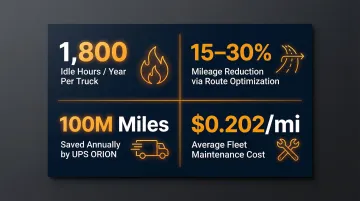
- A typical long-haul truck idles about 1,800 hours per year, consuming approximately 1,500 gallons of wasted diesel
- Automated route optimization typically reduces total fleet mileage by 15% to 30%
- UPS's ORION route optimization saves approximately 100 million miles and 10 million gallons of fuel annually
- Reducing mileage cuts maintenance costs directly — repair and maintenance averaged $0.202 per mile in 2023
Track these metrics to measure impact:
- Fuel cost per mile
- Total fleet fuel spend
- Idle time percentage
- Cost per delivery or job
This benefit is most pronounced for fleets running high daily mileage — logistics, last-mile delivery, and NEMT — and for operations scaling volume without proportionally increasing fuel spend.
Benefit 2: Real-Time Adaptability and On-Time Delivery
Route optimization connected to live fleet tracking doesn't just plan routes — it continuously updates them when conditions change. Drivers always have the most current path, and dispatchers can act before a delay becomes a missed window.
When the fleet tracking system detects a driver running behind schedule, an unexpected road closure, or a stop taking longer than planned, the optimization engine automatically recalculates the sequence and timing for remaining stops — no dispatcher intervention needed.
The stakes are real:
- 60% of consumers will not shop with a retailer again after experiencing a late delivery
- Walmart's OTIF program penalizes suppliers 3% of COGS for shipments that fail to arrive on time or in full
- Real-time visibility platforms cut exception recognition time by 40% and resolution time by 20%
- Accurate ETAs and proactive exception notifications reduce "where is my order" calls — one retailer cut WISMO calls by 27%
Measure improvements with:
- On-time delivery rate
- SLA adherence
- Customer satisfaction score
- Dispatcher workload per shift
This benefit is critical for high-volume delivery operations, time-sensitive field service jobs, and NEMT or paratransit fleets with strict appointment windows — anywhere one delayed stop cascades into downstream misses.
Benefit 3: Fleet Utilization and Capacity Optimization
Route optimization that accounts for vehicle capacity, driver hours-of-service limits, and job-specific constraints enables fleet managers to complete more stops per vehicle per day — without adding vehicles or drivers.
Optimization engines that respect time windows, load capacity, vehicle type restrictions, and driver shift boundaries assign each vehicle the right jobs in the right sequence. Fleet tracking then validates actual utilization — surfacing vehicles that are consistently underloaded or overextended and feeding that data back into smarter assignment logic.
The utilization gains are well-documented:
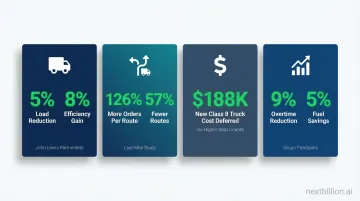
- Retailer John Lewis cut total loads by 5% and achieved an 8% efficiency gain using route optimization
- A last-mile consolidation study showed a 126% increase in orders per route and a 57% reduction in routes used
- Higher utilization defers fleet expansion. Every additional stop per vehicle per day pushes back the need for capital expenditure — a new Class 8 truck runs approximately $188,000
- Beverage distributor Grupo Petrópolis reduced overtime by 9% and fuel consumption by 5% after implementing routing and fleet management software
Monitor these KPIs to quantify the gains:
- Stops/deliveries per vehicle per day
- Fleet utilization rate
- Overtime hours per driver
- Cost per completed job
This benefit matters most for fleets operating near capacity during peak demand, mixed-vehicle operations with different payload or routing restrictions, and any business trying to grow fulfillment volume without proportionally scaling fleet size.
What Happens When Route Optimization Is Disconnected from Fleet Tracking
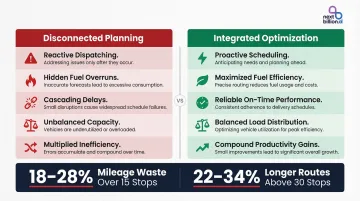
Route plans built without live fleet data rest on assumptions: expected travel times, estimated stop durations, predicted traffic. Those assumptions start breaking down the moment drivers leave the depot.
Compounding consequences:
- Dispatchers field driver calls and customer complaints about delays instead of preventing them
- Fuel and mileage overruns stay hidden — no visibility into which routes, drivers, or stops are driving the waste
- One delayed stop cascades through the rest of the schedule, especially during demand spikes
- Vehicles run either underloaded or overextended, with no systematic way to rebalance capacity
- Adding vehicles or drivers without optimization in place multiplies inefficiency rather than solving it
The data reflects how quickly these gaps compound. Manual route planning wastes 18% to 28% of a fleet's mileage every day for routes over 15 stops. Above 30 stops, manually planned routes run 22% to 34% longer than optimal — and time window compliance drops below 70%.
How to Get the Most Value from Route Optimization in Fleet Operations
Establish the Integration Baseline First
Route optimization only delivers its full value when it has access to live fleet tracking data—actual vehicle locations, real stop durations, and historical traffic patterns. Verify that your optimization platform integrates directly with your fleet management system before configuring routing logic.
NextBillion.ai integrates natively with platforms like Samsara, Geotab, and Motive through plug-and-play API connections, enabling this data exchange without custom development work. These API-based integrations allow bidirectional data flow: pulling vehicle and order data from telematics platforms and pushing optimized routes back to them automatically.
Define and Apply the Right Constraints Upfront
Route optimization is only as good as the constraints it's given. Configure time windows, vehicle capacities, driver shift limits, and any regulatory restrictions (truck routing, hazmat, etc.) from the start. Running optimization without constraints produces routes that look efficient on paper but fail operationally.
Essential constraint categories:
- Time windows and customer appointment slots
- Vehicle capacity (weight, volume, item quantity)
- Driver hours-of-service and shift boundaries
- Vehicle-type restrictions (truck dimensions, hazmat)
- Skill-based job allocation (matching technicians to jobs)
- Multi-depot assignments and depot hours
Close the Feedback Loop on Route Performance
Set a cadence—weekly or bi-weekly—to compare planned routes against actual performance. Analyze where stop durations ran long, where traffic patterns diverged from predictions, and where certain routes consistently underperform.
Use these findings to update optimization parameters. Reviews that stop at reporting miss the point.
What to track in each review:
- Stop durations that consistently exceed estimates
- Traffic patterns that diverge from model predictions
- Routes with repeated on-time delivery failures
This feedback loop improves the accuracy of future plans. The more fleet data feeds into the optimization engine, the more cost-effective future routes become.
Treat Exceptions as Optimization Inputs
When a driver misses a window or a stop takes twice as long as planned, feed that data back into the optimization model to improve future planning accuracy. Make sure your system captures and uses exception data systematically—not as one-off incidents to resolve and forget.
Conclusion
Route optimization delivers its greatest value through the continuous feedback loop between live tracking data and route planning. No single optimized route drives results — consistent improvement does, built from acting on actual performance data over time.
Cost reduction, real-time adaptability, and utilization gains all compound when the system runs consistently and constraints stay current. Fleets that extract the most value treat route optimization as a core operational discipline: reviewing outcomes, refining inputs, and scaling as the operation grows.
Frequently Asked Questions
What is the difference between route planning and route optimization?
Route planning determines which stops to visit and in what general order, while route optimization uses algorithms, real-time data, and operational constraints (time windows, capacity, driver hours) to find the most efficient path—minimizing cost, time, and distance simultaneously.
How does route optimization reduce fuel costs in fleet operations?
Optimization reduces unnecessary mileage, avoids high-congestion periods, and minimizes idle time between stops—all of which directly cut fuel consumption. When tied to live fleet tracking data, the system continuously refines routes based on actual vehicle behavior rather than static assumptions.
Can route optimization software integrate with existing fleet tracking systems?
Most modern route optimization platforms offer API-based integration with major fleet tracking systems. The key is ensuring the integration enables real-time data exchange—not just periodic syncs—so that live vehicle data actively informs routing decisions.
What types of constraints can route optimization handle beyond distance?
Advanced route optimization platforms can handle time windows, vehicle load capacity, driver hours-of-service limits, vehicle-type restrictions (truck routing), customer priority levels, and multi-depot assignments.
How quickly can fleets expect to see ROI from route optimization?
Most fleets see measurable cost improvements within the first few months, with fuel savings, reduced overtime, and improved utilization showing up quickly in operational metrics. Payback timelines vary by fleet size and baseline inefficiency, but Descartes customer success data points to payback periods achievable within months.
What happens to optimized routes when real-time disruptions occur mid-route?
When route optimization is connected to live fleet tracking, the system can detect disruptions—traffic incidents, delayed stops, vehicle breakdowns—and automatically recalculate remaining stops to minimize downstream impact, without manual dispatcher intervention.