Introduction
The wrong route planning software doesn't just slow teams down—it compounds losses across fuel costs, driver hours, missed delivery windows, and customer churn. Research shows that 84% of consumers won't return to a retailer after just one poor delivery experience, making reliable route optimization a matter of survival, not just efficiency.
Most buying guides stop at feature comparisons and ignore what happens after purchase. This post covers the purchasing criteria that distinguish capable platforms from generic tools and the implementation practices needed to realize ROI.
Organizations typically keep their route planning solution for a decade or more. Getting the selection and rollout right the first time matters far more than any single feature on a vendor's spec sheet.
TL;DR
- Route planning software automates multi-stop, multi-vehicle optimization across constraints like time windows, vehicle capacity, driver hours, and road restrictions
- Prioritize algorithm depth, pricing transparency, integration architecture, and support quality — not just feature lists
- 76% of logistics transformations miss critical performance metrics — poor data quality, integration complexity, and change management are the top culprits
- Phased rollouts with defined success metrics consistently outperform big-bang deployments
- Evaluate vendors on long-term operational support capability, not just demo performance
What is Route Planning Software?
Route planning software is a technology platform that uses optimization algorithms to generate the most efficient stop sequences and vehicle assignments across a fleet. It accounts for real-world constraints like delivery time windows, vehicle load capacity, driver shift limits, road restrictions, and traffic patterns—far beyond what any human planner can compute manually.
Route planning focuses on finding the most efficient path for a single vehicle, while route optimization implements transport orders efficiently across an entire fleet while adhering to multiple constraints simultaneously. Modern platforms blur this distinction by combining both capabilities into unified systems.
Core Components of Route Planning Software
Route planning platforms consist of three foundational layers working in concert:
- Optimization engine: Applies mathematical algorithms to solve the "vehicle routing problem"—evaluating thousands of route combinations to find feasible, cost-efficient sequences. This is the computational core of any route planning platform.
- Data layer: Ingests stop locations, vehicle specs, driver schedules, and live map data from order management systems and traffic feeds. Route accuracy depends entirely on the quality of this input—poor data produces unreliable routes.
- Execution and visibility layer: Dispatches routes to drivers, tracks progress in real time, and enables dispatchers to handle exceptions or re-optimize mid-day when disruptions occur.
Enterprise-grade platforms expose these capabilities via APIs, enabling businesses to embed routing intelligence directly into their own logistics apps or fleet management systems rather than operating a separate tool.
Key Business Benefits
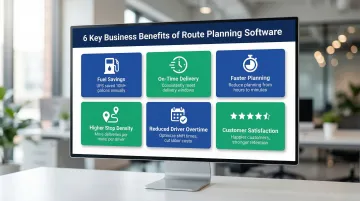
The measurable operational outcomes of effective route planning include:
- Reduced fuel and mileage costs: UPS's ORION system cut fuel consumption by 10 million gallons yearly, saving 100 million miles annually
- Improved on-time delivery rates: Optimized routes account for time windows and traffic, boosting punctuality
- Shorter planning cycles: Automated routing reduces planning time from hours to minutes
- Higher stop density per vehicle: Better sequencing enables drivers to complete more deliveries per shift
- Reduced driver overtime: Routes that respect shift limits eliminate costly overruns
- Improved customer satisfaction: Accurate ETAs and consistent delivery windows build trust
The scale of these benefits ties directly to how well the software is configured and maintained—not just purchased.
Key Factors to Consider When Purchasing Route Planning Software
Route planning solutions vary enormously in how they balance algorithmic power, pricing transparency, integration openness, and deployment flexibility. The right choice depends on mapping these dimensions to your specific operational constraints and growth trajectory.
Optimization Algorithm Depth and Constraint Flexibility
The core differentiator between basic and advanced route planning software is the number and type of constraints the algorithm can handle simultaneously. Advanced systems natively support:
- Vehicle capacity and load type restrictions
- Multi-time-window stops (customers available only during specific hours)
- Mandatory driver breaks and Hours of Service (HOS) compliance
- Priority customers requiring preferential treatment
- Territory locking (preventing cross-territory assignments)
- Vehicle-specific road restrictions (truck height, weight, hazmat certifications)
- Driver skill matching (pairing technicians with jobs requiring specific expertise)
- Load compatibility rules (preventing incompatible items from sharing vehicle space)
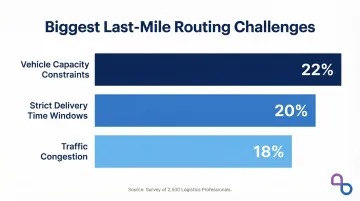
More constraints handled natively means less manual adjustment after optimization. A survey of 2,500 logistics professionals identified vehicle capacity constraints (22%), strict delivery time windows (20%), and traffic congestion (18%) as the most significant challenges impacting last-mile operations.
These factors directly influence route feasibility rate, on-time delivery performance, and how often dispatchers must intervene with manual re-dispatch. Together, they determine how often drivers can actually complete the route as generated — and how much time your dispatchers spend fixing what the algorithm missed.
Pricing Model and Total Cost of Ownership
Pricing structure matters as much as the upfront price. Per-API-call pricing models create unpredictable and exponentially growing costs as fleet size or order volume scales, while per-vehicle or per-order fixed pricing provides cost predictability that supports financial planning.
Compare pricing models across shortlisted vendors by projecting costs at 1x, 2x, and 3x your current volume. Ask vendors for detailed pricing scenarios showing what you'd pay at different scale points. Task-based pricing can become difficult to forecast and may increase costs significantly as delivery volumes grow.
NextBillion.ai uses per-vehicle or per-order pricing rather than per-API-call billing, eliminating cost surprises as operations scale. For businesses processing high order volumes, this means costs stay tied to business outcomes — not to how many API calls your optimization engine makes.
Integration Capabilities and API Architecture
Route planning software doesn't operate in isolation. It must exchange data with order management systems, TMS platforms, telematics and fleet management tools (Samsara, Geotab, Motive), and driver mobile apps.
Evaluate whether the vendor offers:
- Well-documented APIs with clear technical specifications
- Pre-built connectors to your existing technology stack
- Support for standard data formats (JSON, XML, CSV)
- Webhook capabilities for event-driven automation
- Bidirectional data synchronization (not just one-way exports)
92% of operations and supply chain leaders cite at least one reason why tech investments haven't fully delivered expected results, with integration complexity (47%) and data issues (44%) as the most common barriers. Evaluate integration readiness as rigorously as you evaluate routing features.
Scalability, Deployment Flexibility, and Speed
Operations grow — and sometimes shrink seasonally — so the platform must scale route computation speed and capacity without degrading performance. Key questions include:
- How many vehicles and stops can the system optimize in a single run?
- How does routing latency change under peak load?
- Does it support cloud-agnostic, on-premise, or hybrid deployment to match your IT constraints?
Slow route optimization forces earlier order cutoffs and removes the ability to re-optimize when last-minute cancellations, order changes, or traffic disruptions occur mid-day. 69% of companies frequently adjust delivery routes in real-time, with 39% making changes multiple times per day, underscoring the need for fast re-computation.
Modern dynamic routing systems can recalculate routes in seconds or minutes, allowing dispatchers to make informed decisions while trucks are on the road. The difference between 30-second and 5-minute re-optimization latency is the difference between catching a mid-route disruption in time and absorbing the service failure after the fact.
Vendor Track Record and Ongoing Support Quality
Route optimization algorithms improve with real-world operational data and ongoing development, meaning newer or untested vendors carry higher implementation and performance risk. Look for evidence of:
- Deployment across your industry vertical (logistics, field service, NEMT)
- Reference customers willing to discuss results
- Transparency around uptime and SLA commitments
- Regular product updates and algorithm improvements
Day-to-day support quality shapes implementation speed more than most buyers anticipate. Before signing, ask vendors:
- How post-go-live support works (24x7 availability, response times)
- Whether support engineers understand logistics operations (not just software tickets)
- What the escalation path looks like for critical routing failures
- How configuration changes and ongoing training are handled
Route Planning Software Implementation Best Practices
Implementation failures are rarely caused by choosing the wrong software. They're almost always caused by poor data preparation, underestimated integration effort, or treating deployment as a one-time event rather than an ongoing operational commitment.
Define Goals Broadly Across the Organization
Most implementation teams default to measuring success purely on route efficiency and fuel savings, leaving significant value unrealized. Involve stakeholders from sales, customer service, and warehouse operations early to surface goals like:
- Reduced customer complaint volume through more accurate ETAs
- Improved upsell opportunities through tighter delivery windows
- Reduced planner overtime from automated route generation
- Better driver retention through fair workload distribution
Document baseline metrics for each goal before go-live. By capturing cross-functional goals upfront, the implementation team avoids optimizing for dispatcher efficiency while inadvertently degrading customer experience or driver satisfaction.
Audit and Clean Your Data Before Go-Live
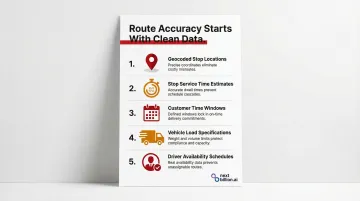
The accuracy of any route plan is limited by the quality of its inputs:
- Geocoded stop locations
- Stop service time estimates
- Customer time window commitments
- Vehicle load specifications
- Driver availability schedules
If manual planning or spreadsheet-based routing was previously used, treat all historical data as suspect and plan a structured cleansing phase before migration.
Inaccurate service time data is a particularly common root cause of routes that look optimal on screen but consistently run over time in the field. Implementing a geodatabase for address registration and geocoding improved speed by 51.33%, reducing reliance on manual processes. Use GPS-based mobile data and driver feedback from early runs to calibrate service time estimates continuously.
Build a Dedicated Integration Workstream
Integration between the route planning platform and upstream/downstream systems — OMS, TMS, telematics, driver apps — is routinely the longest item on the project critical path, and the one most consistently underestimated in scope.
Assign a dedicated integration lead, budget conservatively for resource time, and fix upstream data quality issues (like systems that resend all records rather than only changed records) before integration testing begins. Organizations without recent major integration experience should plan for third-party integration support.
Treat integration effort as a parallel workstream with its own timeline and milestones rather than a sub-task of software configuration.
Test Thoroughly Before Broad Rollout
A limited pilot across one region, depot, or line of business is far more valuable than a rapid company-wide deployment. A pilot reveals configuration gaps, infeasible route patterns, or driver workflow friction that would otherwise surface simultaneously across the entire fleet — creating difficult rollbacks and eroding trust in the system.
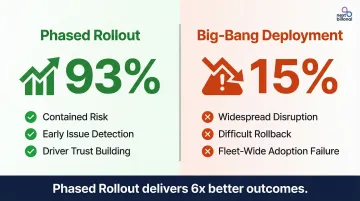
Phased rollouts lower risk by identifying and resolving issues within a contained scope before broader deployment, whereas big-bang deployments carry high risk of widespread disruption.
End users and dispatchers who see infeasible or counterintuitive routes will resist adoption fast. A pilot that demonstrably improves on baseline performance is the single most effective change management tool available.
The stakes are real: projects with effective change management met or exceeded objectives 93% of the time, compared to just 15% for those with poor change management.
Establish Ongoing Ownership and a Competency Center
Treating implementation as a fixed-scope project that ends at go-live is one of the most common and costly mistakes organizations make. Route planning systems require ongoing maintenance as business rules evolve, new capabilities are released by the vendor, and new staff require training.
Designate a small team (or individual) responsible for:
- System configuration updates as business rules change
- Training new dispatchers and planners
- Monitoring optimization quality metrics
- Identifying opportunities for continuous improvement
- Coordinating with the vendor on new feature adoption
Without active ownership, optimization quality degrades silently. Business conditions outpace configuration updates, and the long-term benefits of AI-powered ETAs and demand pattern recognition never fully materialize.
How NextBillion.ai Can Help
NextBillion.ai was built by founders who ran geo and routing infrastructure at Grab. They designed the platform to give logistics, fleet, and mobility businesses enterprise-grade algorithmic power with predictable pricing and no rigid configuration constraints.
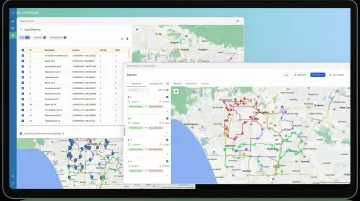
The route optimization engine supports over 50 hard and soft constraints, so businesses can encode complex operational rules directly into the optimization logic. That includes vehicle-specific road restrictions, multi-time-window stops, priority customers, driver skill matching, and load compatibility — no manual exception handling after the fact.
Pricing runs per-vehicle or per-order rather than per-API-call, so costs stay predictable as delivery volumes scale. Sub-second routing latency and large-scale distance matrix computation (no 25×25 limit) make it viable for same-day re-optimization and high-volume last-mile operations.
Additional differentiators include:
- 24x7 support from solution engineers, not just a ticketing queue
- Native integrations with leading fleet management platforms (Samsara, Geotab, Motive, Netradyne)
- Cloud-agnostic and on-premise deployment options with Kubernetes support
- API-first architecture for embedding routing into proprietary logistics platforms
- $11M+ in documented cost savings across 150+ global customers
Conclusion
Selecting route planning software is not primarily a features comparison exercise—it's a strategic decision about which vendor and which implementation approach will deliver measurable, lasting operational improvement across fuel costs, delivery performance, and customer satisfaction.
The businesses that get the most from route planning software share a few consistent habits:
- They revisit and reconfigure routes as their network grows or changes
- They track KPIs monthly, not just at launch
- They treat vendor support as an ongoing relationship, not a one-time onboarding
The software you choose matters. How you manage it after go-live matters more. Treat it as a living operational system—one that evolves alongside your business—and it will keep delivering returns well beyond the initial deployment.
Frequently Asked Questions
How to optimize route planning?
Effective route optimization starts with clean input data — accurate stop locations, service times, and time windows — paired with a routing engine that handles your specific operational constraints. From there, it's an ongoing process: review route performance data regularly and recalibrate parameters as business conditions shift.
What is the best route planner to use?
The best route planner depends on fleet size, industry vertical, integration requirements, and pricing model fit—there is no universal answer. Evaluate shortlisted vendors using real operational data in a pilot scenario rather than relying on vendor-controlled demos alone.
Can ChatGPT do route planning?
General-purpose AI tools like ChatGPT are not designed for production route optimization. They lack specialized constraint-solving algorithms and achieve only around 50% feasibility rates on problems with fewer than 30 nodes. Purpose-built route planning platforms use dedicated optimization engines that are far more capable — handling thousands of nodes with complex constraints that general AI tools cannot reliably solve.
What is the difference between route planning and route optimization software?
Route planning covers the broader process: determining which driver visits which stops, in what sequence. Route optimization is more specific — it applies algorithms to find the mathematically most efficient solution given defined constraints. Most modern platforms combine both capabilities.
How long does it take to implement route planning software?
Timelines range from a few weeks for SaaS or API deployments with clean data and simple integrations, to several months for enterprise rollouts requiring data cleansing, custom integrations, and multi-site configuration. Data quality and integration complexity are the most common causes of delays.
What data do you need to implement route planning software?
Core data requirements include:
- Geocoded stop or customer locations
- Delivery time windows
- Stop service time estimates
- Vehicle specifications (capacity, type, restrictions)
- Driver availability and shift schedules
- Operational constraints and business rules to encode into routing logic