Introduction
Logistics and delivery operations face mounting pressure from rising stop volumes, tighter delivery windows, and growing fleet complexity. The wrong route planning software compounds these problems, while the right tool transforms chaos into predictability. Last-mile delivery alone accounts for up to 41% of total delivery costs, making optimization software a financial necessity.
Routific has earned its place as a popular choice for small-to-mid delivery businesses, particularly those needing straightforward multi-stop routing with transparent per-order pricing. But as operations scale, friction points emerge:
Routific has earned its place as a popular choice for small-to-mid delivery businesses, particularly those needing straightforward multi-stop routing with transparent per-order pricing. But as operations scale, friction points emerge:
- Limited routing constraints that can't handle complex scheduling rules
- No native multi-day routing for weekly planning
- Poor scalability for enterprise volumes
- Per-stop pricing that gets expensive as order counts climb
Each alternative below is evaluated on route optimization depth, pricing flexibility, constraint support, and enterprise readiness — so you can find the right fit for where your operation is headed.
TLDR
- Routific works well for small delivery operations but struggles with complex routing scenarios and high-volume enterprise needs
- NextBillion.ai delivers API-first route optimization with 50+ constraints and predictable pricing — built for mid-market and enterprise logistics teams
- OptimoRoute excels at multi-day weekly planning and return-to-depot workflows that Routific can't handle natively
- Onfleet is purpose-built for on-demand delivery with automated dispatch, age verification, and same-day operational workflows
- Route4Me suits complex fleets with its add-on marketplace and truck-specific routing constraints
Why Businesses Look for Routific Alternatives
Routific delivers a clean UI, transparent per-order pricing (starting free for up to 100 orders per month), and solid core optimization for small-to-medium last-mile delivery businesses with straightforward routing needs. Its strength lies in simplicity: unlimited drivers, real-time GPS tracking, and proof of delivery across all plans.
For many operations, though, specific gaps eventually push teams to look elsewhere:
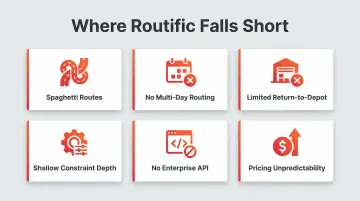
- Spaghetti route issues when constraint configurability is insufficient
- No native multi-day or weekly routing for businesses planning deliveries across multiple days
- Limited return-to-depot support that requires workarounds rather than native configuration
- Shallow constraint depth for operations needing advanced driver skills matching, vehicle-specific restrictions, or load/unload time modeling
- No enterprise API depth for organizations integrating routing into existing ERP, WMS, or telematics systems
- Pricing unpredictability as stop volumes grow, since per-order costs scale linearly with volume
The four alternatives below address these gaps directly, covering developer-first API platforms, dispatch-focused tools, and mid-market solutions—each evaluated on constraint depth, pricing transparency, and verified user feedback.
4 Best Alternatives to Routific Route Planning Software
If Routific's constraint limits or pricing structure aren't working for your operation, these four alternatives cover a range of use cases—from API-driven enterprise routing to on-demand dispatch. Each was evaluated on optimization quality, constraint flexibility, pricing transparency, integration capability, and fit across different fleet scales.
NextBillion.ai
NextBillion.ai is an AI-powered route optimization and mapping platform built for logistics and transportation businesses that need enterprise-grade flexibility without per-API-call billing surprises. Founded in 2020 by former Grab Geo team leaders, it serves 150+ businesses globally including AB InBev, DoorDash, and Meesho, and has optimized over 10.9 million deliveries.
What makes it stand out:
- Supports 50+ hard and soft routing constraints including time windows, vehicle capacity, driver skills, load/unload times, shift schedules, and service location requirements
- Handles truck-compliant routing with vehicle-specific road restrictions for height, weight, and hazmat compliance
- Delivers sub-second response times for large-scale distance matrix computations with no 25x25 origin-destination limits
- Integrates directly with Samsara, Geotab, Motive, and Netradyne for real-time fleet data synchronization
- Charges per-vehicle or per-order (fixed-fee), eliminating the API cost surprises common with pay-per-call models
- Built API-first, enabling deep customization within existing logistics systems
| Feature | Details |
|---|---|
| Key Features | 50+ routing constraints, truck-compliant routing, custom map editing, on-premise deployment, API-first platform with sub-second latency |
| Pricing Model | Per-vehicle or per-order fixed-fee pricing; no per-API-call charges; custom enterprise plans available |
| Best For | Mid-market to enterprise logistics, last-mile delivery, NEMT, field service, fleets needing custom routing rules and telematics integration |
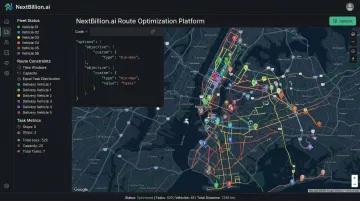
NextBillion.ai's API-first design means developers integrate routing directly into their existing tech stack rather than bending their dispatch workflows to fit a rigid UI. For enterprises running complex operations across multiple platforms, that flexibility translates to faster deployment and fewer integration compromises.
OptimoRoute
OptimoRoute is a structured route planning platform known for multi-day scheduling and return-to-depot routing—two features Routific lacks natively. It's used by distributors, field service teams, and businesses managing recurring or multi-stop delivery cycles.
What makes it stand out:
- Plans routes up to 5 weeks ahead for operations that need advance scheduling visibility
- Supports return-to-depot mid-route reloading while factoring vehicle capacity constraints into sequencing
- Builds detailed driver profiles covering shift schedules, skills matching, and service area restrictions
- Compares actual vs. planned routes via breadcrumb trail tracking for post-route analysis
- Confirms package delivery through barcode scanning
| Feature | Details |
|---|---|
| Key Features | Multi-day/weekly routing, return-to-depot, detailed driver profiles, breadcrumb trail tracking, barcode scanning |
| Pricing Model | Per-driver pricing starting around $44–$49/driver/month (annual); custom pricing for complex needs |
| Best For | Field service businesses, distributors, and operations with fixed driver teams or recurring multi-day delivery cycles |
OptimoRoute's per-driver pricing works best for operations with stable, predictable team sizes. Businesses with seasonal or fluctuating driver counts should model costs carefully, as per-driver fees scale linearly with fleet size.
Onfleet
Onfleet is a last-mile delivery management platform focused on on-demand and same-day delivery workflows, making it a strong Routific alternative for couriers, cannabis delivery, and food service businesses needing automated driver dispatch.
What makes it stand out:
- Automates driver assignment for on-demand dispatch without manual route building
- Verifies customer age in-app for alcohol, cannabis, and tobacco compliance via government-issued PDF-417 barcode scanning
- Confirms package delivery through barcode scanning and proof-of-delivery capture
- Keeps driver-to-dispatcher communication in-platform via built-in team chat
- Collects customer feedback to track service quality and driver performance
| Feature | Details |
|---|---|
| Key Features | Automated on-demand dispatch, age verification, barcode scanning, in-app team chat, customer feedback |
| Pricing Model | Task-based pricing starting around $559/month for up to 2,000 tasks; next tier at ~$1,299/month |
| Best For | On-demand courier services, restaurant delivery, alcohol/cannabis delivery businesses requiring compliance at the point of delivery |
Before committing, calculate costs at your current task volume, peak seasonal volume, and 12-month growth projection—tier jumps can significantly change the monthly bill.
Route4Me
Route4Me has been in market since 2009 and offers an extensive add-on marketplace that lets businesses build customized routing workflows—including truck routing, curbside delivery, territory assignment, and recurring route automation.
What makes it stand out:
- Adds commercial truck routing (via add-on) with vehicle-specific restrictions for height, weight, and cargo type
- Manages territory zones for assigning drivers or teams to specific geographic areas
- Automates recurring routes for operations with repeating delivery patterns
- Connects to Shopify, WooCommerce, and Magento for direct order import
- Offers an extensive marketplace where businesses compose custom solutions from specialized modules
| Feature | Details |
|---|---|
| Key Features | Truck/commercial vehicle routing (add-on), territory assignment, recurring routes, e-commerce integrations, extensive marketplace |
| Pricing Model | Contact sales for current pricing; historically started at ~$400/month for 5-user plan; add-ons increase total cost |
| Best For | Complex fleets needing highly customized routing, truck-specific constraints, or territory-based delivery operations |
Important caveat: Route4Me's modularity is both a strength and a complexity. Core enterprise features like time windows and SMS notifications require separate add-on purchases. Pricing opacity (contact sales required) and add-on costs mean TCO can be difficult to forecast without a detailed quote.
How We Chose the Best Routific Alternatives
Selecting route optimization software requires aligning vendor capabilities with your specific operational scale and constraints. Our evaluation criteria included:
Route optimization depth:
- Number of supported constraints (time windows, vehicle capacities, driver skills, service times)
- Route quality and avoidance of inefficient spaghetti routes
- Real-time execution management capabilities
Pricing model flexibility:
- Scalability without runaway costs as volumes grow
- Transparent tier structures vs. hidden overage fees
- Alignment with business model (per-order, per-driver, per-vehicle)
API and integration capability:
- Native integrations with telematics, ERP, and fleet management systems
- Webhook support for event-driven workflows
- API documentation quality and developer support
Support quality:
- Response times and support tier structures
- Hands-on implementation assistance
- Availability of solution engineers vs. basic ticket systems
Common buyer mistakes when evaluating route planning alternatives include:
- Judging tools by UI alone without testing constraint depth or route quality against real data
- Underestimating how pricing scales with volume — costs that look reasonable at 50 stops can spike sharply at 500
- Skipping real-world data tests that include your actual time windows, vehicle constraints, and delivery patterns
- Missing integration gaps with existing fleet management, telematics, and ERP systems until it's too late
- Assuming constraint configurability without validating it against actual operational requirements
Avoiding these pitfalls narrows the field considerably. From there, the right choice comes down to your specific operational model:
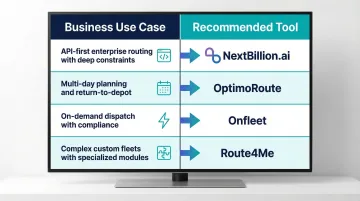
- API-first enterprise routing with deep constraints: Evaluate NextBillion.ai
- Multi-day planning and return-to-depot workflows: Look at OptimoRoute
- On-demand dispatch with compliance requirements: Consider Onfleet
- Complex custom fleets with specialized modules: Explore Route4Me's marketplace
Conclusion
Routific is a capable tool for simple, pre-scheduled delivery operations with straightforward routing needs. But businesses with growing volumes, complex routing requirements, or specialized constraints—truck compliance, multi-day routing, on-demand dispatch—will benefit from evaluating purpose-fit alternatives.
When comparing options, prioritize constraint flexibility, transparent per-volume pricing, and integration depth over feature checklists that look impressive but rarely reflect real operational needs. Test each platform with your own real-world stop data before committing. Model pricing at your current volume, peak seasonal volume, and projected growth to uncover hidden costs.
If those criteria point toward a platform built for high-constraint routing at scale, NextBillion.ai offers a free evaluation — put its 50+ hard and soft constraints, predictable pricing, and hands-on support against your actual routing data.
Frequently Asked Questions
What are the main limitations of Routific for growing delivery businesses?
Routific lacks native multi-day routing for planning deliveries across multiple days, offers limited constraint configurability for complex operations, and doesn't support return-to-depot workflows natively. Additionally, per-order pricing can become costly at high volumes, making alternatives with per-vehicle or fixed-fee models more economical at scale.
What is the best truck routing software?
The best truck routing software depends on fleet complexity and integration needs. NextBillion.ai supports truck-compliant routing with vehicle-specific road restrictions, height/weight limitations, and hazmat compliance at the API level, while Route4Me offers truck routing as a marketplace add-on — both outperforming general-purpose planners like Routific on commercial vehicle constraints.
What is the best Circuit route planner app?
Circuit (now rebranded as Spoke Dispatch in 2025) is a driver-friendly route planner suited for small teams managing up to 10 stops on the free tier. Its route optimization quality and lack of timeline view, however, make it a poor fit for larger operations needing enterprise-grade routing or deeper constraints.
How do I choose between per-order and per-driver pricing in route planning software?
Per-order pricing (like Routific and NextBillion.ai) suits businesses with fluctuating volumes or variable driver counts, while per-driver pricing (like OptimoRoute) works better for fixed teams with predictable routes and stable workforce sizes. Platforms like NextBillion.ai support both models, making them adaptable for mid-market operations with variable volumes.
Can route optimization software integrate with fleet management and telematics systems?
Yes, most enterprise-grade platforms support integrations. NextBillion.ai natively integrates with Samsara, Geotab, Motive, and Netradyne for real-time fleet data synchronization, while OptimoRoute and Route4Me offer third-party connections. Routific's integration options are more limited compared to API-first platforms designed for enterprise tech stacks.
Is there a free alternative to Routific?
Most enterprise route planners use subscription models. Routific offers the first 100 orders free per month with multi-vehicle support, which is a solid free tier for commercial use. NextBillion.ai offers evaluation trials, while basic free tools like Spoke Route Planner (10 stops) and RouteXL (20 stops) fall well short of commercial-grade routing needs.