Introduction
Fleet managers and trucking companies face mounting pressure in 2026. Diesel prices exceeding $5.50 per gallon, stricter compliance requirements, and last-mile complexity are rendering manual route planning unsustainable at scale. AI-driven predictive analytics in logistics can reduce transportation costs by up to 15% and improve fuel efficiency by 10-20%, making route planning technology a direct cost-control lever.
The wrong tool creates real liability, not just operational delays. Consumer GPS apps like Google Maps are fundamentally inadequate for commercial vehicles — they ignore bridge clearances, weight restrictions, and Hours of Service (HOS) regulations.
Google has explicitly stated that commercial truck routing is "infeasible" and not on its roadmap. State DOTs directly link consumer GPS use to bridge strikes and infrastructure damage.
This guide reviews the leading trucking route planning tools of 2026 — evaluated across compliance handling, HOS integration, scalability, and pricing — so fleet operators and logistics teams can make an informed decision before committing.
TLDR
- Two distinct tool categories exist: driver-facing navigation apps for individual truckers, and enterprise route optimization platforms for fleets and logistics tech builders
- Bridge clearances, weight limits, hazmat classifications, and HOS compliance are non-negotiable — consumer apps like Google Maps don't cover them
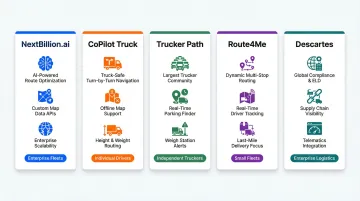
- Top tools covered: NextBillion.ai, CoPilot Truck, Trucker Path, Route4Me, and Descartes — each suited to different use cases and scales
- Prioritize constraint depth, integration flexibility, predictable pricing models, and real-time adaptability over brand recognition
What Are Trucking Route Planning Tools?
Trucking route planning tools are software solutions that determine the most efficient, cost-compliant paths for commercial vehicles. Unlike consumer navigation apps, these platforms factor in vehicle dimensions, load type, time windows, driver availability, and road restrictions specific to commercial operations.
Two Distinct Categories
The market conflates two fundamentally different product types:
| Type | What It Does | Best For |
|---|---|---|
| Driver navigation apps | Turn-by-turn GPS guidance that helps individual truckers avoid road hazards in real time | Single drivers, in-cab use |
| Enterprise route optimization platforms | API-driven systems that plan multi-vehicle, multi-stop routes, enforce business rules, and integrate with TMS and telematics | Fleet operators, logistics software builders |
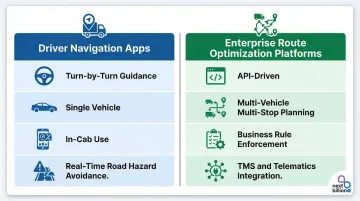
Enterprise fleets need the latter. A driver app helps one truck navigate safely — an optimization platform cuts fuel costs across an entire fleet, improves on-time delivery rates, and prevents costly compliance violations.
Market Context
That demand for enterprise-grade optimization reflects a broader market shift. Grand View Research projects the global route optimization software market will grow from $8.51 billion in 2023 to $21.46 billion by 2030 — a 14.4% compound annual growth rate. Rising freight volumes, AI advances in routing algorithms, and the persistent complexity of last-mile delivery are all accelerating that growth.
Best Trucking Route Planning Tools for 2026
Each tool below was assessed on truck-specific constraint support, real-time adaptability, integration capability, pricing transparency, and fit across fleet sizes and use cases.
NextBillion.ai Route Optimization API
NextBillion.ai is an AI-powered, API-first route optimization platform built for enterprise fleets, logistics software companies, and transportation technology providers who need deep customization without prohibitive API costs. It supports multi-vehicle, multi-stop planning with 50+ hard and soft constraints including vehicle weight, height, cargo type, time windows, and driver shift rules.
Key differentiators include:
- Truck-compliant routing — enforces height, weight, and cargo-specific restrictions that regulatory compliance demands
- Sub-second response times — built for large-scale operations without sacrificing speed
- Per-vehicle or per-order pricing — eliminates cost penalties as fleets scale, unlike per-API-call models
- Native telematics integrations — connects directly with Geotab, Samsara, Motive, and Netradyne for real-time fleet monitoring
- Large-scale distance matrix support — handles computations well beyond the 25×25 limits of generic mapping providers
| Feature | Details |
|---|---|
| Key Features | 50+ optimization constraints (time windows, vehicle type, HOS, hazmat), AI-driven multi-vehicle routing, real-time rerouting, API-first design, telematics integrations |
| Pricing | Per-vehicle or per-order pricing model; no per-API-call charges; contact NextBillion.ai for enterprise pricing |
| Best For | Enterprise fleets, logistics software builders, and transportation tech providers needing scalable, deeply customizable route optimization |
CoPilot Truck (by Trimble)
CoPilot Truck is a commercial-grade navigation app built on Trimble's PC*Miler routing engine—an industry-standard data source used by major fleet management platforms. It offers truck-legal turn-by-turn navigation tailored to commercial vehicle dimensions and compliance requirements.
Standout capabilities include:
- Full offline map support — critical for rural corridors with poor connectivity
- Bridge and weight limit enforcement based on entered vehicle profiles
- Lane assist and driver safety view for active navigation guidance
- Multi-stop optimization for up to 50 stops
- 5M+ truck-specific POIs covering weigh stations, truck stops, and service facilities
| Feature | Details |
|---|---|
| Key Features | Offline maps, truck-legal routing (bridge heights, weight limits, hazmat), vehicle profile compliance, lane assist, 5M+ truck-specific POIs |
| Pricing | Starting around $119.99/year for individual subscription; enterprise fleet pricing available—verify current pricing before purchase |
| Best For | Individual commercial drivers and fleets needing reliable offline navigation with proven PC*Miler routing accuracy |
Trucker Path
Trucker Path is a community-driven trucking platform trusted by over one million drivers, combining truck-specific GPS navigation with real-time crowd-sourced data on parking availability, fuel prices, and weigh station statuses.
The community data layer is what separates it from standard navigation apps. Live parking availability, driver-reviewed truck stops, real-time diesel pricing, and weigh station open/closed alerts give drivers visibility no static map can match. Fleet management and ELD integrations with 30+ providers—including Geotab—extend its utility to small fleets that need driver locations and HOS data synced to dispatch dashboards.
| Feature | Details |
|---|---|
| Key Features | Truck-specific routing (bridge/weight avoidance), real-time parking and fuel data, weigh station alerts, community reviews, ELD integration with 30+ providers |
| Pricing | Free basic version; premium Diamond plans starting around $29.99/month for individuals; fleet plans available—verify current pricing before purchase |
| Best For | Long-haul owner-operators and small fleets who need an all-in-one navigation and trip amenities companion |
Route4Me
Route4Me is a high-volume route optimization platform that has processed over 30 million optimized routes, purpose-built for businesses managing dense multi-stop delivery or service operations at scale. It integrates with telematics providers including Geotab for real-time fleet tracking and syncs with ERP and CRM systems.
Key differentiators include dynamic route reoptimization that adjusts to live conditions, commercial truck compliance enforcement (weight, height, road class, hazmat type, axle weight), what-if scenario modeling for planning ahead, and automated customer status alerts. The platform supports configurable business rules that allow dispatchers to enforce operational constraints specific to their fleet.
| Feature | Details |
|---|---|
| Key Features | Dynamic reoptimization, commercial truck compliance (class, size, weight, hazmat, axle weight), ERP/CRM/telematics integrations, customer alerts, planned vs. actual analytics |
| Pricing | Subscription-based; custom enterprise quotes required—contact Route4Me for pricing details |
| Best For | Retail, e-commerce, and logistics fleets running high-volume multi-stop delivery operations |
Descartes Route Planning
Descartes is an enterprise logistics platform with over 30 years of industry experience, offering AI/ML-driven route planning that covers both strategic (long-term) and daily operational planning. It serves businesses of all sizes that need geospatial intelligence alongside traditional route optimization.
Distinguishing capabilities include:
- Predictive road speed modeling and geospatial hazard avoidance
- Continuous ML-driven rerouting as conditions and orders change in real time
- Driver mobile app with electronic proof-of-delivery built in
- Unified planning and execution visibility — strategic planning and daily dispatch in one platform
In 2025, the ARC Advisory Group recognized Descartes as the leading provider of cloud-based Transportation Management Systems (TMS).
| Feature | Details |
|---|---|
| Key Features | AI/ML continuous optimization, predictive road speeds, hazardous road avoidance, integrated driver mobile app with electronic proof-of-delivery, strategic and daily planning modes |
| Pricing | Enterprise pricing; contact Descartes for custom quote |
| Best For | Mid-to-large enterprises needing sophisticated logistics planning with geospatial intelligence and real-time operational visibility |
How We Chose the Best Trucking Route Planning Tools
Tools were assessed across five dimensions:
- Truck-specific constraint depth — bridge clearance, weight limits, hazmat routing, HOS compliance
- Real-time adaptability — live traffic, dynamic rerouting, disruption handling
- Integration capability — telematics, TMS, and ERP connectivity
- Pricing model fairness — predictable fixed fees vs. per-call charges that penalize scale
- User fit — individual driver apps vs. enterprise-grade platforms
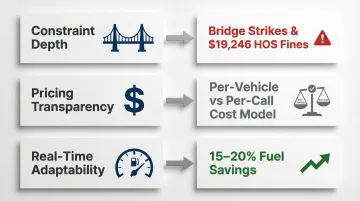
The most common buyer mistake is choosing based on brand recognition rather than operational fit. Each dimension above maps directly to a measurable business outcome — and getting the wrong tool in even one area creates friction that compounds across every route, shift, and shipment. FMCSA penalties for non-recordkeeping HOS violations reach $19,246 per incident, so constraint depth alone can mean the difference between compliance and a five-figure fine. Pricing structure affects your unit economics as you scale, and integration gaps determine how much operational data actually flows between systems.
Connecting Evaluation Criteria to Business Outcomes
Here's what each criterion actually costs you when a tool gets it wrong:
- Constraint depth — A system that misses a bridge clearance or weight restriction risks infrastructure damage, regulatory fines, and failed deliveries. Last-mile delivery already accounts for 53% of total shipping costs, and each failed delivery attempt adds $17.78 in direct re-attempt costs.
- Pricing transparency — Per-API-call models become cost-prohibitive at scale. Per-vehicle or per-order pricing aligns what you pay with what you actually deliver.
- Real-time adaptability — With diesel above $5.50/gallon in early 2026, AI-driven route optimization cuts fuel consumption by 15–20%, which matters when margins are already thin.
No Single Tool Is Universally "Best"
Individual truckers benefit most from driver-centric apps like CoPilot or Trucker Path that provide turn-by-turn navigation, offline maps, and on-road amenities. Enterprise fleets and logistics tech builders need API-first platforms like NextBillion.ai that can be embedded into existing workflows, enforce complex business rules across dozens of vehicles, and scale without cost penalties.
Conclusion
The trucking route planning landscape in 2026 offers purpose-built solutions for every operational context. The gap between a driver navigation app and an enterprise optimization platform is real, and conflating the two leads to wasted budget and operational friction.
Evaluate tools not just on current feature lists, but on scalability, pricing transparency, and how cleanly they integrate with existing telematics and dispatch infrastructure. A platform that works for three trucks may become prohibitively expensive or operationally limiting at thirty.
If your fleet has outgrown generic mapping tools, NextBillion.ai offers truck-compliant, AI-powered route optimization built for that next stage — with 50+ customizable constraints, telematics integrations (Samsara, Geotab, Motive), and predictable per-vehicle pricing instead of per-API-call costs. Request a demo to see how it fits your operational requirements.
Frequently Asked Questions
What is the app for truck drivers to avoid low bridges?
Truck-specific navigation apps like CoPilot Truck and Trucker Path route around low-clearance bridges using vehicle height profiles entered by the driver. Standard apps like Google Maps do not account for bridge restrictions and should not be used for commercial routing.
What is the best truck route planner?
The right tool depends on whether you're routing a single truck or managing a fleet. CoPilot Truck excels for individual driver navigation with offline maps and truck-legal routing. Trucker Path offers strong on-road amenity data and community features. NextBillion.ai is built for enterprise fleets and logistics platforms that need API-driven, multi-vehicle optimization with deep constraint support.
What is the difference between a truck navigation app and route optimization software?
Truck navigation apps are driver-facing tools that provide real-time GPS and turn-by-turn guidance for a single vehicle. Route optimization software is enterprise-focused, planning multi-vehicle, multi-stop routes based on business constraints like time windows, vehicle capacity, and driver shifts—designed for fleet dispatchers and logistics platforms.
Can I use Google Maps for trucking route planning?
No. Google Maps lacks truck-specific constraints including bridge heights, weight limits, hazmat routes, and road class restrictions. Google has officially stated that commercial truck routing is "infeasible" and not on its roadmap. Using consumer GPS for commercial vehicles exposes fleets to compliance violations, infrastructure damage, and failed deliveries.
How does AI improve trucking route planning?
AI enables real-time dynamic rerouting based on traffic and disruptions, learns from historical route data to improve future planning accuracy, and allows simultaneous optimization across dozens of vehicles and hundreds of stops. This reduces fuel costs, minimizes idle time, and improves on-time delivery rates—with studies showing 10-20% fuel efficiency gains.
What should I look for when choosing trucking route planning software?
Start by confirming the tool fits your operation—single driver or enterprise fleet—then evaluate:
- Truck-specific constraints: bridge clearance, weight limits, HOS compliance, hazmat routing
- Real-time adaptability: dynamic rerouting for traffic, closures, and disruptions
- System integration: compatibility with your TMS and telematics (Geotab, Samsara, Motive)
- Pricing structure: per-vehicle or per-order models vs. unpredictable per-API-call billing