Introduction
Every day, dispatchers manage a complex ballet of moving vehicles, shifting priorities, and impatient customers. A driver stuck in traffic threatens to miss a delivery window. A last-minute order needs assignment to the nearest available truck. Customers call every 20 minutes asking "where's my order?", and the dispatcher has no good answer because the tracking system doesn't talk to the dispatch platform.
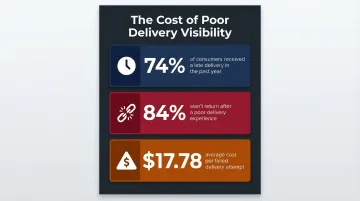
That disconnection has a measurable cost. Failed last-mile deliveries average $17.78 per attempt, with industry failure rates ranging from 8% to 20%. Meanwhile, 60-80% of inbound customer service calls are "Where Is My Order" inquiries — problems that largely disappear when tracking and dispatch systems share data.
The operational toll compounds from there. Dispatchers spend up to 70% of their time resolving issues caused by blind handoffs and siloed tools — time that could go toward higher-value coordination instead.
This guide explains what real-time fleet tracking with dispatch integration actually means, how the two systems work together to eliminate these problems, the features and benefits that matter most, and how to evaluate the right solution for your operation.
Key Takeaways:
- Integrated tracking and dispatch creates a live data loop — location triggers automatic job reassignment, rerouting, and customer alerts
- Dynamic routing cuts fuel costs by 20-25% and lifts on-time delivery from 68% to 93%
- Integrated systems reduce dispatcher workload by up to 70% and lower failed delivery rates
- Prioritize sub-second route optimization, 50+ constraint support, and native telematics integration
- Choose per-vehicle pricing models over unpredictable per-API-call billing
What Is Real-Time Fleet Tracking with Dispatch Integration?
Real-time fleet tracking uses GPS or telematics hardware to continuously report vehicle location, speed, heading, and status. The "real-time" distinction matters: active GPS trackers transmit location data every 1-2 seconds (Samsara and Motive both update at this frequency), while passive tracking systems record data in batches and require manual downloads when vehicles return to base.
Dispatch integration connects this tracking layer to your dispatch system so that live vehicle data—location, availability, ETA—feeds directly into job assignment, routing, and scheduling decisions. No manual lookups. No phone calls. No toggling between screens.
Why integration matters beyond dots on a map:
True integration means the dispatch system acts on tracking data automatically, without dispatcher intervention. That looks like:
- A delayed vehicle triggers automatic reassignment to the nearest available driver
- An early stop completion surfaces the next priority task immediately
- A traffic spike on a planned route recalculates ETAs for every downstream customer in real time
The two-layer technical architecture:
- Hardware and connectivity: GPS trackers from providers like Samsara, Geotab, and Motive transmit location and status updates via cellular or IoT networks
- Optimization and dispatch software: The dispatch platform, route optimization engine, and APIs connect both sides. NextBillion.ai's Route Optimization API fits into this layer, supporting 50+ hard and soft constraints with sub-second response times. Dispatchers can layer intelligent routing onto existing telematics setups without replacing working infrastructure.
How Real-Time Tracking and Dispatch Work Together
The Continuous Data Loop
Vehicle sends location + status updates → dispatch system ingests live data → route optimization engine recalculates optimal assignments or ETAs → dispatcher sees actionable insight or system auto-triggers a change.
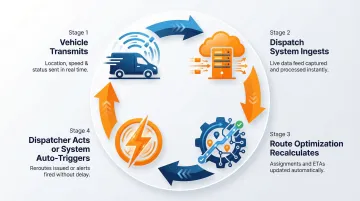
This loop repeats every few seconds. When Pacific Coast Delivery implemented automated dispatch using this model, on-time delivery rates jumped from 77% to 94%, and daily driver idle time dropped from 45 minutes to 10 minutes within 60 days.
Event-Driven Dispatch Triggers
Tracking events automatically prompt the dispatch system to take action:
- Vehicle stopped unexpectedly: System checks for breakdown or traffic incident, alerts dispatcher, recalculates ETAs for remaining stops
- Job completed early: System surfaces next priority task or reassigns driver to urgent order
- Traffic spike detected: System reroutes affected vehicles and updates customer notifications
Denton County Transportation Authority used real-time data engines to increase on-time performance by 18.6% and reduce early departures by 55% through these automated triggers.
Dynamic Rerouting in Practice
When a driver falls behind schedule, integrated systems recalculate the remaining route in real time, update downstream ETAs, and notify affected customers automatically. UPS ORION's dynamic routing system saves approximately 100 million miles and 10 million gallons of fuel annually by continuously recalculating optimal routes based on real-time conditions.
NextBillion.ai's platform monitors on-ground conditions like traffic and weather, automatically adjusting routes in real time to prevent delays and match expected ETAs. Routes remain flexible to accommodate late order reprioritizations and real-world variables.
Bi-Directional Communication Flow
Tracking data flows into dispatch. Dispatch instructions—new job, reroute, priority change—flow back to the driver via mobile app. This closed loop eliminates phone-tag between dispatchers and drivers.
Proactive delivery notifications enabled by this bi-directional flow reduce inbound customer calls by 34%, freeing dispatcher capacity for exception handling.
API Connectivity as the Foundation
An API-first approach enables fleet tracking hardware to feed data directly into route optimization and dispatch engines. NextBillion.ai integrates with leading telematics providers through REST APIs and webhooks, including:
- Samsara:
/fleet/vehicles/stats/feedendpoint for near real-time location polling - Geotab: MyGeotab SDK and Data Feed API for accessing LogRecords (GPS and speed)
- Motive: Open API endpoints for Vehicles, Locations, and Webhooks
Open integrations are critical for operations that already have telematics infrastructure in place. Ride Care's integration with Samsara eliminated manual route entry, reducing route planning time from half a night to just 2 hours.
Must-Have Features in a Fleet Tracking and Dispatch System
Live Vehicle Tracking with Configurable Update Frequency
Tracking intervals directly impact dispatch decisions. A system pinging every 30 seconds versus every 5 minutes produces meaningfully different outcomes:
- Last-mile/urban delivery: Requires sub-minute or 1-second updates for real-time decision-making, dynamic rerouting, and accurate customer ETAs
- Long-haul trucking: 1-2 minute intervals typically sufficient
- Unpowered assets/trailers: Battery-powered trackers check in every 8-24 hours to balance visibility with battery life
Samsara collects location data every second for continuous visibility. Geotab uses patented curve-logic that logs new points upon significant speed/position changes or every 100 seconds.
Intelligent Route Optimization Engine
Basic routing tools calculate A-to-B directions. Advanced route optimization handles multi-stop sequencing with real-world constraints:
- Vehicle type, load capacity, cargo restrictions
- Delivery time windows and service times
- Driver hours and HOS compliance
- Road restrictions (weight, height, hazmat)
- Traffic patterns and real-time conditions
Real-world impact: Dynamic, traffic-aware routing improved on-time delivery rates from 68.1% to 92.8% in urban last-mile operations, while reducing total operational costs by 24.3% and cutting congestion exposure by 54.4%.
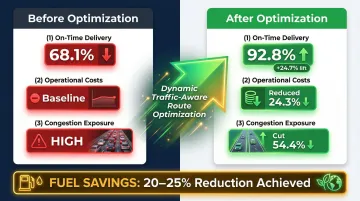
NextBillion.ai's Route Optimization API supports 50+ hard and soft constraints with sub-second response times, enabling dispatchers to make instant rerouting decisions at scale without waiting for batch calculations. The platform's Distance Matrix API handles matrices up to 5,000×5,000 (compared to some providers' 25×25 limitations), critical for operations managing hundreds of stops across multiple depots.
Automated Dispatch and Job Assignment
The system should auto-assign incoming jobs based on:
- Proximity to pickup/delivery location
- Vehicle capacity and equipment requirements
- Driver availability and skill certifications
- Current route efficiency and time windows
Fleets using AI dispatch software report up to 70% reduction in manual scheduling time. Automation minimizes data entry errors and improves assignment accuracy.
Driver Mobile App with Two-Way Communication
Essential field-facing functionality:
- Receiving job updates and route changes
- Turn-by-turn navigation optimized for vehicle type
- Proof of delivery capture (photo, signature, notes)
- Status updates (en route, on-site, complete)
- Exception reporting (unable to deliver, customer not available)
This data feeds back into the tracking and dispatch loop, keeping the office informed without phone calls.
Customer-Facing ETA Notifications and Tracking
Automated, real-time ETA updates triggered by actual vehicle position (not estimated schedules) reduce inbound customer calls and improve satisfaction scores. Last-mile and field service operations benefit most, where customers now expect live delivery visibility as a baseline, not a differentiator.
74% of consumers experienced a package arriving later than estimated in the past year, and 84% won't return to a brand after a poor delivery experience. Accurate, proactive ETAs directly address this expectation gap.
Analytics and Reporting Dashboard
A reporting dashboard gives dispatch and operations teams the data to act on what's actually happening across the fleet:
- Fleet utilization rates and vehicle idle time
- On-time delivery performance and SLA compliance
- Route adherence and deviation analysis
- Driver safety metrics and HOS compliance
- Fuel consumption and cost per mile/delivery
Over time, this data exposes where the operation is losing time and money: routes that consistently run long, assets sitting idle between jobs, or drivers deviating from planned paths. Those are the levers dispatchers can pull to cut costs without adding headcount.
Key Business Benefits of Integrated Fleet Tracking and Dispatch
Reduced Operational Costs
Combined tracking and dispatch directly reduces expenses:
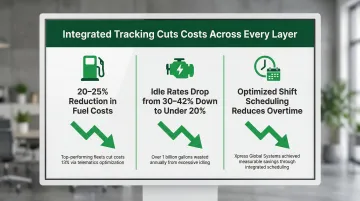
- Route optimization cuts fuel costs by 20-25% through reduced mileage and traffic avoidance — top-performing fleets using telematics insights have trimmed fuel consumption by 13%.
- Heavy-duty trucks burn 0.8-1 gallon per hour while idling. Rest-period truck idling consumes up to 1 billion gallons annually, costing $3 billion. Telematics drops fleet idle rates from 30-42% to under 20%.
- Smarter scheduling and realistic time windows reduce driver overtime. Xpress Global Systems cut overtime by optimizing routes and driver schedules around shift timing constraints.
Faster Exception Handling and Fewer Failed Deliveries
Connected systems flag delays, vehicle breakdowns, and missed stops in real time — giving dispatchers the window to intervene before a delivery fails. At $17.78 per failed attempt, that early visibility protects both revenue and customer relationships.
Proactive reassignment when delays emerge is the difference between a missed stop and a completed delivery. Disconnected tools don't offer that option.
Improved Driver Safety and Compliance
Live tracking supports safer operations:
- Monitoring driving behavior (speeding, harsh braking, rapid acceleration)
- Ensuring HOS compliance with automated logbook validation
- Routing drivers away from hazardous weather or road conditions
- Identifying patterns that indicate fatigue or risky driving
Organizations using video-based safety and telematics reported an average 29% reduction in accidents, cutting net insurance premium costs by 2%. FMCSA fines for non-recordkeeping HOS violations reach up to $19,246 per offense — automated compliance eliminates that exposure.
How to Choose the Right Fleet Tracking and Dispatch Solution
Evaluate Integration Compatibility with Your Existing Telematics Stack
Prioritize solutions with pre-built connectors or open APIs that work with your current GPS hardware (Samsara, Geotab, Motive) to avoid ripping and replacing working infrastructure.
NextBillion.ai's platform integrates natively with leading telematics providers through REST APIs and webhooks, letting you add route optimization and dispatch logic on top of existing hardware without a forklift migration. Sunderstorm Inc's VP of Technology credited the platform for its "seamless integration with our Samsara telematics and ERP systems."
When evaluating any solution, Gartner recommends assessing:
- Safety analytics depth (harsh event detection, in-cab coaching)
- Compliance modules (ELD, HOS, DVIR)
- Open APIs for TMS integration
- Scalability to electric vehicles
Assess Scalability and Constraint Support for Your Fleet Type
Fleets with specialized needs require systems that can model their actual operating constraints:
- Truck routing: Weight/height/clearance restrictions, hazmat routing, bridge limitations
- NEMT scheduling: Appointment windows, ADA-accessible vehicle requirements, passenger compatibility rules
- Multi-depot last-mile: Territory management, vehicle capacity, service time windows, driver skill matching
Generic A-to-B routing fails when your operation has 20+ constraints governing every dispatch decision. NextBillion.ai's Route Optimization API handles specialized parameters including vehicle capacity management, driver skill assignment, NEMT-specific constraints, and max drive time enforcement for HOS compliance.
Consider Total Cost of Ownership Beyond Per-API-Call Pricing
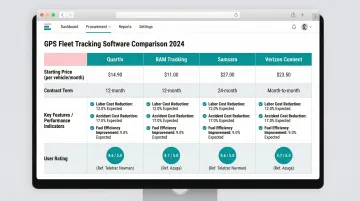
Some routing and tracking platforms charge per API call, which becomes unpredictable at scale. A fleet making 800,000 distance matrix calls monthly can face escalating costs as volume grows.
Look for per-vehicle or per-order pricing models that scale predictably with fleet size:
| Vendor | Monthly Cost (Per Vehicle) | Contract Terms |
|---|---|---|
| Samsara | $27-$50 | 3-5 year contracts |
| Motive | $25-$50 | 1-3 year contracts |
| Geotab | $10-$25 | 1-3 year contracts |
TCO components to evaluate:
- Acquisition/hardware costs (GPS devices, dash cams, asset tags)
- Subscription fees (software access, cellular data, support)
- Installation and training expenses
- Downtime costs during implementation
Fleets expect 3:1 to 6:1 ROI within the first 12 months. GOIN achieved 40% cost reduction by switching to NextBillion.ai's transparent, standardized pricing, now processing nearly 2 million API calls monthly.
Frequently Asked Questions
How does fleet tracking integrate with dispatch software?
Integration happens via APIs or native connectors that pass real-time vehicle location and status data into the dispatch system. This enables automated job assignment, rerouting, and ETA updates without manual data transfer between field operations and the dispatch office.
What tracking system can track in real time?
GPS telematics-based systems from providers like Samsara, Geotab, and Motive provide true real-time tracking with update intervals as frequent as every 1-2 seconds. Active GPS trackers continuously transmit location data, unlike passive trackers that store data for later download.
How much does fleet tracking software cost?
Pricing varies widely. Basic GPS tracking starts at $10-$25 per vehicle/month, while enterprise platforms with route optimization and dispatch integration range from $27-$50 per vehicle/month. Some providers offer fixed monthly fees instead of per-API-call charges; contract terms typically span 1-5 years, with hardware devices billed separately.
What is the best fleet tracking system?
The right system depends on fleet size, industry, and integration needs. Fleets requiring route optimization alongside tracking should look for platforms that combine telematics integration with a routing engine supporting time windows, vehicle restrictions, and driver compliance—not standalone GPS tools that only provide location visibility.
What is the difference between fleet tracking and fleet management?
Fleet tracking refers specifically to monitoring vehicle locations in real time using GPS technology. Fleet management is a broader category encompassing tracking plus dispatch, maintenance scheduling, compliance management, driver management, fuel monitoring, and analytics—essentially all systems required to operate a fleet efficiently.
Can real-time fleet tracking reduce fuel costs?
Yes. Real-time tracking with dispatch integration reduces fuel costs through smarter routing, less idle time, and reduced unauthorized vehicle use. Smart route optimization cuts fuel costs by 20-25% through reduced mileage and traffic avoidance, while top-performing fleets using telematics insights have cut fuel consumption by 13%.