What is the best route planner for trucks?
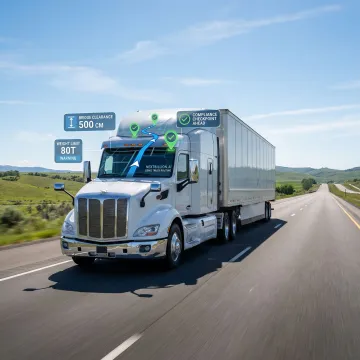
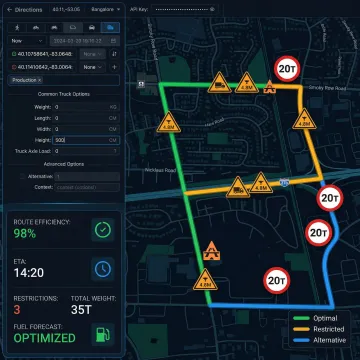
The best truck route planner accounts for vehicle-specific constraints—height, weight, axle load, cargo type, and HGV road restrictions—rather than applying car routing to all vehicles. NextBillion.ai's platform offers truck-native routing through its Directions API, Navigation API, and Route Optimization API, all of which accept vehicle dimension inputs and enforce compliance with bridge clearances, weight limits, and truck-prohibited roads.
How does heavy vehicle route assessment differ from standard route planning?
Heavy vehicle route assessment evaluates roads against truck-specific parameters: bridge weight ratings, vertical clearances, axle load limits, sharp turn feasibility, and vehicle class restrictions. Standard route planners ignore these factors entirely. NextBillion.ai's APIs take your vehicle's exact dimensions and cargo classification as inputs and generate routes that comply with the regulatory and physical constraints your specific vehicle faces on the road network.
Can I define custom road restrictions for my specific fleet?
Yes. The Road Editor App lets operations teams apply custom road attributes—speed overrides, no-entry zones, safe parking locations, plying permissions, theft-prone corridor avoidance—scoped by vehicle type, time of day, and day of week. These edits feed directly into all route calculations without any engineering work, ensuring routing reflects your fleet's actual operational environment.
Does NextBillion.ai support hazardous materials routing for heavy vehicles?
Yes. The Directions API and Navigation API both support hazardous materials cargo classification as a vehicle parameter. Routes generated for hazmat-carrying vehicles automatically avoid roads where such cargo is restricted under applicable transportation regulations, ensuring compliance without requiring manual route verification for every trip.
What vehicle dimension parameters can I specify for route calculations?
You can specify vehicle height, width, length, gross weight, and axle load. The routing engine uses these dimensions to exclude roads with insufficient clearance, weight restrictions, or length limitations. This applies across the Directions API, Distance Matrix API, and Navigation API, ensuring every route and ETA calculation reflects the physical reality of your specific vehicle configuration.
How does NextBillion.ai handle hours-of-service compliance for trucking routes?
The Route Optimization API supports driver shift duration constraints and break requirements as hard optimization parameters, ensuring generated routes respect HOS limits. The Route Reconstruction API produces time-stamped, road-snapped trip records from GPS data that serve as legally defensible compliance documentation for HOS audits, inspection requirements, and regulatory reporting for commercial trucking operations.
Can the platform handle large fleet routing across many vehicles simultaneously?
Yes. The Distance Matrix API supports matrices up to 5,000×5,000 origin-destination pairs in a single call, and the Route Optimization API handles large multi-vehicle, multi-stop planning problems with 50+ constraint types. The platform is built for high-throughput production environments and has been used to optimize over 10.9 million deliveries and tasks globally.
What pricing model does NextBillion.ai use for its heavy vehicle routing APIs?
NextBillion.ai offers per-vehicle and per-order pricing alternatives to the per-API-call model used by most providers. This means re-optimization cycles, seasonal demand spikes, and large matrix calculations don't translate into unpredictable cost overruns. Monthly costs align to your fleet size or throughput, not the underlying computational activity of the routing engine.