Introduction
A routing engine that works flawlessly at 9 AM needs to perform just as reliably at 2 AM during a demand surge. Logistics, food delivery, NEMT, and field services don't pause—and neither can the software running them.
The scale of these operations is growing fast. The Non-Emergency Medical Transportation market alone is projected to reach $12.77 billion by 2026, with 3 to 4 million Medicaid beneficiaries requiring continuous scheduling support. The North American same-day delivery market is forecasted to grow from $10.94 billion in 2025 to $15.47 billion by 2031.
Choosing route optimization software for 24/7 operations is fundamentally different from selecting a tool for planned, daytime routes. Uptime becomes a high-stakes concern: high-impact IT outages cost enterprises an average of $1.8M to $2M per hour. Real-time re-routing, API reliability under load, and round-the-clock vendor support become non-negotiable.
This guide covers a curated list of the best route optimization platforms evaluated specifically on their ability to support continuous, high-volume operations—plus a framework for making the right choice.
TLDR
- Route optimization for 24/7 operations requires sub-second API response, guaranteed uptime, real-time re-routing, and round-the-clock vendor support
- Leading platforms pair constraint-aware optimization engines with infrastructure designed for continuous, high-load performance
- Selection criteria include pricing model fit, integration with fleet systems, and deployment flexibility
- Shortlist: NextBillion.ai, Onfleet, Samsara, Route4Me, and DispatchTrack
What Makes Route Optimization Different for 24/7 Operations?
Continuous operations introduce routing challenges that standard daytime planning tools simply aren't built to handle.
Unique Pressures of 24/7 Operations
Operating around the clock introduces operational complexity that planned daytime workflows don't face:
- Demand spikes at off-hours: On-demand delivery platforms consistently show peak volumes between 5:00 PM and 7:00 PM. Late-night workplace orders are heavily concentrated in dense metros — the Bay Area (24%), Manhattan (23%), and Chicago (20%) lead after 6:00 PM.
- Driver shift handoffs mid-route: Routes must accommodate shift changes without service disruption
- Real-time order injection: No morning "planning window" exists to batch-process routes
- Traffic uncertainty: Research demonstrates that integrating dynamic, congestion-penalized cost functions can increase on-time delivery rates from 68.1% to 92.8% under traffic uncertainty
- Zero tolerance for downtime: When routes fail at 3 AM, the business cost is immediate
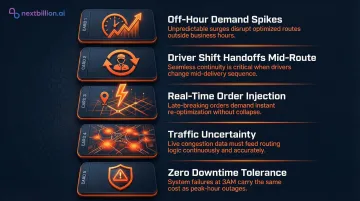
The platforms listed below were selected for their proven ability to support continuous, high-frequency routing operations across all hours — not just standard business-day workflows.
Best Route Optimization Software for 24/7 Operations
These platforms were evaluated on reliability, real-time routing capability, constraint depth, API performance, support model, and fit for continuous operations. Each entry below covers what the platform does well, where it has limits, and which operational profiles it suits best—so you can match the right tool to your specific requirements.
NextBillion.ai
An API-first route optimization and mapping platform founded in 2020 and built by veterans of Grab's geo team. NextBillion.ai is designed specifically for enterprises running high-frequency, complex routing operations across logistics, NEMT, food delivery, field service, and ride-hailing.
Why it stands out for 24/7 operations:
- Sub-second routing response times with API support for 100 queries per second
- 50+ hard and soft constraints including time windows, vehicle type, driver skills, shift timings, and load limits
- Predictable fixed-fee pricing (per-vehicle or per-order) that doesn't penalize high API call volumes
- 24x7 hands-on support from solution engineers
- Seamless integrations with Samsara, Geotab, and Motive—critical for fleets already running telematics
- Proven uptime reliability across 100+ enterprise deployments globally
- Optimized 10.9M+ deliveries and navigated 557M+ miles globally
- Delivered $11M+ in cost savings to customers
| Attribute | Details |
|---|---|
| Key Features | 50+ routing constraints, large distance matrix computation (up to 5,000×5,000), truck-compliant routing, real-time re-routing, custom map editing, on-premise/cloud deployment |
| Best For | Enterprises and platform builders needing API-grade route optimization at scale—logistics, NEMT, last-mile, field service, ride-sharing |
| Pricing Model | Fixed-fee monthly pricing (per-vehicle or per-order)—no per-API-call charges; cloud-agnostic and on-premise options available |
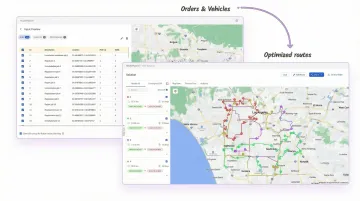
Where NextBillion.ai focuses on API-layer routing depth, Onfleet packages optimization with end-to-end delivery execution tools—making it a strong fit for teams that manage both dispatch and customer experience from one platform.
Onfleet
A last-mile delivery management platform with a strong track record in high-volume, on-demand courier operations. Onfleet is widely used by pharmacy, cannabis, grocery, and specialty food delivery teams running continuous dispatch. Forbes reported that Onfleet doubled its revenue in 2020, driven largely by cannabis and alcohol deliveries, which saw a 300% increase.
Differentiators:
- AI-powered route optimization with real-time ETA drift detection
- Top-rated driver app (4.8 on Apple App Store, 4.7 on Google Play)
- Branded customer tracking and multi-factor proof of delivery (photo, signature, barcode)
- Strong support for multi-depot operations
- Native compliance features including ID scanning and age verification for regulated deliveries
Onfleet's official Service Level Agreement warrants 99% monthly uptime with a 5% service credit per hour of downtime—significantly lower than enterprise-grade SLAs.
| Attribute | Details |
|---|---|
| Key Features | AI route optimization, real-time traffic + ETA updates, driver app, branded tracking, proof of delivery (photo, signature, barcode), SMS/email notifications |
| Best For | High-volume on-demand courier, pharmacy, cannabis, and grocery delivery teams needing dispatch + customer experience tools in one platform |
| Pricing Model | Task-based pricing; plans start at $619/month for 2,500 tasks—scales with delivery volume |
For fleets where safety compliance and hardware integration are as critical as routing, Samsara takes a different approach—anchoring route optimization inside a broader telematics and fleet management platform.
Samsara
A leading fleet management and telematics platform with route optimization capabilities built in. Samsara is particularly strong for commercial fleets that need routing tightly coupled with real-time GPS tracking, driver safety monitoring, and ELD compliance. The platform offers a robust 99.99% uptime SLA with 24/7/365 multi-lingual support.
Important limitation: Samsara's native route optimization is limited to 20 stops per route, with the dashboard slowing down for routes exceeding 80-100 stops. To address this, Samsara natively integrates with NextBillion.ai for complex multi-vehicle routing scenarios, expanding capacity to 2,000 locations directly within the Samsara dashboard.
| Attribute | Details |
|---|---|
| Key Features | Real-time GPS tracking, route progress monitoring, driver safety scoring, ELD compliance, telematics integration, 20-stop route optimization native (expandable to 2,000 via NextBillion.ai integration) |
| Best For | Commercial fleets prioritizing safety, compliance, and real-time visibility alongside route tracking—strong for regulated trucking and field operations |
| Pricing Model | Custom enterprise pricing; hardware + software subscription model (typically 3-5 year non-cancelable contracts) |
Route4Me suits a different profile: operations teams that need fine-grained control over routing rules across territories, rather than API-scale throughput or telematics integration.
Route4Me
One of the original multi-stop route optimization platforms, offering a highly modular, add-on-driven architecture. Route4Me allows operations teams to configure routing logic for specific use cases—curbside pickup, left-turn avoidance, time-window allocation, territory management, and multi-depot dispatch.
Why it suits 24/7 use cases requiring granular control:
- Supports unlimited stops and multi-fleet routing
- Real-time tracking with comprehensive API
- Add-on marketplace for territory-based planning
- Predictive ETA modeling
Known limitations: Essential enterprise features—including Time Windows, Text Message Notifications, and Commercial Truck Routing—are gated as paid add-ons, requiring careful Total Cost of Ownership evaluation. Third-party reviews note concerns about ETA accuracy and navigation precision.
| Attribute | Details |
|---|---|
| Key Features | Add-on marketplace, territory-based planning, multi-depot support, GPS driver tracking, predictive ETA modeling, comprehensive API |
| Best For | Operations needing granular routing rule customization across territories—franchise models, service-zone operations, and mixed fleet scenarios |
| Pricing Model | Starts at $9.99/month for mobile-only plans; team plans and add-ons (time windows, notifications) priced separately |
DispatchTrack addresses a distinct operational challenge: commercial fleets where appointment precision and white-glove delivery execution—not just routing throughput—determine customer satisfaction.
DispatchTrack
An enterprise route optimization and delivery execution platform built for last-mile commercial fleets. DispatchTrack is particularly strong in furniture, appliance, building materials, and food and beverage distribution where tight time windows, installation tasks, and customer appointment scheduling are central.
Differentiators:
- 98% ETA accuracy through AI-based dynamic routing
- Hybrid routing model blending static skeleton routes with dynamic optimization
- 50%+ reduction in time spent routing documented across customer case studies
- Real-time tracking, proof of delivery, and customer self-scheduling
- Strong telematics integration for white-glove delivery operations
| Attribute | Details |
|---|---|
| Key Features | AI-based ETA accuracy (98%), dynamic + static routing, real-time tracking, proof of delivery, customer self-scheduling, telematics integration |
| Best For | Commercial truck fleets, heavy/white-glove delivery, food distribution—where time-window precision and customer communication are critical |
| Pricing Model | Custom enterprise pricing; SaaS-based, contact for quote |
How We Chose the Best Route Optimization Software for 24/7 Operations
Each platform was assessed on its ability to sustain performance in continuous, high-frequency environments—not just on feature checklists.
The most common buyer mistake: evaluating tools only under daytime conditions. Most teams never stress-test API behavior under sustained load, verify after-hours support responsiveness, or review uptime SLAs before signing a contract.
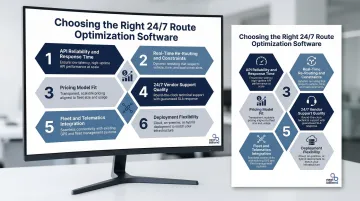
Core Evaluation Criteria
1. API Reliability and Response Time Under Load
In digital commerce and logistics, a 100ms increase in API latency correlates with a 1% loss in sales. For 24/7 operations, routing engines must handle sustained query volumes without degradation. Each platform was scored on rate limits, response time benchmarks, and published uptime SLAs.
2. Real-Time Re-Routing and Dynamic Constraint Handling
Static routes planned at 6 AM fail by 2 PM when traffic patterns shift or new orders arrive. Dynamic Vehicle Routing Problems (DVRPs) require real-time adjustments to time-dependent delivery plans. The ability to handle 50+ constraints—including shift timings, time windows, vehicle type, and load limits—determines whether a platform can adapt to continuous operational changes.
3. Pricing Model Fit for Continuous High-Volume Usage
Per-API-call pricing becomes prohibitively expensive at scale. A fleet making 100 routing requests per second (typical for continuous dispatch) can generate millions of API calls monthly. Fixed-fee or per-vehicle pricing models provide the cost predictability essential for 24/7 budgeting.
4. 24/7 Vendor Support Quality
When routing fails at 3 AM, email-only support is inadequate. Support quality was scored on availability windows, response time SLAs, and whether after-hours assistance comes from solution engineers or a generic help desk.
5. Integration Depth with Fleet/Telematics Systems
Native integrations with platforms like Samsara, Geotab, and Motive eliminate gaps between route planning and fleet tracking, enabling real-time synchronization between route planning and fleet tracking.
6. Deployment Flexibility (Cloud vs. On-Premise)
Regulated industries (healthcare, government) and enterprises with data sovereignty requirements need on-premise deployment options with predictable latency and protection from third-party outages.
Operational Maturity Matters
Platforms with proven deployment at scale—measurable deliveries optimized, miles navigated, and documented customer cost savings—were weighted more heavily than those with strong marketing but limited real-world reference data.
Conclusion
For 24/7 operations, the right route optimization software isn't the one with the most features on a spec sheet—it's the one that stays reliable, responsive, and supported when your operation is running at 3 AM on its highest-volume day.
Evaluate vendors on:
- Uptime track record (look for 99.99% SLAs, not 99%)
- Pricing model sustainability at high call volumes
- Real-time re-routing depth with 50+ constraint support
- Quality of post-sale support (response times, not just availability claims)
Don't just assess demo performance—request load testing data, reference customers with similar operational profiles, and verify after-hours support responsiveness through trial periods.
If those criteria matter to your team, NextBillion.ai is worth a closer look. Fixed-fee pricing, 50+ routing constraints, and 24/7 engineer support are built into the platform—not offered as add-ons. Book a demo or contact the team to discuss your specific routing requirements.
Frequently Asked Questions
What features should I look for in route optimization software for 24/7 operations?
Prioritize always-on API reliability with sub-second response times, real-time re-routing capabilities, 24/7 vendor support with documented SLAs, flexible pricing for continuous high-volume usage (fixed-fee vs. per-call), and native integration with existing fleet and telematics systems. Uptime guarantees of 99.99% are essential—99% SLAs allow over 7 hours of downtime monthly.
Which algorithm is widely used for route optimization?
Most commercial platforms use variants of the Vehicle Routing Problem (VRP) solver, combining classical heuristics (Clarke-Wright savings algorithm) with metaheuristics like Tabu Search, Simulated Annealing, and Genetic Algorithms. Modern solvers add machine learning on top to handle real-world constraints like traffic patterns and time windows.
Can ChatGPT optimize routes?
No. ChatGPT is a generative language model, not a routing engine. It lacks access to real-time traffic data, geographic distance matrices, and VRP solvers needed for true multi-stop optimization. LLMs suffer from mathematical hallucinations, run-to-run non-determinism, and context window limits that make them unsuitable for production logistics use.
What is the difference between route planning and route optimization?
Route planning assigns stops to drivers in a logical order based on manual judgment or simple rules. Route optimization uses algorithms to evaluate thousands of possible sequences and select the most efficient one given real-world constraints (traffic, time windows, vehicle capacity, driver skills)—reducing miles driven and improving on-time performance.
How does API-based route optimization work for continuous dispatch operations?
API-based route optimization lets dispatch systems call a routing engine in real time, submitting new orders, updated constraints, or re-routing requests and receiving optimized responses in milliseconds. This enables continuous, event-driven logistics without manual replanning, which is essential for 24/7 operations handling live order injection and traffic changes.
Is on-premise route optimization software better than cloud for 24/7 operations?
Cloud solutions offer easier scalability and lower maintenance overhead. On-premise deployment (supported by platforms like NextBillion.ai) gives enterprises data sovereignty, predictable latency, and protection from third-party outages. The right choice depends on your data compliance requirements (HIPAA, government contracts) and how much reliance on external uptime your operations can tolerate.