Introduction
A logistics manager at a regional courier service faces a critical decision: the company's fleet has grown from 15 to 50 drivers in 18 months, route optimization API costs have ballooned by 250%, and the operations team needs sub-second route recalculations to handle real-time pickups. Should they deploy a cloud-based route optimization platform for instant scalability and remote access—or bring the entire routing engine on-premise to control costs and keep sensitive customer delivery data within their own infrastructure?
This decision carries unique stakes for sales route planning. Unlike generic business software, route optimization systems process thousands of API calls daily, handle Protected Health Information for NEMT providers, and must deliver real-time responses while drivers wait at stops. Dynamic routing reduces operational costs by 24.3% and pushes on-time delivery rates from 68% to 93%—but only if the deployment model matches your fleet's operational reality.
TL;DR
- Cloud route planning delivers rapid deployment, elastic scaling, and anywhere access: best for growing fleets and multi-location operations with seasonal surges
- On-premise deployment gives full data control, predictable long-term costs, and deep customization for compliance-driven or high-volume fleets
- The right choice hinges on five factors: fleet size volatility, data residency requirements, integration depth, cost model preference (OpEx vs. CapEx), and connectivity reliability in operating areas
- Hybrid deployments are gaining ground: on-premise optimization engines paired with cloud-based driver apps and live traffic feeds balance control with mobile accessibility
Cloud vs On-Premise Sales Route Planning: Quick Comparison
| Dimension | Cloud-Based Route Planning | On-Premise Route Planning |
|---|---|---|
| Deployment Speed | Hours to days—API integration only | Weeks to months—infrastructure setup, Kubernetes configuration |
| Cost Model | OpEx: Monthly subscription or per-vehicle/per-order pricing | CapEx: $140K–$345K 5-year TCO (hardware, licenses, maintenance) |
| Scalability | Elastic—scales automatically for seasonal surges | Fixed capacity—requires hardware provisioning for peak demand |
| Data Control | Data passes through vendor cloud infrastructure | All route, customer, and fleet data stays on internal servers |
| Real-Time Updates | Automatic map and traffic updates included | Requires external traffic feed integration and manual maintenance |
| Customization | Limited to vendor API constraints and parameters | Full control—modify routing logic, add proprietary road attributes |
| Connectivity Dependency | Requires internet for optimization calls and driver apps | Can operate with offline route access and edge deployments |
Cloud route planning means the optimization engine, map data, and routing algorithms run on vendor-managed infrastructure (AWS, Azure, or dedicated routing APIs). Dispatchers and drivers access the system over the internet via web dashboards and mobile apps.
On-premise route planning means the optimization engine, algorithms, and map data are deployed on your organization's own servers or private cloud infrastructure—often containerized with Kubernetes. Your IT team controls compute, data, and routing logic entirely.
Cloud platforms typically bill per API call (which scales unpredictably with volume), per completed task, or per vehicle. Common examples:
- Google Maps Platform: $10–$30 per 1,000 shipments
- Onfleet: $619/month, includes 2,500 tasks
- Routific: $150/month for up to 1,000 orders
On-premise involves upfront costs: $15K–$40K for hardware, $75K–$150K for software licenses, plus $35K–$105K in IT support over 5 years—but long-term cost per optimization call can be considerably lower for high-volume operations.
What is Cloud-Based Sales Route Planning?
Cloud-based route planning hosts the optimization engine, map data, and routing algorithms on vendor-managed infrastructure (typically AWS, Azure, or a dedicated routing API). Dispatchers access route planning through web dashboards, while drivers receive optimized routes directly to mobile apps—all synchronized in real time over the internet.
Operational Benefits for Logistics
Cloud-hosted systems give distributed teams capabilities that on-premise setups struggle to match:
- Dispatch from anywhere: Planners access the system from headquarters, home offices, or regional hubs — no VPN required. Drivers get turn-by-turn navigation on their smartphones, replacing paper manifests.
- Instant route updates: When a dispatcher adds a last-minute pickup or a driver marks a delivery complete, the system recalculates and pushes updates to all affected vehicles — critical for same-day and on-demand services.
- Zero infrastructure upkeep: Map tiles, traffic feeds, and software patches update automatically. No servers to maintain, no database backups to manage.
Elastic Scaling for Seasonal Demand
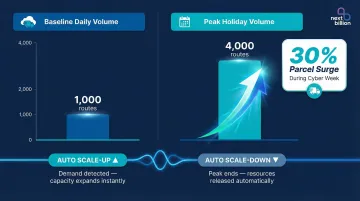
Logistics networks face sharp seasonal swings — during Cyber Week, parcel volumes surge 30% above baseline. Cloud platforms handle this through rapid elasticity: fleets processing 1,000 routes daily can scale to 4,000 during holiday peaks without provisioning new hardware. When demand drops, capacity scales down automatically.
Google Cloud Fleet Routing allows up to 20 route re-optimizations per day without additional costs — essential for responding to traffic congestion or ad hoc requests. Brazilian retailer Magalu uses cloud routing to optimize 2.1 million shipments monthly, calculating multiple pickups and deliveries in seconds.
API Pricing Risk
Scaling benefits come with a pricing caveat. Most cloud route optimization providers charge per API call or per geocoding request, and as delivery volume grows, bills can spiral fast. A fleet making 500 optimization calls daily pays for 15,000 API calls monthly — potentially thousands of dollars at typical cloud pricing.
NextBillion.ai's route optimization API uses per-vehicle or per-order pricing instead of per-call billing, capping costs regardless of how often routes are recalculated. Tipplr reduced API costs by 60% after switching from a per-call model.
Use Cases of Cloud-Based Route Planning
Best fit for:
- Last-mile delivery platforms needing live ETAs and real-time rerouting
- On-demand field service teams (HVAC, pest control) with fluctuating daily workloads
- Food and grocery delivery operations requiring 30-minute delivery windows
- NEMT providers coordinating rides across multiple counties with distributed dispatch
- Multi-city field sales operations where remote dispatchers need centralized visibility
Industries where cloud dominates:
The cloud logistics market reached $24.93 billion in 2025 and is projected to hit $81.73 billion by 2034 (14.1% CAGR). Retail and e-commerce hold 34% market share, driven by high order volumes, fast fulfillment cycles, and omnichannel distribution demands.
Gig-economy delivery models (DoorDash, Zepto) rely exclusively on cloud routing to coordinate thousands of independent drivers simultaneously. That flexibility makes cloud the default choice for any operation where demand is unpredictable and downtime is not an option — which is exactly where on-premise deployments tell a different story.
What is On-Premise Sales Route Planning?
On-premise route planning deploys the optimization engine, routing algorithms, and map data on your organization's own servers or private cloud infrastructure—often containerized with Kubernetes. Your IT team controls compute resources, data storage, and routing logic entirely within internal systems.
The Operational Case for On-Prem
Data residency and compliance: Organizations handling sensitive delivery data—pharmaceutical distribution, government contracts, financial couriers—may be prohibited from routing customer addresses through third-party cloud APIs. On-premise keeps all delivery data, customer addresses, and fleet telemetry within internal networks.
Under HIPAA, a patient's street address is Protected Health Information (PHI). Cloud service providers processing that data become business associates requiring a signed BAA—a compliance burden many healthcare logistics operators prefer to avoid entirely by keeping routing on-premise.
Performance advantages: On-premise deployments eliminate internet round-trip latency for optimization calls. This matters for real-time dispatching requiring sub-second route recalculation—large fleets processing hundreds of stops simultaneously can't wait 300–500ms for cloud API responses when decisions happen in microseconds.
Cost Model: CapEx vs. OpEx
On-premise involves higher upfront investment but lower long-term per-call costs for steady-state, high-volume fleets.
5-Year Total Cost of Ownership:
- Hardware: $15K–$40K
- Software licenses: $75K–$150K
- IT support & maintenance: $35K–$105K
- Total: $140K–$345K
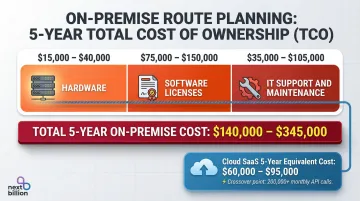
Compare this to cloud SaaS at $60K–$95K over 5 years—but cloud's per-call pricing can exceed on-premise TCO once fleets cross 200,000+ monthly optimization calls. For stable fleets with predictable volume, on-premise offers cost efficiency at scale.
Customization Depth
With on-premise deployment, organizations can:
- Modify routing constraint logic for custom business rules—service area restrictions, driver skill matching, preferred customer time windows
- Integrate proprietary road attributes such as bridge clearances, customer access restrictions, and preferred loading dock locations
- Tune the optimization engine for industry-specific requirements without vendor API limitations
NextBillion.ai's route engine supports 50+ hard and soft constraints, allowing enterprises to configure routes exactly as required—where generic routing APIs fall short of specialized operational needs.
Use Cases of On-Premise Route Planning
Best fit for:
- Enterprise logistics platforms embedding route optimization into their own TMS or fleet management software
- Government fleet operations with FedRAMP or data sovereignty requirements
- Pharmaceutical last-mile distributors routing controlled substances with strict chain-of-custody data rules
- ISVs offering white-label route optimization to their customers
Example scenario: A telematics provider (similar to Geotab or Samsara partners) embeds on-premise route optimization to offer customers a vertically integrated solution. Fleet operators access routing capabilities directly within the telematics dashboard—without routing data leaving their infrastructure or creating separate vendor relationships.
Kubernetes as the Deployment Bridge
Kubernetes has become the de facto standard for container orchestration in production environments. This shared foundation lets complex VRP solvers deploy consistently on-premises or in private clouds. NextBillion.ai's on-premise deployment uses Kubernetes architecture with multiple API Gateways and Route Engines, supporting high-availability traffic management and air-gapped environments for high-security customers.
Cloud vs On-Premise Route Planning: What's Better for Your Operations?
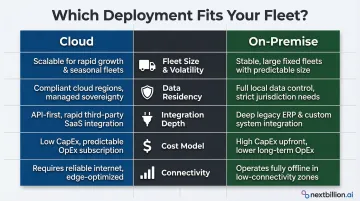
The choice isn't universal—it should be evaluated across five dimensions specific to route planning:
Decision Framework
| Dimension | Choose Cloud | Choose On-Premise |
|---|---|---|
| Fleet Size & Volatility | Seasonal spikes (holiday surges, pest control peaks) or rapid growth (20%+ annual driver adds) | Stable fleet with predictable year-round volume and 200,000+ monthly optimization calls |
| Data Residency | No strict data sovereignty mandates; comfortable with vendor BAAs and security certifications | PHI, government logistics, or controlled substance delivery where routing data cannot pass through third-party systems |
| Integration Depth | Plug-and-play API integration with fleet platforms (Samsara, Geotab) and minimal IT overhead | Building route optimization into your own logistics product or requiring deep customization of routing logic |
| Cost Model | OpEx preferred; low upfront investment; predictable per-vehicle or per-order pricing | CapEx budget available; high volume where per-call pricing becomes unsustainable; 5+ year deployment lifecycle |
| Connectivity | Drivers in urban/suburban areas with reliable LTE/5G coverage | Rural routes with spotty connectivity or offline navigation required |
The Hybrid Path
Many logistics operations land somewhere in the middle. A common hybrid model pairs an on-premise optimization engine for core route calculation (keeping customer addresses internal) with cloud-based driver apps and live traffic feeds for mobile field access.
This approach balances data control with usability: dispatchers work through web dashboards pulling from on-premise servers, while drivers use cloud-connected mobile apps that sync whenever connectivity allows.
Connectivity Reality Check
Drivers in warehouses with poor signal, rural delivery areas, or international routes need offline route access. On-premise or hybrid edge deployments handle this better. Mapbox's TileStore, for example, lets users download map regions ahead of time, enabling turn-by-turn navigation without any HTTP API calls in non-connected environments.
NextBillion.ai's Live Tracking API includes offline tracking mode to maintain accurate location history in low-connectivity areas, ensuring drivers can continue operations without interruption.
Real-World Applications: How Businesses Choose Their Route Planning Deployment
Scenario 1: ISV Evaluating Cloud vs. On-Premise at Scale
A logistics software company serving 150+ enterprise clients needs to offer route optimization as a core feature. Their evaluation:
- Cloud API with per-call pricing: Initially attractive for speed-to-market, but projections show costs becoming unsustainable once clients collectively make 500K+ optimization calls monthly
- On-premise embedded deployment: Higher upfront development effort, but reduces total cost and improves product control, with no dependency on external API availability or pricing changes
Outcome: The ISV partners with NextBillion.ai for on-premise Kubernetes deployment, embedding the route engine directly into their TMS. Clients get white-label route optimization without data leaving their infrastructure, and the ISV avoids recurring per-call API expenses.

Scenario 2: Healthcare Logistics with HIPAA Compliance
A Non-Emergency Medical Transportation (NEMT) provider routes 2,000+ patient rides weekly. Each route contains patient addresses (PHI under HIPAA). Their evaluation:
- Cloud routing API: Requires BAA with vendor, third-party audit of vendor security controls, and risk assessment of data breach liability
- On-premise deployment: Keeps all patient address data on internal HIPAA-compliant servers; optimization happens entirely within controlled infrastructure
Result: The provider chose on-premise deployment to eliminate third-party PHI sharing risk. Cloud vendors can offer HIPAA-compliant BAAs, and some NEMT operators do use them successfully. But for this provider's risk management team, the certainty of data never leaving internal systems outweighed the operational convenience of cloud.
What These Cases Have in Common
In both cases, the deciding factor wasn't technology preference. It was a concrete operational constraint: cost trajectory for the ISV, regulatory risk tolerance for the NEMT provider. Neither defaulted to cloud or on-premise. They followed where their requirements led.
NextBillion.ai supports both deployment paths, including on-premise Kubernetes and cloud API configurations, so the decision stays yours to make based on your actual constraints.
Explore NextBillion.ai's Route Optimization Platform →
Conclusion
Neither cloud nor on-premise route planning is universally superior. Cloud wins on accessibility, deployment speed, and elastic scaling—ideal for fast-growing fleets, seasonal operations, and distributed teams. On-premise wins on data control, latency performance, and long-term cost efficiency for high-volume operations with strict compliance requirements.
The right deployment model supports operational efficiency without creating hidden infrastructure costs or compliance risks. Anchor your decision to real logistics outcomes: fuel cost reduction, on-time delivery rates, driver productivity, and API cost management.
Before you decide, evaluate against these five factors:
- Fleet size volatility — how much your vehicle count fluctuates month to month
- Data residency obligations — whether regulations require local data storage
- Integration depth — how tightly the solution must connect to existing systems
- Cost model preference — predictable subscription vs. capital expenditure
- Connectivity reliability — whether field operations run in low-bandwidth environments
If your needs span both models, NextBillion.ai supports cloud APIs and on-premise Kubernetes deployment, giving you the flexibility to match your infrastructure and compliance requirements without compromise.
Frequently Asked Questions
What is the difference between cloud-based and on-premise route planning software?
Cloud routing uses vendor-hosted APIs accessed over the internet, with the optimization engine running on the vendor's infrastructure. On-premise means the optimization engine runs on your organization's own servers, giving full control over data, compute, and routing logic within your internal network.
Is cloud-based route planning more cost-effective than on-premise?
Cloud has lower upfront costs but per-API-call pricing can become expensive at high volume. On-premise has higher setup costs ($140K–$345K over 5 years) but lower per-call costs at scale. Fixed-fee cloud pricing models (per-vehicle or per-order) mitigate runaway API costs for high-volume fleets.
Can on-premise route planning software handle real-time traffic updates?
Yes. On-premise engines can integrate real-time traffic feeds via external providers like TomTom Intermediate Traffic API or INRIX Data Network. This requires more configuration than cloud platforms that include live traffic natively, though it gives you full control over traffic data sources and refresh intervals.
Which is better for large fleets — cloud or on-premise route optimization?
Stable, predictable fleets often benefit from on-premise due to cost efficiency at scale and deeper customization. Fleets with geographic spread or seasonal volume swings tend to favor cloud deployments, where capacity scales automatically without infrastructure investment.
Can I use both cloud and on-premise deployment for route planning?
Yes. Hybrid approaches are increasingly common: for example, using an on-premise optimization engine for core route calculation (keeping customer data internal) while deploying cloud-based driver apps and live traffic feeds for mobile field access. This balances data control with user experience.
How does data security differ between cloud and on-premise route planning?
On-premise keeps all route, customer, and fleet data within internal systems, which matters most for regulated industries like healthcare logistics and government contracts. Cloud providers hold strong security certifications (ISO 27001, SOC 2, HITRUST) but do require trusting a third party with sensitive delivery and customer data.