Introduction
Fuel costs represent the single largest variable expense in commercial fleet operations. According to the American Transportation Research Institute's 2025 analysis, fuel accounted for $0.481 per mile of a total $2.260 per mile in average trucking operating costs in 2024. For a heavy-duty truck averaging 62,169 annual miles, that translates to roughly $29,900 in fuel spend per vehicle each year.
Pump prices get the attention, but operational inefficiency quietly drains just as much. An extra mile here, five minutes of idling there, a vehicle dispatched from the wrong depot, a route planned without accounting for a construction zone—these losses compound across dozens of vehicles and hundreds of routes, eroding margins that never show up as a clear line item on any budget report.
Route optimization directly targets these operational causes of fuel waste. Fleets that implement it consistently report savings of up to 30%—and the math behind those numbers is worth understanding.
TL;DR
- Fuel represents nearly half of per-mile operating costs and is one of the most controllable expenses in fleet operations
- Root causes include poor routing decisions, driver behavior, vehicle idling, inefficient load utilization, and failure to account for real-world road constraints
- Route optimization targets these causes directly through smarter planning, real-time responsiveness, and data-driven feedback loops
- Documented case studies show fuel savings of 15%–31% when optimization combines with driver coaching and idle reduction
- Gains stack across three layers: pre-departure planning, real-time route adjustments, and structural operational changes
How Fuel Costs in Fleet Operations Typically Build Up
Fleet fuel costs don't spike in a single visible event. They accumulate gradually through hundreds of small daily inefficiencies that individually seem negligible but collectively drain budgets. A single vehicle running 8% more miles than necessary may escape notice, but when ten vehicles do the same, the losses scale dramatically.
Consider the math: a fleet of ten trucks averaging 62,169 miles annually at $0.481 per mile spends roughly $299,000 on fuel each year. An 8% routing inefficiency adds 4,973 unnecessary miles per vehicle—49,730 total fleet miles—burning an additional $23,920 annually. Across 50 vehicles, that same 8% inefficiency costs nearly $120,000 per year in avoidable fuel spend.
These costs remain invisible until scale or operational stress exposes them. Three layers of the operation typically miss the problem entirely:
- Drivers don't notice routes that run a few miles longer than necessary
- Dispatchers focused on real-time demand won't catch suboptimal stop sequencing
- Finance teams see only the aggregate fuel bill, not the dozens of decisions that inflated it
Each additional vehicle added to the fleet compounds the waste already baked into the system — making early detection the only reliable way to contain it.
Key Fuel Cost Drivers for Fleets
Understanding where fuel costs originate is essential before attempting to reduce them. Fleet fuel waste stems from four primary categories, each contributing distinct but interrelated inefficiencies.
The four main cost drivers are:
- Route distance and inefficiency: Poor stop sequencing—doubling back, crossing service zones, failing to cluster nearby deliveries—adds unnecessary mileage. Routes that ignore truck-specific restrictions force mid-route diversions when vehicles hit weight limits, low bridges, or turn bans.
- Driver behavior: Aggressive acceleration, hard braking, excessive idling, and speeding all increase consumption. According to the U.S. Department of Energy, aggressive driving reduces fuel economy by 15–30% at highway speeds and up to 40% in stop-and-go traffic.
- Vehicle and load factors: Dispatching an oversized truck for a small load wastes fuel through weight-based consumption penalties. Running below optimal load capacity compounds the problem. Empty miles reached 16.7% of all miles driven in 2024, burning fuel with zero revenue return.
- Real-world road conditions: Congestion pushes vehicles into stop-and-go patterns that increase both idling and hard braking. Hills and elevation changes affect consumption when ignored during planning. Construction zones and accidents create unplanned detours that inflate costs further.
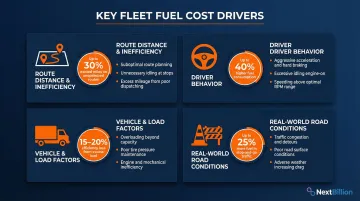
These drivers don't operate in isolation. A route planned without real-time traffic visibility pushes drivers into congested corridors, triggering both idling and frequent acceleration. A vehicle assigned to the wrong load type may follow a suboptimal route at the same time, compounding two inefficiencies at once.
Cost-reduction strategies need to target the drivers most relevant to each fleet type. Last-mile delivery operations suffer most from idling and poor stop sequencing. Long-haul fleets face greater exposure from route length decisions and load efficiency.
Cost-Reduction Strategies for Fuel
Effective fuel cost reduction requires matching strategies to the specific drivers causing waste. Cutting across three layers—upfront decisions, real-time management, and operational context—determines the depth of achievable savings.
Routing Decisions That Cut Fuel Costs Before Vehicles Leave
The highest-leverage interventions happen before vehicles leave the depot. These decisions define the boundaries within which every other variable operates.
Static-to-dynamic route planning. Fixed routes assigned without daily recalibration lock in inefficiency. Fleets that recalculate routes based on current order volumes, delivery locations, and traffic conditions consistently travel fewer total miles than those following pre-set paths. Daily route optimization accounts for variables that static planning ignores: new customer locations, canceled orders, and evolving traffic patterns.
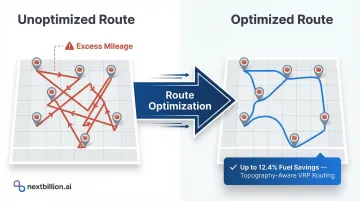
Stop sequencing with multi-stop logic. The order in which stops are visited has an outsized impact on total distance. Poor sequencing—visiting a nearby customer last instead of first, or crossing the same intersection multiple times—adds significant mileage that proper route sequencing eliminates. Algorithms solving the Vehicle Routing Problem (VRP) determine mathematically optimal stop order while respecting constraints like time windows and vehicle capacity. Research on topography-aware VRP routing found that accounting for road grade and vehicle load-weight yielded fuel cost savings opportunities up to 12.4% in certain instances, with average savings of 2.7%. When routes explicitly consider both arc payloads and road grades, fuel savings can reach up to 53%.
Vehicle-to-load matching. Dispatching an oversized vehicle for a small load wastes fuel due to weight-based consumption penalties. Matching vehicle type and capacity to actual load requirements reduces per-mile fuel burn. A cargo van consumes less fuel per mile than a box truck, and a day cab burns less than a sleeper cab when overnight capacity isn't needed. Proper matching also frees larger vehicles for trips that require their capacity.
Truck-specific road constraints at planning time. Routing a heavy vehicle onto roads with weight limits, low bridges, or restricted turns forces costly mid-route diversions. Constraint-aware routing that incorporates vehicle profiles—height, weight, axle count, hazmat classification—at the planning stage prevents these avoidable detours. Planning tools that understand which roads are accessible for which vehicle types eliminate the rerouting delays and extra miles that occur when drivers encounter unexpected restrictions.
In-Route Management That Reduces Fuel Waste in Real Time
Better visibility, control, and responsiveness while vehicles are actively on route significantly reduce fuel waste, especially in high-stop, high-traffic environments.
Real-time dynamic rerouting. Static routes dispatched in the morning become suboptimal as the day evolves. Real-time rerouting systems that push updated routes to drivers based on live traffic, accidents, and road closures prevent vehicles from burning fuel in avoidable congestion. Dynamic rerouting also allows dispatchers to respond to canceled appointments and urgent new orders without forcing drivers to follow outdated plans.
Engine idling reduction. Extended idling—at loading docks, customer locations, or in traffic—is one of the most direct and controllable forms of fuel waste. Heavy-duty trucks consume about 0.8 gallons of fuel per hour while idling, with a typical long-haul truck idling roughly 1,800 hours per year and using about 1,500 gallons of diesel. Nationally, rest-period truck idling consumes up to 1 billion gallons of fuel annually at a cost of around $3 billion. Telematics-integrated route management systems flag excessive idling events for dispatcher intervention, enabling operations teams to coach drivers and enforce idle-reduction policies.
Driver behavior coaching. Acceleration patterns, braking frequency, and speed consistency are directly controllable and have measurable effects on fuel consumption. A Federal Motor Carrier Safety Administration study on telematics systems found that fuel economy improved by 5.4% for drivers of sleeper cabs and 9.3% for drivers of day cabs following intervention and coaching. Driver behavior monitoring through telematics makes fuel efficiency a visible, trackable performance metric rather than an invisible cost.
Constraint-aware optimization platforms. Tools that factor in vehicle type, time windows, load weight, and driver hours give operations teams the granularity needed to close the gap between planned and actual fuel performance. NextBillion.ai's route optimization engine—supporting 50+ hard and soft constraints and integrating with fleet telematics systems including Geotab, Samsara, Motive, and Netradyne—accounts for real-world variables that simpler routing tools miss, enabling fleets to optimize for fuel efficiency alongside service-level requirements.
Structural Changes That Address Fuel Waste at the Fleet Level
Structural or environmental factors surrounding route execution often drive costs more than routing decisions themselves. Three operational levers consistently unlock deeper savings:
- Off-peak delivery windows: Shifting to early morning, late evening, or midday deliveries reduces time in stop-and-go traffic. A pilot off-peak delivery program in the Region of Peel found average speeds were 18.1% faster than daytime hours, with greenhouse gas emissions per kilometer decreasing by 10.6%. This is a scheduling and customer-agreement decision as much as a routing one.
- Load consolidation: Batching orders by geography, delivery window, and vehicle capacity reduces both empty miles and partially loaded trips. Operating vehicles below optimal capacity yields worse fuel efficiency per ton of freight moved — consolidation fixes this directly.
- Continuous data feedback: Fleets that treat route optimization as a one-time setup miss opportunities to refine their fuel baseline over time. Analyzing which routes, times, or drivers consistently over- or underperform creates the data foundation for smarter future planning.
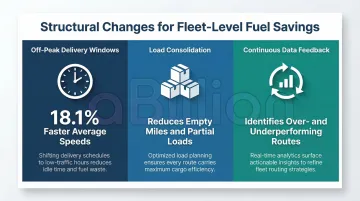
Comparing planned versus actual fuel consumption per route reveals where planning assumptions diverge from reality. Integration with telematics systems that capture fuel burn, idle time, and miles driven provides the data needed to identify patterns and refine optimization parameters over time.
Conclusion
The path to a 30% reduction in fuel costs is not a single product deployment or policy change. It requires identifying where in the decision-making process fuel waste originates—whether at the planning stage, during active route management, or in the structural conditions surrounding the fleet. Case studies show that a comprehensive approach combining route optimization, idle reduction, and driver coaching can deliver fuel cost reductions of up to 31%, but achieving these results demands commitment across multiple operational layers.
The most durable fuel cost reductions come from treating route optimization as a continuous operational discipline: smarter upfront planning, real-time responsiveness, and data-driven iteration working together rather than as a one-time cost-cutting exercise. Fleets that embed optimization into daily workflows, monitor performance against fuel targets, and refine their approach based on actual results build a compounding advantage.
Each improvement in routing logic, driver behavior, or operational scheduling reduces the baseline cost against which future gains are measured. Over time, that compounding effect is what turns a 10% fuel reduction into 20%, and 20% into the 30% benchmark this article set out to reach.
Frequently Asked Questions
How can route planning help lower fuel costs?
Route planning reduces fuel costs by minimizing total distance traveled, eliminating inefficient stop sequences, and avoiding traffic-heavy corridors. These improvements reduce both miles driven and engine idle time per trip, cutting fuel consumption at the source.
What is fuel optimization?
Fuel optimization is the process of systematically reducing fuel consumption across a fleet through route planning, real-time traffic responsiveness, driver behavior management, and load utilization. The goal is to lower per-trip fuel spend and total fleet operating costs through targeted, measurable changes.
What is the purpose of VRP?
The Vehicle Routing Problem (VRP) is an optimization framework used to determine the most efficient set of routes for a fleet of vehicles serving multiple stops. It minimizes total distance, fuel consumption, or delivery time while respecting constraints such as vehicle capacity, time windows, and driver availability.
What percentage of fleet operating costs does fuel typically represent?
For U.S. motor carriers in 2024, fuel costs were $0.481 per mile out of a total average operating cost of $2.260 per mile — roughly 21% of total operating expenses. At that share, even small percentage reductions translate to substantial dollar savings across a fleet.
How does driver behavior affect fuel consumption?
Aggressive acceleration, hard braking, excessive idling, and speeding can meaningfully increase fuel consumption per mile. Driver behavior monitoring through telematics, combined with coaching programs, is a proven approach to recovering this avoidable cost, with documented fuel economy improvements of 5–9%.
Can route optimization software work with existing fleet management systems?
Modern route optimization platforms are designed to integrate with existing telematics and fleet management systems, allowing fuel performance data, GPS tracking, and route plans to flow between tools. Integration depth varies by provider—NextBillion.ai, for example, integrates with systems like Samsara, Geotab, Motive, and Netradyne—making integration depth a practical factor to verify before committing to a platform.