Introduction
Waste haulers in 2026 face converging operational challenges: diesel prices averaging $4.80 per gallon, a projected shortage of 14,200 collection drivers, and increasingly strict landfill regulations. Choosing the wrong software platform means missed pickups, billing errors, inefficient routes, and failure to meet sustainability reporting requirements—each one cutting directly into margins and customer retention.
The waste management software market is projected to reach $11.97 billion in 2026, growing at 8.4% annually. Yet many operators still rely on manual dispatch boards and paper manifests that cost 3–5% of gross revenue in preventable errors and delays.
Route optimization alone can reduce fleet mileage by 20–30%. This guide breaks down the features, trade-offs, and evaluation criteria that matter most when choosing a waste management platform in 2026.
TL;DR
- Waste management software handles routing, dispatch, billing, driver management, and compliance—far beyond generic fleet tools
- Evaluate five core categories: route optimization, dispatch/scheduling, billing integration, AI/automation, and ESG reporting
- Route optimization quality delivers highest ROI—assess constraint support, real-time adaptability, and dispatch integration
- Match platforms to your service mix, fleet size, integration needs, and growth trajectory before comparing feature lists
- Require AI capabilities and ESG reporting as baseline features—any platform treating them as upgrades is already behind
What Is Waste Management Software?
Waste management software is a specialized operational platform designed to manage the full lifecycle of waste collection and hauling—from route planning and driver dispatch to customer billing and regulatory reporting. Unlike generic fleet or logistics software, waste-specific platforms understand the unique workflows of hydraulic compactors, container-level tracking, and waste type differentiation.
The category spans multiple service types: residential curbside, commercial front load, roll-off dumpster rental, portable toilets, and specialty hazardous waste. Not all platforms serve each type equally well—a system optimized for residential curbside collection operates on fundamentally different assumptions than one built for roll-off hauling.
Benefits of Waste Management Software
Purpose-built platforms replace error-prone manual processes (spreadsheets, paper tickets, phone-based dispatch) with automated workflows that reduce costs and improve service reliability. Core operational benefits include:
- Fuel savings: Optimized routing cuts fleet mileage by 20-30%, directly reducing fuel consumption
- Faster billing cycles: Automated invoice generation from completed service records eliminates manual data entry delays
- Fewer missed pickups: Real-time driver visibility and route tracking reduce service failures
- Reduced go-backs: Digital service verification eliminates disputes; some operations report 70% fewer unnecessary return trips, saving $150,000+ annually
- Improved customer communication: Automated notifications and self-service portals reduce call volume and complaints
The right platform turns these operational gains into a compounding advantage—lower costs, fewer service failures, and customers who stay longer.
Core Features to Compare in Waste Management Software
The following breakdown helps buyers evaluate vendor claims against real operational requirements — because platforms vary widely in how deeply each feature is actually implemented.
Route Optimization
Route optimization is the highest-impact feature in waste management software, directly affecting fuel costs, driver hours, and on-time service completion. The quality of the underlying optimization engine varies significantly between vendors.
What good route optimization looks like:
- Handles time windows, vehicle capacity, waste type restrictions, truck-specific road access, alley navigation, and side-of-street rules
- Reroutes dynamically based on live traffic and road conditions
- Pushes optimized routes directly to driver apps — no manual intervention required
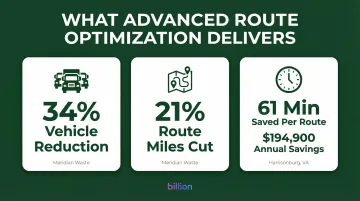
- Leading implementations report 21-34% route reductions and 15-26% lower costs per lift
Meridian Waste freed up 34% of solid waste vehicles and cut route miles by 21% using advanced route optimization. Harrisonburg, VA saved 61 minutes per route, translating to $194,900 in annual savings. These results depend on constraint depth and optimization quality, not just basic mapping.
Dispatch and Scheduling
Dispatch functionality determines how quickly and accurately work orders flow from back office to drivers. Strong dispatch platforms handle recurring routes, on-call pickups, and exception handling (blocked containers, missed stops, early/late completions) within a unified workflow.
Key capabilities to assess:
- Mobile driver apps: Intuitive interfaces with offline capability and real-time synchronization
- Real-time status updates: Live visibility into route progress, completion status, and service verification
- Route deviation alerts: Automatic notifications when drivers deviate from planned routes
- Multi-service-type support: Handle front load, roll-off, and residential routes in the same dispatch workflow without switching systems
When evaluating dispatch tools, ask vendors to demo exception handling specifically — that's where most platforms fall short.
Billing and Invoicing
Billing accuracy is a major pain point in waste hauling. Manual entry from paper tickets creates delays, disputes, and revenue leakage. Tightly integrated billing — auto-generated from completed service records — is a core differentiator.
What to look for:
- Multiple pricing structures: Support for recurring commercial contracts, one-time pickups, variable weight-based billing, and tiered service levels
- Accounting software integration: Native connections to QuickBooks, Sage, or similar platforms eliminate double entry
- Automated customer payment portals: Self-service billing access reduces payment delays and support calls
- Exception handling: Flags for unserviced stops, overages, and contamination charges
Operators typically lose 3-5% of gross revenue annually to billing errors and write-offs — on a $10M operation, that's $300,000–$500,000 recovered by closing the gap between field service and invoicing.
AI and Automation Capabilities
AI in waste management has expanded well past routing — the most practical applications now sit in operational verification and customer call handling.
Capabilities to evaluate:
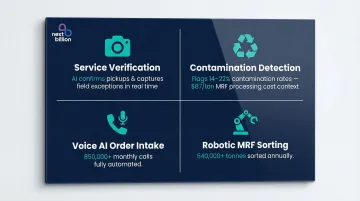
- Service verification: AI cameras confirm pickups, capture bag/volume counts, and photograph exceptions (blocked containers) without manual driver action
- Contamination detection: Real-time identification of recycling violations in curbside bins (addressing 14-22% contamination rates that drive MRF costs to $87 per ton)
- Voice AI order intake: Automated handling of customer calls for pickup scheduling and missed service reporting (Waste Connections processes 850,000+ monthly calls via AI)
- Robotic sorting integration: For MRFs, AI-based sorting technology in facilities handling 540,000+ tonnes annually
When evaluating AI features, confirm accuracy rates and ask whether outputs — photos, contamination flags, call transcripts — connect directly to billing and customer records. Features that generate data without connecting to downstream workflows add complexity without ROI.
Reporting, Analytics, and ESG Compliance
Reporting has evolved from basic route completion summaries to multi-dimensional dashboards covering driver productivity, route profitability, customer churn risk, and sustainability metrics. ESG and emissions reporting is increasingly required by enterprise customers and municipal contracts.
Specific capabilities to assess:
- Real-time versus historical views: Live operational dashboards plus trend analysis over time
- Scope 3 emissions tracking: Calculate and report waste-generated emissions per GHG Protocol standards (Scope 3 covers indirect emissions across the value chain)
- Recycling diversion rates: Track contamination, diversion percentages, and material recovery performance
- Audit-ready compliance exports: Support EPA e-Manifest electronic submissions (mandatory by 2026) and landfill chain-of-custody documentation
- Segmentation flexibility: Break reporting down by route, driver, customer segment, or service type
If a platform can't export audit-ready ESG reports, budget for manual workarounds — or expect to lose bids to operators who can document their sustainability performance.
What to Look For When Choosing Waste Management Software
The right software aligns with how your operation runs today and where it needs to go—not just which platform has the most features.
Line-of-Business Fit
This is the first filter. A platform optimized for residential curbside collection has different workflow logic than one built for commercial front load or roll-off hauling. Using a mismatched platform creates friction at every step—from dispatch rules to billing logic to driver app interfaces.
Action step: Map your current service mix (residential, commercial, roll-off, specialty) and verify that the platform handles each line of business with equal depth, not just as an afterthought module. Ask vendors for references from operators with similar service mixes.
Integration with Existing Systems
Waste management software rarely operates in isolation. It needs to exchange data with telematics/GPS providers, fleet maintenance systems, accounting software, and customer CRMs. Poor integration creates data silos and manual re-entry.
Key integrations to verify:
- Telematics platforms: Compatibility with Samsara, Geotab, Motive, Verizon Connect
- Accounting tools: Native connections to QuickBooks, Sage, Microsoft Dynamics
- Open APIs: Whether the platform offers flexible APIs for custom integrations or is locked into proprietary connectors
Ask for integration documentation and implementation timelines. Confirm that data flows bidirectionally where needed—not just one-way exports.
Scalability and Customization
Software that fits a 10-truck operation may become a constraint at 50 trucks. Evaluate how the platform handles growth in fleet size, service territory, and customer volume without requiring a full platform migration.
Customization depth matters:
- Pricing rules configuration: Ability to define custom pricing structures without vendor coding
- Route constraints: Configure operational rules specific to your territories and truck types
- Reporting fields: Add custom data fields and build reports without professional services
- Workflow triggers: Set up automated actions based on operational events
If a vendor requires professional services to change a billing rule or add a report field, that's a signal the platform wasn't built with operator control in mind.
Implementation Timeline and Ongoing Support
Implementation is frequently underestimated. Data migration, driver training, route data import, and billing history transfer all take time. A 4–12 week timeline is typical for core modules, with longer timelines for complex multi-line operations.
Poor support creates real operational risk—a dispatch system outage on a Monday morning affects every route running that day. Ask for references and check review platforms for support feedback before committing.
Evaluate support quality as a long-term factor:
- Response time SLAs: Guaranteed response times for critical issues
- Access to live support engineers: Not just ticketing systems
- Documentation quality: Comprehensive help resources and training materials
- Platform update frequency: Regular feature releases and security patches
Pricing Model and Total Cost of Ownership
SaaS pricing for waste management software typically follows a per-truck or per-user model. Sticker price comparisons can be misleading—implementation fees, training costs, add-on module pricing, and integration costs must be factored into a 3–5 year TCO calculation.
Typical 2026 pricing ranges:
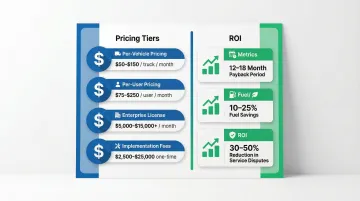
- Per-vehicle model: $50–150 per truck/month for routing and dispatch
- Per-user model: $75–250 per user/month for centralized platforms
- Enterprise/tiered: $5,000–15,000+ monthly for full ERP integration
- Implementation fees: 20–40% of first-year subscription cost ($2,500–25,000)
Calculate payback period using fuel savings, billing accuracy gains, and labor efficiency as inputs. Most waste management companies reach full ROI within 12–18 months, driven by 10–25% fuel savings and 30–50% reductions in service disputes.
Data Security and Regulatory Compliance
Waste management software handles sensitive customer billing data, GPS location data, and in some cases hazardous waste manifests. Each of these data types carries distinct liability exposure—billing data under PCI standards, location data under state privacy laws, and hazardous waste records under EPA requirements.
What to verify:
- SOC 2 compliance: Industry-standard security certification
- Data encryption standards: Both at rest and in transit
- Role-based access controls: Granular permissions management
- Audit logging: Complete activity tracking for compliance verification
- EPA e-Manifest support: Electronic submission capability for hazardous waste tracking (mandatory by 2026)
Enterprise and municipal procurement increasingly requires ISO 27001, SOC 1, and SOC 2 Type II certifications. Verify vendors' security posture before shortlisting.
How NextBillion.ai Can Help Power Waste Hauling Operations
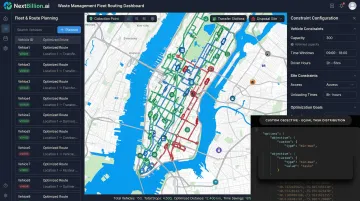
NextBillion.ai is an AI-powered route optimization and mapping platform that serves as the routing intelligence layer for waste management operations and software developers building for the waste hauling vertical. The routing engine is built for the complex, multi-stop, multi-constraint demands waste collection fleets actually face—not retrofitted from a generic mapping provider.
The platform supports 50+ hard and soft constraints: time windows, vehicle capacity, truck-specific road access, and service duration variability. Pricing runs per vehicle rather than per API call, so costs stay predictable as fleets grow. Alley navigation, side-of-street rules, and mixed-service-type routing all work within a single workflow.
Key capabilities for waste management operators and ISVs:
- Integrates natively with Geotab and Samsara to feed real-time fleet data into routing decisions
- Handles distance matrices up to 5,000×5,000—no 25×25 caps limiting large service territory planning
- Deploys cloud-agnostic or on-premise to meet security and compliance requirements
- Provides 24×7 access to solution engineers, not just a ticketing queue
For ISVs building waste management platforms, NextBillion.ai provides the routing foundation without the constraints of generic mapping providers. For operators, it delivers the intelligence layer that makes route optimization measurably better—delivering 20-30% mileage reductions and sub-12-month payback periods.
Conclusion
The right waste management software decision isn't about the longest feature list—it's about matching core capabilities (especially route optimization, billing integration, and AI automation) to your operational profile, fleet size, and growth ambitions.
Software selection isn't a one-time event. As fleets grow and regulations shift, the best platforms get re-evaluated against actual performance metrics—not just initial promises.
Prioritize a flexible, integration-ready architecture that adapts as your operation scales, so you're not rebuilding from scratch every few years. The vendors worth shortlisting are the ones that grow with you without locking you in.
Frequently Asked Questions
How much does commercial waste collection route planning software cost?
Typical SaaS pricing ranges from $50–150 per truck/month for routing and dispatch, or $75–250 per user/month for centralized platforms. Implementation and training are often separate costs ($2,500–25,000), so calculate total cost of ownership over 3–5 years and factor in ROI from fuel savings and efficiency gains before comparing monthly rates alone.
What is waste management software used for?
Waste management software manages the full operational workflow of a waste hauling business: route planning, driver dispatch, service verification, customer billing, and compliance reporting. It replaces manual and paper-based processes with automated workflows that reduce costs, improve service reliability, and provide real-time operational visibility.
What features should I prioritize when comparing waste management routing software?
Prioritize route optimization depth (constraint support, real-time traffic adaptation), dispatch-to-driver app integration, automated billing from service records, and real-time reporting. In 2026, AI capabilities (service verification, contamination detection) and ESG reporting are standard expectations, not premium add-ons—evaluate each based on operational impact, not checklist presence.
How long does it take to implement waste management software?
Core module implementation typically takes 4–12 weeks, with longer timelines for multi-site operations or complex data migrations. Plan for driver training, historical data transfer, route data import, and billing system integration before go-live.
Can waste management software integrate with existing telematics and fleet systems?
Most modern platforms offer integrations with telematics providers (Samsara, Geotab, Motive, Verizon Connect) and accounting tools (QuickBooks, Sage). Verify API availability and integration depth before committing, confirming that data flows bidirectionally where needed and that integrations don't require extensive custom development.
What is the difference between general fleet software and purpose-built waste management software?
General fleet software lacks waste-specific workflows: service type differentiation (residential vs. roll-off), container-level tracking, weight-based billing, contamination handling, and compliance reporting (EPA e-Manifest). Purpose-built platforms understand waste hauling operations at a granular level, making them far more effective for reducing errors, improving efficiency, and meeting regulatory requirements.