Introduction
Imagine a fleet of refrigerated trucks fanning out across a city at 4 a.m., loaded with fresh produce, dairy, and prepared meals. Each vehicle has 12 to 18 stops. Each stop has a 30-minute delivery window. And each minute of delay doesn't just risk a late arrival—it means spoilage, rejected loads, and thousands of dollars in lost revenue.
Perishable food delivery is a timing and quality problem that traditional vehicle routing models weren't built to handle. Approximately 14% of all food produced globally is lost between harvest and retail, with 526 million tonnes lost specifically due to insufficient refrigeration in the cold chain.
Cold chain failures and temperature excursions cost companies an estimated $35 billion globally every year.
The Vehicle Routing Problem with Time Windows (VRPTW) is the mathematical framework designed to solve this exact problem. This guide covers the definition, unique constraints, solution approaches, and practical implementation of VRPTW for perishable food delivery — because for cold chain logistics, correct implementation is the difference between fresh goods and waste.
TLDR
- VRPTW requires every delivery stop to be served within a set time interval, making on-time arrival non-negotiable for perishable food
- Beyond time windows, perishable food routing adds freshness decay, quality thresholds, vehicle capacity, and reverse logistics coupling as hard constraints
- Time windows can be "hard" (strict, zero tolerance) or "soft" (lateness allowed but penalized financially), significantly affecting route feasibility and total operating cost
- Solving VRPTW for perishable food at scale requires AI-powered route optimization—exact solvers work for small fleets but become impractical as stops and constraints grow
What Is the Vehicle Routing Problem with Time Windows?
VRPTW is an extension of the classical Vehicle Routing Problem (VRP) where each customer or stop has an assigned time interval during which a vehicle must begin service. A vehicle arriving too early must wait; arriving after the window closes results in a service failure or penalty, depending on whether the window is hard or soft.
The classical VRP was introduced by G.B. Dantzig and J.H. Ramser in their 1959 paper, "The Truck Dispatching Problem," published in Management Science. Time window constraints were formally added in the 1980s by Marius M. Solomon in 1987 to reflect real-world delivery scheduling requirements such as store receiving hours, staffing availability, and customer preference windows.
A valid VRPTW solution must satisfy five conditions:
- Each customer is visited exactly once
- Every route starts and ends at a depot
- Vehicle capacity is never exceeded
- Service begins within each customer's time window
- Total operational cost (typically distance or time) is minimized across all routes
VRPTW has two close relatives worth distinguishing. The Pickup and Delivery Problem with Time Windows (PDPTW) pairs each pickup with a specific delivery on the same vehicle route. The Time-Dependent VRP (TDVRP) adjusts travel times based on congestion or time-of-day conditions. In perishable food delivery, PDPTW applies to restaurant aggregators, while TDVRP matters for any operation running across peak traffic hours.
Where VRPTW Fits in the Broader VRP Family
The taxonomy flows as follows:
- Standard VRP → Minimizes total distance for a fleet serving customers
- Capacitated VRP (CVRP) → Adds vehicle capacity constraints
- VRPTW → Adds time window constraints
- PDPTW → Adds pickup-delivery pairing requirements
- Multi-Pickup and Delivery Problem with Time Windows (MPDPTW) → Handles multiple pickups and deliveries per route
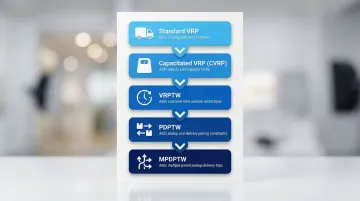
Perishable food delivery often requires the most complex variants because orders frequently involve pickups from multiple restaurants or suppliers and delivery to a single customer, as seen in platforms like food delivery aggregators.
Why Perishable Food Delivery Adds Layers of Complexity to VRPTW
Perishable goods introduce a freshness decay dimension that standard VRPTW ignores. Unlike a parcel that arrives in identical condition whether delivered in two hours or four, food quality degrades continuously during transit.
This creates a dual-objective tension: minimizing travel distance often conflicts with minimizing freshness loss. A route that is longer in miles but shorter in total transit time may deliver better product quality. That means optimizing for distance alone is insufficient for food logistics.
Real-World Quality Degradation
Research using the Arrhenius equation demonstrated that exposing milk (normally stored at 4°C) to room temperature (25°C) for just 3.2 hours decreases its shelf life by one full day. For Pseudomonas fluorescens in milk, specific growth rates accelerate exponentially: 0.056 h⁻¹ at 4°C, 0.17 h⁻¹ at 15°C, and 0.46 h⁻¹ at 29°C.
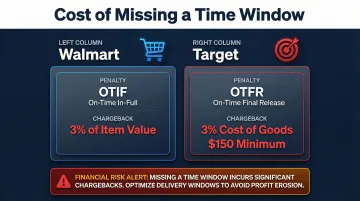
Those decay rates translate directly to dollars. A retailer who rejects a late dairy delivery generates not just a penalty fee but complete revenue loss on the load, plus disposal costs. Major retailers enforce strict On-Time In-Full (OTIF) mandates:
Economic Consequences of Time Window Violations
| Retailer | Penalty Type | Chargeback Amount |
|---|---|---|
| Walmart | OTIF | 3% of item value for late or missing products |
| Target | OTFR | 3% cost-of-goods penalty, $150 minimum chargeback |
Simultaneous Pickup and Delivery Requirements
Collecting expired stock, returnable packaging, or empty containers while delivering fresh goods makes this a pickup-and-delivery problem with time windows. The same vehicle must manage both inbound and outbound flows. Neither capacity nor time constraints at any stop can be violated.
The Key Constraints of VRPTW for Perishable Food
Vehicle Capacity
Each vehicle has a maximum load measured in weight, volume, or pallet slots. Capacity must be tracked continuously as goods are loaded at depots and unloaded at customer stops. In pickup-and-delivery scenarios, the vehicle's real-time load changes at every stop, requiring careful route sequencing to avoid overloading at any point.
Time Windows (Hard and Soft)
- Hard time windows: Service must begin within the exact interval; any violation makes the solution infeasible
- Soft time windows: Violations are permitted at a financial penalty
Food distributors often use soft time windows to maintain route feasibility under traffic unpredictability, but penalty costs must be calibrated to avoid repeated late deliveries that damage customer relationships.
Freshness and Quality Decay
Perishable VRPTW models include a quality-level function that decreases as transit time increases. Customers may set minimum acceptable quality thresholds.
For example, Tesco contracts require suppliers to deliver 75% of total shelf life remaining — meaning 9 days of a 12-day product must still be usable on arrival. Across the industry, supply clauses commonly require at least 80% of shelf life intact at delivery.
Precedence Constraints in Multi-Stop Routes
In pickup-and-delivery variants, goods must be picked up before they can be delivered — enforced as precedence constraints. For food aggregators picking up from multiple restaurants before delivering to one customer, the vehicle cannot visit the delivery address until all restaurant pickups for that order are complete.
Fleet and Depot Constraints
- Driver working-hour regulations
- Vehicle return-to-depot requirements
- Refrigeration unit operating times
- Loading dock slot availability
Together, these layers of constraint mean solvers must handle far more interdependencies than standard VRP — and why off-the-shelf routing tools often fall short for perishable food operations.
Solving VRPTW for Perishable Goods: From Exact Methods to AI
Exact mathematical approaches (branch-and-cut, branch-and-price):
For small fleets with fewer than 25–50 stops, exact algorithms can find provably optimal solutions. However, VRPTW is classified as NP-hard, meaning computation time grows exponentially with the number of stops and constraints. For the problem sizes typical of a regional food distributor (50–500+ stops), exact methods are computationally impractical in real time.
Heuristic and metaheuristic approaches:
- Savings algorithms (Clarke-Wright): A foundational route construction heuristic that begins by supplying every customer individually and iteratively merges routes based on calculated distance and cost savings
- Tabu search: Uses memory structures (tabu lists) to forbid recently visited solutions, preventing cycling and allowing the algorithm to escape local optima
- Genetic algorithms (GA): Evolutionary algorithms that use reproduction, crossover, and mutation operators to evolve populations of routing solutions
- Adaptive Large Neighborhood Search (ALNS): Dynamically selects from a pool of multiple removal and insertion heuristics to destroy and repair routes, adapting selection probability based on historical success
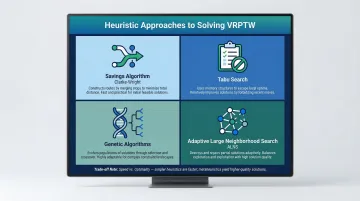
These methods trade guaranteed optimality for speed, producing near-optimal solutions in seconds or minutes even for large fleets. For perishable food, the choice of objective function (minimize distance vs. minimize freshness loss) significantly affects which heuristic produces the best real-world outcome.
Performance of ALNS on Large-Scale Pickup and Delivery Problems:
| Locations | ALNS Avg. Gap to Best-Known | ALNS Avg. Runtime (seconds) |
|---|---|---|
| 100 | 0.19% | 49 |
| 200 | 0.72% | 305 |
| 600 | 0.93% | 1,069 |
| 1,000 | 2.26% | 2,916 |
Source: ALNS benchmark results
AI-powered route optimization platforms:
Modern cloud-based route optimization tools encode VRPTW constraints as configurable parameters: time windows, vehicle capacities, pickup-delivery coupling, and quality thresholds are all handled by the same hybrid solver. This means food distributors can model complex perishable delivery scenarios without building custom algorithms from scratch.
NextBillion.ai's route optimization platform, for example, supports 50+ hard and soft constraints simultaneously. Sub-second response times allow dynamic re-routing when conditions change mid-delivery.
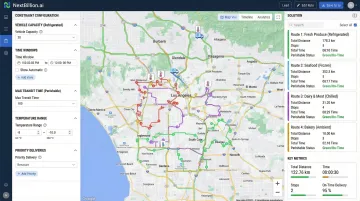
Dynamic and real-time VRPTW:
In dynamic VRP, new orders arrive or traffic conditions change while the fleet is already in operation. For on-demand food delivery (similar to platforms like DoorDash or Zepto), routes must be re-optimized continuously rather than solved once at the start of the day.
Research on dynamic meal delivery platforms using rolling-horizon algorithms demonstrates that a 5-minute optimization interval outperforms a hyper-frequent 2-minute interval. The 5-minute window yields a lower rate of undelivered orders (0.23% vs. 0.28%) and improves click-to-door times by allowing the algorithm sufficient time to identify denser order bundling opportunities.
Putting VRPTW Into Practice for Food Distributors
Data Requirements for VRPTW Implementation
A practical VRPTW deployment requires accurate inputs:
- Customer delivery time windows (obtained from contracts or customer preferences)
- Realistic travel time matrices (accounting for traffic and road restrictions, not just straight-line distance)
- Vehicle capacity specifications
- Product shelf-life parameters
Routes built on inaccurate data will consistently miss time windows in the field — no matter how sophisticated the algorithm.
Integration with Existing Fleet and Logistics Systems
Route optimization does not operate in isolation. It must connect with:
- Order management systems
- Telematics/GPS for real-time vehicle tracking
- Cold chain monitoring (IoT temperature sensors)
- Driver mobile apps for turn-by-turn navigation
The IFDA 2025 Technology Benchmarking Report found that integration compatibility with existing systems and budget constraints remain the top factors influencing technology decisions for foodservice distributors.
Measuring Outcomes and Continuous Improvement
Once integration is in place, measurement is what separates sustained gains from one-time wins. Key performance indicators food distributors should track after implementing VRPTW-based routing:
- On-time delivery rate (measured against time windows)
- Average freshness score upon delivery
- Number of rejected loads due to quality failure
- Fuel consumption per route
- Fleet utilization rate
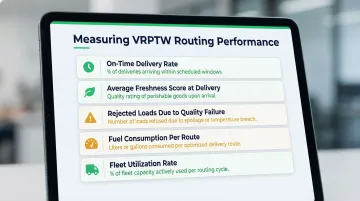
These metrics compound over time. A Southeast US fresh produce processor using Paragon Routing Software, for example, reduced delivery cost-per-case from $2.40 to $1.92 — a 20% reduction — while increasing pallets per trailer by 25%. Those results came from iterative refinement: adjusting time window parameters and constraint weights based on real delivery outcomes, not just the initial software configuration.
That ongoing tuning is what separates high-performing operations from those that implement routing software and see limited results.
Frequently Asked Questions
What is the vehicle routing problem with time windows?
VRPTW is a logistics optimization problem where a fleet of vehicles must serve customers within specified delivery time intervals while minimizing total cost. Vehicles arriving early must wait; those arriving late either create an infeasible route or trigger a financial penalty, depending on how the time windows are configured.
What is the pickup and delivery problem with time windows?
PDPTW extends VRPTW by pairing each pickup location with a specific delivery location — both served by the same vehicle, pickup before delivery, each within its own time window. Food delivery platforms rely on this structure when drivers collect orders from restaurants and drop them off at customer addresses.
What is the time dependent vehicle routing problem?
TDVRP is a variant where travel times between locations are not fixed but change based on the time of day—capturing real-world traffic congestion patterns. For perishable food delivery in urban environments, TDVRP is especially relevant because rush-hour delays can push deliveries outside their time windows and cause quality degradation.
What is the difference between hard and soft time windows in route planning?
Hard time windows treat any out-of-window delivery as infeasible; soft time windows allow violations but assign a financial penalty for lateness or earliness. Food distributors often prefer soft windows when traffic is unpredictable — provided the penalty is steep enough to still drive on-time performance.
How does food perishability affect route optimization decisions?
Perishability adds a freshness decay objective alongside cost minimization — the optimal route isn't always the shortest one. A longer path with faster cumulative delivery time may preserve more product quality. Late arrivals also carry a steeper financial cost than in standard VRP: rejected perishable loads mean total revenue loss, not just a penalty charge.
What algorithms are used to solve the vehicle routing problem with time windows?
Small instances can be solved exactly using branch-and-cut or branch-and-price algorithms, but large real-world problems are typically solved with heuristics such as genetic algorithms, tabu search, or adaptive large neighborhood search (ALNS). AI-powered optimization platforms often combine several of these techniques to generate high-quality solutions in near real time — practical for fleets that need replanning mid-shift.