This guide is for logistics managers, last-mile delivery operators, e-commerce fulfillment teams, and fleet managers who want to understand how delivery window scheduling works at an operational level and what it takes to implement it effectively.
TLDR
- Delivery window scheduling assigns specific time slots to last-mile deliveries based on route feasibility, fleet capacity, and customer availability
- Failed windows multiply costs fast—research shows re-delivery attempts can more than double the cost of a stop
- Hard windows are fixed constraints; soft windows carry penalties when missed and require different solver logic
- Effective scheduling combines route optimization, real-time data, and capacity awareness rather than relying on manual slot assignment
- Narrower windows don't always mean better service—overly tight constraints often lead to more failures
What Is Delivery Window Scheduling in Last-Mile Delivery?
Delivery window scheduling is the process of assigning specific, time-limited slots to individual stops within a last-mile route — so each delivery is attempted within a committed time range, not just "sometime today."
Stop-Level vs. Route-Level Planning
What distinguishes delivery window scheduling from general delivery scheduling is its stop-level precision—it's tied to each customer drop point, not just day-level or route-level planning. Understanding the difference between these three concepts is critical:
- Delivery date: The day a package will arrive (e.g., "Tuesday, March 18")
- Delivery window: A specific time range on that date (e.g., "2–5 PM")
- Narrow delivery slot: A compressed window (e.g., "2–3 PM") that offers higher precision but tighter constraints
Hard vs. Soft Time Windows
Not all delivery windows carry the same consequences. The two core types behave very differently in practice:
| Window Type | Definition | Typical Use Cases | If Missed |
|---|---|---|---|
| Hard | Delivery must occur within the window | B2B, healthcare logistics, time-sensitive retail | Failed delivery — requires rescheduling |
| Soft | Delivery can occur outside the window with a penalty | E-commerce, general parcel delivery | SLA penalty or scheduling cost incurred |
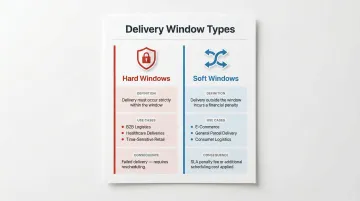
Hard windows suit customers who cannot accept late arrivals. Soft windows give operators room to balance customer expectations against route efficiency — a practical trade-off in high-volume e-commerce networks.
Why Delivery Window Scheduling Matters in Last-Mile Delivery
Customer Expectations Are Non-Negotiable
The numbers tell a clear story: 82% of consumers expect a specified delivery time window, yet the vast majority of retailers can't deliver on that expectation. This has made window scheduling a competitive necessity, not a nice-to-have feature. Consumer priorities have shifted dramatically—speed has dropped to fifth place, displaced by reliability, cost transparency, and flexibility.
The Cost Consequence of Missed Windows
Delivery failures require re-delivery attempts, which can more than double the cost of that stop. Window scheduling accuracy is a cost-control lever—not just a service quality measure. When windows are missed, the downstream costs compound fast: re-delivery fuel, driver overtime, and support volume all climb together.
The Operational Reality Without Structure
Without structured window scheduling, dispatchers assign delivery slots reactively—and routes get planned without verifying whether promised windows are actually achievable. Commitments made at checkout become impossible to honor in the field. The result is predictable: failed first-attempt deliveries, expensive "Where Is My Order?" (WISMO) calls, and customer churn that's hard to recover from.
Fleet Utilization and Workload Balancing
Unstructured scheduling creates uneven workload distribution across the fleet. Structured window scheduling fixes this by enabling capacity-aware slot assignment that:
- Levels driver workload so shifts end consistently
- Reduces idle time between stops
- Turns fleet capacity into a predictable, plannable resource
Dual Nature: Operations and Product
Delivery window scheduling is both an operational best practice and increasingly a customer-facing product feature—self-scheduling portals, time-slot selection at checkout, branded tracking pages. That dual nature is what makes it genuinely difficult to implement: the system needs to validate route feasibility at the moment a slot is offered, before any promise reaches the customer.
How Delivery Window Scheduling Works in Last-Mile Operations
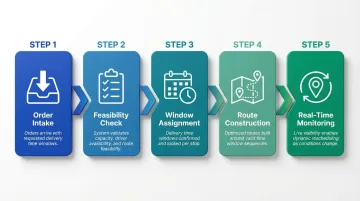
The end-to-end flow connects five interdependent steps, each feeding the next:
- Orders arrive with requested or assigned time windows
- The scheduling system checks vehicle capacity, driver availability, and route feasibility
- Windows are assigned or confirmed for each stop
- Routes are built around the sequence of valid windows
- Real-time visibility enables rescheduling when conditions change
Route Optimization Is the Foundation
Assigning a delivery window without validating travel time, stop density, and vehicle load is the most common failure mode. Route-aware scheduling—where the optimizer treats time windows as hard or soft constraints during route construction—is what makes windows achievable, not just promised.
Platforms like NextBillion.ai's route optimization engine handle time-window constraints as part of the Vehicle Routing Problem (VRP) solver. Operators can define 50+ hard and soft constraints — including time windows — to generate feasible, executable schedules automatically. Windows are validated against route reality before they're ever committed to customers.
Forward vs. Backward Scheduling
Forward scheduling fills the earliest available slots first — better for B2C and e-commerce where customers want the soonest possible delivery. Backward scheduling fills later slots first and works inward, better suited for recurring B2B stops or when anchor deliveries must be accommodated. Most route optimization tools are designed for forward-in-time scheduling.
Step 1: Window Definition and Customer Commitment
The process begins before routing: either the customer selects a time window at checkout (self-scheduling), or the operator assigns a window based on zone, historical performance data, and fleet capacity.
Window width determines feasibility:
- Wider windows (4 hours) are operationally easier but less appealing to customers
- Narrower windows (1–2 hours) increase customer satisfaction but compress the routing feasibility margin
Whatever width you choose here, every downstream system — routing, dispatch, customer notifications — must be built to honor it.
Step 2: Route-Feasibility Validation and Stop Sequencing
Each confirmed window must be tested against route reality. The system checks whether the delivery vehicle can realistically reach the stop within the window given:
- Travel time from prior stops
- Service time at each location
- Current or predicted traffic conditions
- Vehicle load and capacity constraints
Valid windows are sequenced into a route. Infeasible ones must be rescheduled or renegotiated before dispatch — catching conflicts here avoids broken promises once drivers are on the road.
Step 3: Execution Monitoring and Real-Time Replanning
Once a driver is on route, window adherence requires live visibility. GPS tracking and ETA recalculation flag stops at risk of missing their window. Dispatchers or automated systems can then:
- Resequence remaining stops
- Notify affected customers proactively
- Trigger re-scheduling logic
Catching risk early keeps SLA compliance intact and gives customers enough notice to adjust — rather than discovering a miss after the fact.
Key Factors That Affect Delivery Window Scheduling in Last-Mile Operations
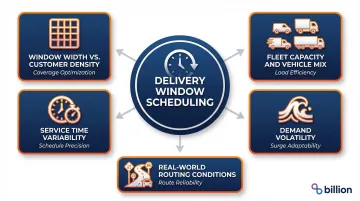
Five operational variables consistently determine whether your delivery windows hold—or fall apart mid-route.
- Window width vs. customer density: Narrow windows constrain stop sequencing, leaving the optimizer fewer options to arrange routes efficiently. In dense urban zones this is manageable; in sparse suburban or rural areas, tight windows can cause route costs to spike sharply.
- Service time variability: Time spent at each stop—parking, access, signatures, installation—flows directly into whether downstream windows are met. This is especially acute for bulky goods, white-glove delivery, or multi-unit residential buildings, where stop durations are hardest to predict.
- Fleet capacity and vehicle mix: Available vehicles, load limits, and vehicle-specific restrictions (size, temperature control, driver certifications) set a hard ceiling on how many windows you can commit per route. You can't promise slots you don't have capacity to serve.
- Demand volatility: Seasonal surges, promotional peaks, or same-day order cuts can outpace available windows fast. Without dynamic capacity management, operators either over-commit (and miss windows) or under-supply (and lose orders to competitors).
- Real-world routing conditions: Windows are planned on predicted travel times. Traffic, road closures, or access restrictions—such as loading dock hours in commercial zones—can unravel even well-sequenced routes mid-shift. Real-time rerouting is essential for sustained window adherence.
Common Challenges and Misconceptions About Delivery Window Scheduling
Narrower Windows Don't Always Mean Better Service
The most common misconception is that narrower windows always mean better service. In practice, very narrow windows (for example, 1-hour slots across a large geographic zone) often lead to more failed windows because routing constraints become too tight to handle traffic variability or service-time deviations. The result: a worse customer outcome than a reliable 3-hour window would have produced.
The Scheduling-Routing Disconnect
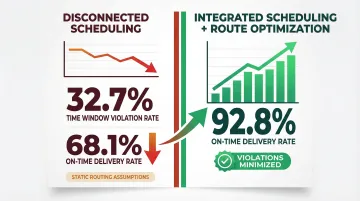
A common operational failure is confirming delivery windows at the order level—often in a separate CRM or OMS—then handing off to routing software without cross-checking feasibility. Windows get promised before routes are built, and routes then have to work around commitments that can't physically be met.
Research shows that static routing assumptions lead to time window violation rates as high as 32.7%. When scheduling and route optimization work as an integrated process, on-time rates improve from 68.1% to 92.8% — a gap that's hard to ignore.
Confusing "Scheduled Window" with "Actual Arrival Time"
Teams often report on-time delivery based on whether a driver reached the zone in time—not whether the specific customer stop was served within the committed window. This masks real window failure rates and prevents accurate SLA measurement. Tracking must be stop-level, not zone-level.
Best Practices for Optimizing Delivery Window Scheduling
Validate Capacity Before Confirming Windows
Delivery windows should only be confirmed after checking vehicle availability, driver hours, route load, and zone capacity. Operators that build a dynamic capacity pool—updated in real time as orders and windows are confirmed—avoid the common trap of over-committing slots that cannot be executed without overtime or failed stops.
Use Historical Performance Data to Set Window Widths by Zone
Urban high-density zones can support narrower windows; low-density or long-distance stops require wider buffers. Analyze actual delivery completion times by zone and time-of-day to determine realistic window widths—rather than applying a uniform window policy across the entire network.
Logistics teams using platforms like NextBillion.ai can use route simulation and historical stop-data analysis to calibrate zone-specific window widths and service time buffers before committing them operationally.
Build Exception-Handling Logic Into the Scheduling Workflow
Define what happens when a window is at risk before a driver reaches the stop—not after they've missed it. This includes:
- Automated customer notification
- Resequencing logic for downstream stops
- Escalation protocols for high-priority or time-sensitive deliveries
Building this logic into the scheduling workflow—before execution begins—means exceptions get resolved in seconds, not after a customer complaint. Anheuser-Busch reduced late deliveries by 80% by automating dispatching and integrating real-time traffic patterns into route execution, which shows what systematic exception handling delivers at scale.
Frequently Asked Questions
What is a delivery time window in logistics?
A delivery time window is the committed time range during which a package is expected to arrive at a specific address. It gives both the recipient and the logistics team a defined operational target per stop—enabling tighter coordination and fewer missed deliveries than a vague delivery date.
What's the difference between hard and soft delivery windows?
Hard windows must be met exactly—failure means a missed delivery or SLA breach. Soft windows carry a penalty cost when missed but don't automatically disqualify the delivery. Hard windows are used for time-sensitive deliveries (healthcare, B2B contracts), while soft windows are common in e-commerce where flexibility balances service with efficiency.
How does delivery window scheduling affect route optimization costs?
Narrow or tightly-clustered time windows restrict the optimizer's ability to sequence stops efficiently, often increasing total mileage or requiring more vehicles. Wider windows give the optimizer more flexibility to build cost-efficient routes. Matthews International achieved a 7% reduction in mileage by implementing automated route optimization that balanced window commitments with efficient sequencing.
How long does last-mile delivery typically take?
Timeframes range from under two hours for same-day urban deliveries to 1–5 business days for standard ground shipments, depending on geography, carrier, and service tier. Delivery window scheduling determines how predictably those timeframes are communicated and honored—turning a rough ETA into a specific, trackable commitment.
What is the last-mile delivery process?
The last-mile delivery process runs from order dispatch at a local hub through route sequencing, driver execution, and proof of delivery. Delivery window scheduling controls when each stop is attempted, keeping customer expectations in sync with what the operation can actually deliver.
What do 'picked up by last-mile provider' and 'last mile en route' mean?
Both statuses confirm the package has been transferred to the carrier handling the final delivery leg and is actively in transit. The window shown at checkout or in your tracking link is the committed arrival target—real-time updates reflect how closely the driver is adhering to it.