Introduction
Delivering thousands of newspapers before dawn—across dense urban grids, using carriers on foot, bikes, and vehicles—leaves almost no margin for inefficiency. FK Distribution manages 20,000+ routes visiting 2.7 million households twice weekly, and Publishers Circulation Fulfillment coordinates 6,000 couriers delivering 1 million copies daily. At that scale, a poorly sequenced route isn't a minor inconvenience—it's a missed delivery window for thousands of subscribers.
Route optimization for paper distribution is the automated process of calculating the most efficient sequence and path for carriers to visit all delivery addresses within set time and workload limits. Unlike standard logistics routing, paper delivery operates within narrow early-morning windows, relies on pedestrian and cycling networks rather than road networks, requires non-overlapping carrier zones, and must balance workload evenly across carriers.
What follows covers the mechanics, constraints, and common failure points specific to paper distribution—not last-mile delivery in general.
TL;DR
- Paper distribution routing models pedestrian and cycling networks, not just road infrastructure
- Routes are recurring (static or hybrid), requiring periodic re-optimization rather than daily recalculation
- Primary goals: balance carrier workload, minimize distance, respect time windows, reduce route count
- Key variables: subscriber density, carrier type (walker/cyclist/vehicle), time-per-stop, crossing safety
- Software-based optimization reduces planning time from hours to minutes and adapts faster to subscriber changes
What Is Route Optimization for Paper Distribution?
Route optimization for paper distribution is the process of calculating the most efficient delivery sequence and path for each carrier. Given a fixed subscriber list, carrier constraints, and operational parameters, it ensures every stop is covered within available work time—at minimum total distance or cost.
The result: every subscriber gets their paper on time, while carrier count and total distance across the distribution network stay as low as possible.
How It Differs from Standard Last-Mile Delivery
Unlike parcel or food delivery, paper distribution routing:
- Uses pedestrian sidewalk and cycling path networks rather than road networks
- Operates at walking or cycling speeds instead of driving speeds
- Requires non-overlapping route territories to prevent carrier conflict
- Prioritizes uniform workload balancing over individual stop-to-stop speed
- Serves recurring addresses on fixed schedules rather than dynamic daily orders
These differences make general vehicle routing software poorly suited for paper distribution—it models the wrong network type, assumes driving speeds, and lacks workload balancing logic required for pedestrian carriers.
Why Paper Distribution Needs Dedicated Route Optimization
Manual route planning and general-purpose mapping tools cannot handle the scale or constraints of paper distribution. With thousands of subscriber addresses, even small inefficiencies translate into wasted carrier hours and unnecessary fuel costs.
Demand Characteristics That Generic Tools Fail to Address
Narrow early-morning delivery windows: All stops must be complete before a specific hour (typically 6-7 AM). Standard routing tools don't enforce strict time cutoffs across entire carrier networks.
No-overlap requirements between carrier zones: Unlike vehicle delivery where routes can cross paths, paper carriers need exclusive territories to prevent confusion and duplication.
Workload balancing: Each carrier should finish in roughly equal time. Vehicle routing prioritizes speed for individual routes, not equalized work across the fleet.
Sidewalk and cycling network requirements: Road-based routing produces physically impractical paths—carriers can't follow vehicle-only routes through neighborhoods.
The Cost of Unoptimized Paper Routes
Unoptimized routes produce:
- Excessive carrier overtime from unrealistic workloads
- Missed deliveries when routes exceed time windows
- Higher vehicle fuel costs from backtracking and inefficient territory boundaries
- Subscriber churn when delivery consistency breaks down
When The Seattle Times shifted 2% of subscribers to postal mail delivery, dissatisfaction with delivery timing resulted in a 23% loss in print revenue among the test group. Delivery consistency directly impacts retention.
Recurring Delivery Model with Continuous Destabilization
Paper distribution is predominantly a recurring (static) delivery model — the same households receive deliveries on a fixed schedule. Subscriber additions, cancellations, and seasonal shifts continuously destabilize that balance.
Mather Economics reports a print weekly churn average of 0.66%, meaning routes degrade faster than most managers expect. The Irish Times found that holidays and daily subscription changes make manual re-routing a full-time job — which is why publishers need tooling that can re-optimize routes automatically as subscriber data changes.
Operational and Compliance Drivers
Route optimization solves operational problems first — but labor law and safety standards layer on additional constraints, particularly in the UK:
- In the UK, the Working Time Regulations 1998 cap average weekly hours at 48 (with opt-out provisions). Routes that push carriers past these limits create both overtime costs and compliance exposure.
- The UK National Federation of Retail Newsagents requires routes to avoid zigzagging across main roads, poorly lit areas, and railway lines — constraints that general routing tools don't model at all.
How Route Optimization Works in Paper Distribution
Paper distribution optimization moves through three distinct stages: geocoding and stop preparation, algorithmic route building, and real-world dispatch with ongoing refinement. Each stage depends on the one before it — get the geocoding wrong, and everything downstream suffers.
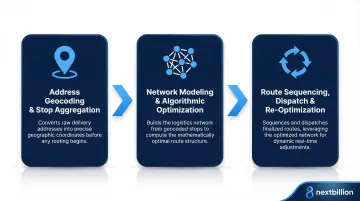
Step 1: Address Geocoding and Stop Aggregation
All subscriber addresses must first be geocoded and validated—assigned precise geographic coordinates. Incorrect or missing coordinates cause route errors downstream.
Rooftop or Address Point geocoding is highly accurate, centering on the rooftop or parcel centroid. Interpolated (Street Range) geocoding approximates location along a street segment and is often 10 to 50 meters off, producing physically impractical routes.
Addresses are then **aggregated into small geographic clusters** to reduce computational complexity—for example, grouping one side of a block into a logical delivery cluster. These clusters become the building blocks for full carrier routes, ensuring carriers walk or cycle in coherent geographic patterns rather than zigzagging.
Step 2: Network Modeling and Algorithmic Optimization
Unlike vehicle routing that uses road networks and driving speeds, paper distribution optimization must model sidewalk networks, pedestrian crossings, and cycling paths.
This requires either a specialized postal network layer or a converted road network that represents walkable/cyclable segments. Vehicle routing algorithms applied to pedestrian delivery produce inaccurate time estimates and physically impractical route sequences.
How Optimization Algorithms Build Routes:
The system minimizes total distance or carrier work time while enforcing constraints such as:
- Maximum work time per carrier
- Geographic non-overlap between routes
- Safe crossing preferences (avoiding high-traffic road crossings)
- Carrier-specific load limits for printed bundles
Modern route optimization platforms such as NextBillion.ai's Route Optimization API support 50+ configurable hard and soft constraints. Paper distribution operators can encode their specific rules — time limits, carrier types, zone boundaries — directly into the optimization model, no custom engineering required.
Step 3: Route Sequencing, Dispatch, and Continuous Re-Optimization
With routes built, the next task is sequencing. The system generates an optimized stop sequence within each route (the exact order addresses are visited) to minimize backtracking and ensure carriers complete all stops within the allotted window.
Finalized routes are dispatched to carriers via mobile app, printed map, or navigation tool. Performance data from completed routes feeds back into future re-optimization cycles, particularly when:
- Subscriber lists change (additions, cancellations)
- Carriers are added or removed
- Seasonal delivery volumes shift
This feedback loop ensures routes remain efficient as operational realities change.
Key Factors That Affect Route Optimization in Paper Distribution
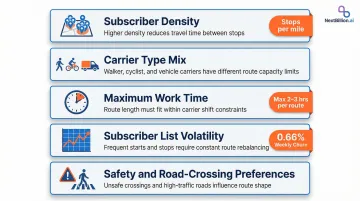
Route quality depends on several primary inputs:
Subscriber density and geographic distribution: Higher density allows more stops per kilometer but increases crossing complexity. Sparse suburban or rural zones require more vehicle-assisted delivery and reduce walking route efficiency.
Carrier type and capability mix: Routes built for walkers, cyclists, and vehicle-assisted carriers have different network, speed, and capacity assumptions. Mixing carrier types without reflecting this in the model produces unrealistic route assignments.
Maximum work time per carrier: Labor rules or contractual limits on carrier hours are hard constraints. Routes that exceed these limits force overtime and create compliance risk. In the US, DOT Hours of Service rules govern commercial drivers; for foot and cycle carriers, contractual caps vary by operator. Any optimization model must treat these limits as non-negotiable boundaries.
Subscriber list volatility: High cancellation or new-subscription rates destabilize balanced routes quickly. Mather Economics reports a digital-only monthly churn median of 3.8% and a print weekly churn average of 0.66%. The frequency with which operators re-run optimization determines how far actual routes drift from theoretical efficiency.
Safety and road-crossing preferences: Minimizing crossings of high-traffic roads or assigning a penalty cost to unsafe crossings is a distinct optimization parameter not found in standard vehicle routing. UK NFRN guidelines mandate routes avoid zigzagging across main roads. Routes that ignore this increase carrier risk.
Common Challenges and Misconceptions in Paper Route Optimization
Misconception: Paper Routes Are "Static" and Don't Need Ongoing Optimization
The delivery schedule may repeat daily, but the subscriber list does not — and that distinction is what makes static route thinking so costly.
Route imbalance accumulates with every subscriber change. Routes that are never re-optimized become progressively less efficient. The Irish Times noted routes constantly change due to holidays and daily subscription updates.
Misapplying Tools: Vehicle Routing Software for Pedestrian Routes
Using vehicle routing software (designed for road networks and driving speeds) for pedestrian or cycling routes produces inaccurate time estimates and physically impractical route sequences.
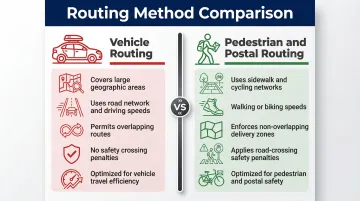
According to ESRI conference research, the two approaches differ in fundamental ways:
- Vehicle routing covers large geographic areas, uses road speeds, and permits overlapping routes
- Pedestrian/postal routing builds on sidewalk networks, uses walking or biking speeds, enforces non-overlapping routes, and applies safety penalties for crossing major roads
General-purpose tools like Google Maps compound this problem. They lack the multi-stop optimization, constraint handling, and workload balancing that paper distribution at scale requires.
Confusion Between Route Optimization and Route Sequencing
Building balanced carrier territories (route optimization) is a distinct and more complex task than simply ordering stops within an already-defined territory (route sequencing).
Many teams invest in sequencing tools while neglecting territory rebalancing, which drives the largest efficiency gains. The Atlanta Journal-Constitution decreased route counts by 15% and saved more than $1 million by replacing a county-line manual structure with optimized routing.
Frequently Asked Questions
What is the best route optimization software for paper distribution?
Prioritize platforms that support:
- Pedestrian and cycling network routing (not just road networks)
- Constraint handling for workload balancing, time windows, and safe crossings
- Scalability to thousands of stops per optimization run
- API flexibility for integration with existing dispatch systems
NextBillion.ai, for example, supports 50+ configurable hard and soft constraints and pedestrian network modeling — both critical for paper distribution operations.
What is an example of route optimization for paper distribution?
FK Distribution, serving 2.7 million households in Denmark twice weekly, used optimization software to rebuild carrier routes. The system reduced overall route count, eliminated planning time bottlenecks, and re-balanced workloads across 20,000+ routes.
How is paper distribution routing different from standard last-mile delivery routing?
Paper distribution routing uses pedestrian sidewalk and cycling networks rather than road networks, operates at walking or cycling speed, requires strict geographic non-overlap between carrier zones, and prioritizes workload balance over individual delivery speed.
How do route optimization tools handle recurring newspaper routes?
Most systems manage recurring routes as static or hybrid routes — fixed base routes that are periodically re-optimized when subscriber changes accumulate — rather than recalculated fresh each day as in dynamic last-mile delivery.
What constraints should a route optimization system handle for paper delivery?
A capable system should handle:
- Maximum carrier work time per shift
- Geographic zone non-overlap between carrier areas
- Pedestrian or cycling network compatibility
- Safe road-crossing preferences
- Carrier type and capacity limits
- Subscriber time window requirements
Can paper distribution use the same route optimization tools as other logistics operations?
General vehicle routing tools can be partially adapted but typically lack pedestrian network modeling, workload-balancing across zones, and the constraint sets paper distribution requires. Highly configurable API-based platforms handle these gaps more reliably than off-the-shelf vehicle routing software.