Introduction
Third-party logistics providers operate under relentless pressure. Shipment volumes climb year over year, clients demand tighter SLAs and real-time visibility, and margins shrink as operational costs rise. For 3PLs managing hundreds of daily deliveries across multiple clients, routing has become the single most critical operational lever—the difference between profitability and losses, contract renewal and churn.
The financial stakes are steep. The global 3PL market is projected to reach $2.5 trillion by 2033, yet fuel costs alone account for 21-25% of total operating expenses, with non-fuel marginal costs hitting a record $1.779 per mile in 2024. Every inefficient mile directly erodes already-thin profit margins.
This guide covers everything 3PL operators need to act on routing inefficiency. You'll learn what makes 3PL routing uniquely complex, how optimization addresses the core challenges, which software features actually move the needle, and how to measure the ROI of any solution you deploy.
TLDR:
- 3PLs face unique routing challenges across multiple clients, diverse SLAs, and mixed vehicle fleets that generic tools can't handle
- Poor routing wastes 16.7% of miles driven and costs $17-18 per failed delivery
- Route optimization cuts fuel costs 20-30% and pushes on-time delivery rates above 99%
- Must-have features include 50+ constraint support, multi-depot capability, and seamless TMS/telematics integration
- AI-powered optimization learns from historical data to continuously improve ETAs and automate exception handling
What Makes 3PL Route Optimization Different from Standard Routing
Unlike single-brand fleets serving one customer base, 3PLs operate across multiple clients simultaneously. Each client brings its own delivery windows, SLA tiers, product handling protocols, and penalty structures. A route that works for one client may violate another's time window, vehicle type requirement, or temperature control mandate.
Generic route planning tools designed for single-client scenarios lack the constraint-aware, multi-client routing logic 3PLs need to operate profitably.
The operational scale compounds this further. 3PLs typically manage multi-depot operations, serving overlapping delivery zones from different warehouse locations. Order volumes spike unpredictably based on seasonal demand, promotional campaigns, or supply chain disruptions.
Fleet composition adds another layer: vans for small parcels, refrigerated units for perishables, and heavy trucks for bulk freight each carry different capacity limits, operating costs, and access restrictions. Standard off-the-shelf tools don't account for this variability.
The Mathematical Challenge: Vehicle Routing Problem (VRP)
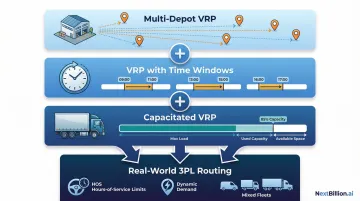
At the heart of 3PL routing lies the Vehicle Routing Problem (VRP): designing optimal route sets for vehicle fleets while minimizing distance, time, and cost. But 3PLs don't face the basic VRP. They wrestle with layered variants that multiply complexity:
- Multi-Depot VRP (MDVRP): Routes originating from several warehouse locations serving overlapping zones
- VRP with Time Windows (VRPTW): Service at each stop must occur within specific time windows
- Capacitated VRP (CVRP): Vehicle load limits constrain how many orders each route can accommodate
Real-world 3PL operations combine all three variants simultaneously, adding driver hours-of-service limits, inter-depot routing, dynamic demand changes, and heterogeneous fleets. At that scale, purpose-built optimization engines aren't a nice-to-have — they're the difference between meeting SLAs and eroding client margins on every run.
Top Routing Challenges Facing 3PLs Today
Operational Complexity Across Multiple Clients
Juggling diverse client requirements within a single driver network creates constant routing conflicts. One client requires exact two-hour delivery windows with SMS notifications. Another demands proof-of-delivery photos and signature capture. A third ships temperature-sensitive pharmaceuticals requiring continuous cold-chain monitoring.
All three share the same driver pool, often within overlapping delivery zones, under different SLA commitments. Multi-warehouse pickups amplify this further—drivers collect orders from several depots, consolidate loads, and serve multiple clients in the same trip, each with distinct priority tiers, handling instructions, and penalty clauses for late delivery.
Manual route planning breaks down quickly at scale, creating costly errors: wrong vehicle assignments, missed time windows, SLA breaches that trigger contract penalties, and inefficient routes that waste driver hours.
Real-Time Disruptions and Dynamic Conditions
Static pre-planned routes rarely survive contact with reality. Flash demand surges force last-minute order additions. Customer cancellations leave gaps mid-route. Road closures, weather events, and unexpected traffic invalidate carefully optimized plans. Without real-time adaptation, these disruptions cascade: one delayed stop pushes all subsequent deliveries late, creating a domino effect of missed windows and failed deliveries.
The financial cost is measurable. Deadhead miles—empty trucks running with no payload—rose to 16.7% of all miles driven in 2024. This represents pure waste: fuel burned, driver hours consumed, vehicle wear incurred, with zero revenue generated. Poor real-time adaptability directly creates this inefficiency.
Regulatory and Compliance Constraints
Routing can't ignore regulation. Hours-of-service (HOS) rules limit how long drivers can operate before mandatory rest breaks. Weight limits restrict which corridors heavy vehicles can use. Hazardous materials require specific routing protocols and certifications. Urban areas enforce delivery time restrictions—no large trucks during rush hour, loading zone time limits, residential noise ordinances.
Non-compliance carries real penalties:
- Fines that erode already-thin margins
- Delayed deliveries that trigger SLA breaches
- Legal liability for HOS violations
- Contract termination for repeated infractions
These aren't edge cases. Compliance constraints belong in routing logic from day one, not patched in after problems surface.
Driver Shortage and Capacity Pressure
The trucking industry faces a projected shortage of 160,000 drivers by 2030, with approximately 237,600 annual openings for heavy and tractor-trailer positions through 2034. This chronic shortage means 3PLs must extract maximum productivity from every available driver-hour.
Poor routing directly wastes driver capacity through:
- Unnecessary mileage from inefficient stop sequences
- Excessive idle time waiting for time windows to open
- Unbalanced workloads that create overtime spikes for some drivers while others underutilize hours
- High turnover from driver frustration with inefficient routes
Each of these inefficiencies compounds when multiplied across dozens of routes and drivers daily—making route optimization one of the highest-leverage investments a 3PL can make before headcount becomes the only lever left.
How Route Optimization Transforms 3PL Operations
Fuel and Cost Reduction
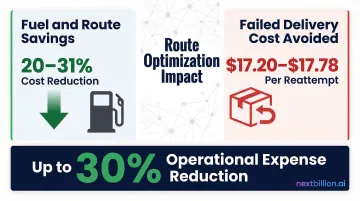
Optimized routing delivers immediate, measurable cost savings. Shorter total distances mean lower fuel consumption—significant when fuel represents 21-25% of operating costs at an average of $0.553 per mile. Reduced mileage also cuts vehicle maintenance frequency, extends equipment life, and lowers wear-and-tear expenses.
Real-world results demonstrate substantial impact. A mid-sized 3PL achieved a 31% reduction in route costs and 24% reduction in fuel consumption after implementing AI-powered route optimization. Another deployment delivered a 22% reduction in transportation and warehousing costs for a pharmaceutical distribution network.
Eliminating failed deliveries adds a second layer of savings. Each failed delivery costs $17.20 to $17.78 to reattempt, with up to 20% of e-commerce packages failing on first attempt. Tighter ETAs and automated customer notifications directly reduce failure rates, avoiding these expensive second trips.
Higher SLA Compliance and On-Time Performance
Optimization engines sequence stops to respect each client's time windows and priority tiers simultaneously. They generate predictive ETAs based on real-time traffic, historical patterns, and actual driver behavior. When conditions change mid-route, dynamic rerouting keeps drivers on track, adjusting stop sequences without manual dispatcher intervention.
Consistent SLA compliance is also a competitive differentiator in contract renewals and new client acquisition. 3PLs that can demonstrate superior on-time performance win business others can't. One documented case showed on-time delivery rates improving from 84% to 99.2% after optimization deployment — making routing a measurable factor in revenue retention.
Increased Driver and Fleet Utilization
Optimization matches the right vehicle type, driver skill set, and familiar geography to each route. This spreads workload evenly across the fleet, preventing overtime spikes while keeping all drivers productively engaged. Balanced assignments reduce turnover. Drivers prefer consistent, well-planned routes over chaotic, constantly changing ones.
Higher utilization means a smaller driver pool handles greater order volumes. Instead of hiring proportionally as volume grows, 3PLs extract more delivery capacity from existing staff through intelligent route design and balanced workload distribution.
Scalability Without Proportional Headcount Growth
Manual route planning consumes dispatcher time — hours spent each day building routes, assigning loads, and responding to disruptions. Optimization automates this work. One 3PL reduced dispatcher planning time from 4 hours to 30 minutes, a 75% productivity increase.
This automation enables scaling. Planners shift from building every route manually to managing exceptions. When new clients onboard, the system absorbs increased volume without requiring additional planning staff. Operational costs rise more slowly than volume, which is how profitable 3PLs maintain margins as they grow.
Enhanced Customer and Client Transparency
The efficiency gains above are internal — but optimization also reshapes how 3PLs communicate with the clients and end recipients they serve. Real-time tracking feeds and automated notifications make logistics visible rather than opaque. End recipients receive accurate ETAs and delivery updates. Shipper clients access performance dashboards showing on-time rates, miles per stop, and SLA compliance by route, driver, and time period.
This visibility provides the data-backed reporting needed to justify contract terms, demonstrate value during renewals, and win competitive bids. Transparency becomes a service differentiator, not just an operational capability.
Must-Have Features in 3PL Route Optimization Software
Multi-Constraint Route Planning
The most critical differentiator in 3PL route optimization is constraint breadth—how many real-world limitations the engine handles simultaneously. Basic tools might support vehicle capacity and time windows. Enterprise 3PL operations require far more:
- Delivery time windows (hard and soft)
- Vehicle capacity (weight, volume, pallet count)
- Driver hours-of-service limits
- Customer priority tiers
- Load type compatibility (hazmat, refrigerated, fragile)
- Truck restrictions (height, weight, axle count)
- Multi-depot origins
- Proof-of-delivery requirements
- Break and rest period scheduling
- Skills-based assignment (liftgate, forklift certified)
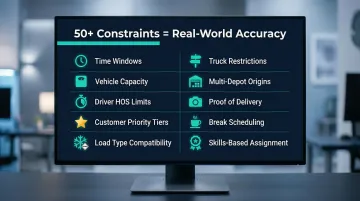
Solutions supporting 50+ hard and soft constraints (like NextBillion.ai's routing engine) enable 3PLs to model real-world complexity without workarounds. Fewer constraints mean planners must manually adjust routes post-optimization, defeating the purpose of automation.
Dynamic Rerouting and Real-Time Adaptation
Static optimization solves yesterday's problem. Today's 3PL operations demand continuous adaptation as conditions change. The software should ingest live traffic, weather alerts, and order changes to automatically recalculate routes mid-day.
Look for:
- Sub-second rerouting response times—not minutes—so dispatchers aren't waiting on the system
- Automatic rebalancing of remaining stops across the fleet when one route falls behind
- No manual dispatcher intervention required for standard adjustments
Without this, a single late pickup can ripple into missed delivery windows across a dozen other stops.
Multi-Depot and Large-Scale Distance Matrix Support
3PLs with distributed warehouses need multi-depot routing—optimizing across several origins simultaneously to serve overlapping zones efficiently. But technical limits matter here. Some routing tools cap distance matrix computations at 25×25 (625 total calculations), which breaks down quickly for large networks.
Google's Distance Matrix API limits requests to 25 origins or 25 destinations, while OpenRouteService restricts optimization to 50 routes and 3 vehicles. These constraints force workarounds, fragmented API calls, and higher costs.
Enterprise-grade platforms handle large-scale matrices—5000×5000 or greater—needed for hundreds of simultaneous stops across multiple depots without hitting artificial ceilings.
Seamless Integration with TMS, WMS, and Fleet Systems
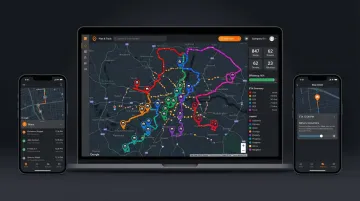
Route optimization doesn't operate in isolation. It must plug into existing transportation management systems (TMS), warehouse management platforms (WMS), and telematics providers (Samsara, Geotab, Motive, Netradyne) to function effectively.
API-first architecture is the standard to require here. It should:
- Synchronizes order data from TMS/WMS in real time
- Pushes optimized routes directly to driver apps without manual re-entry
- Receives live vehicle location and status updates from telematics platforms
- Exports performance data back to analytics and reporting systems
Data silos between systems create the planning errors and delays optimization is meant to eliminate. Seamless integration ensures the entire logistics stack operates on consistent, synchronized information.
Reporting, Analytics, and Client-Specific Dashboards
3PLs need performance visibility at the client level—on-time rate, miles per stop, SLA compliance rate, and exception frequency. This serves two purposes:
- Internally, trend analysis surfaces underperforming routes and benchmarks driver productivity over time
- Externally, client-facing reports build trust, justify contract terms, and give 3PLs the data to retain and grow accounts
Platforms offering customizable dashboards segmented by client, route, driver, and time period give 3PLs the transparency that shifts contract conversations from price to proven performance.
How AI and Real-Time Data Are Reshaping 3PL Routing
AI-powered route optimization goes beyond today's routing problem—it learns from historical delivery data to generate increasingly accurate ETAs and efficient plans over time. Machine learning models analyze traffic patterns, dwell times at specific locations, and failed delivery rates by zone. One study showed ML-powered transit time predictions improving on-time deliveries by up to 41% when integrated into scheduling optimization.
Each completed route makes the system smarter. Over time, it surfaces patterns—seasonal shifts, customer behavior changes, emerging congestion corridors—that human dispatchers simply can't track at scale. The practical result: less planner intervention, more consistent execution.
Predictive Demand Forecasting
AI enables 3PLs to move from reactive to proactive operations through predictive demand forecasting. By analyzing order history, seasonal patterns, promotional calendars, and external signals (weather, events, economic indicators), systems can predict volume surges before they hit.
That forward visibility lets operations teams act ahead of the rush rather than scrambling to catch up:
- Pre-position drivers and vehicles in high-demand zones before volume peaks
- Adjust capacity allocations across depots based on predicted load distribution
- Align shift schedules to anticipated order volume instead of historical averages
Gartner predicts 70% of large-scale organizations will adopt AI-based forecasting by 2030—a signal that predictive planning is becoming a baseline expectation, not a differentiator.
Automated Exception Handling
AI reduces dispatcher firefighting burden through automated exception management:
- Automatically reschedules failed deliveries to the next available driver in the zone
- Redistributes loads instantly when a driver no-shows, without manual intervention
- Pushes updated ETAs to customers when congestion delays are detected—no dispatcher action required
Dispatchers stop reacting to individual exceptions and start focusing on operational decisions that actually require human judgment.
Measuring the ROI of Route Optimization for 3PLs
Key Performance Indicators to Track
Establish baseline metrics before deployment to prove ROI:
- On-time delivery rate: Percentage of deliveries completed within promised window
- Cost per stop: Total route cost divided by number of deliveries
- Total miles driven per day: Aggregate distance across all routes
- Fuel spend per route: Direct fuel cost for each delivery run
- Driver utilization rate: Productive driving hours as percentage of total shift time
- SLA compliance rate per client: On-time performance segmented by customer contract
Tracking these KPIs before and after deployment shows exactly where optimization pays off.
Financial Return Categories
ROI typically falls across three categories:
Direct Savings:
- Fuel cost reduction from shorter routes
- Overtime elimination through balanced workloads
- Maintenance cost reduction from lower mileage
Avoided Costs:
- Re-delivery fees eliminated through higher first-attempt success rates
- SLA penalty avoidance from improved on-time compliance
- Driver turnover reduction from better route quality
Revenue-Side Benefits:
- Contract retention from demonstrated performance improvement
- New client wins enabled by data-backed performance reporting
- Volume growth absorbed without proportional cost increase
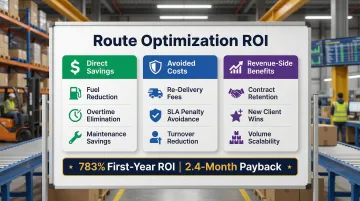
The numbers back this up. One mid-sized 3PL achieved a 2.4-month payback period and 783% first-year ROI. A separate study found 10–30% reductions in operational expenses, with some operators recovering their investment within 3 months.
The Scalability Dividend
The most overlooked ROI factor is what happens as you grow. With optimized routing, cost per delivery decreases as volume increases — the opposite of what happens with manual planning.
Manual processes add planner hours and error risk with every new client or order. Optimization absorbs that volume without proportional overhead, which is where real margin expansion happens at scale.
Frequently Asked Questions
What is 3PL route optimization?
3PL route optimization is AI-powered software that plans and dynamically adjusts delivery routes for third-party logistics providers. It accounts for multi-client SLAs, vehicle constraints, driver hours, and real-time conditions to minimize cost while maximizing service quality.
What is the best route optimizer?
The best route optimizer depends on operational complexity. 3PLs should prioritize platforms that support 50+ hard and soft constraints and offer API-first integration with existing TMS/WMS systems. Multi-depot handling and real-time dynamic rerouting — rather than static planning — are non-negotiable for serious 3PL operations.
How does route optimization reduce costs for 3PL providers?
Route optimization cuts costs across several areas: shorter routes reduce fuel spend, accurate ETAs prevent failed deliveries, and balanced driver workloads lower overtime. Reduced unnecessary mileage also extends vehicle life. Combined savings typically range from 20–30% of operational expenses.
What routing constraints should 3PL software support?
Essential constraints include:
- Delivery time windows and customer priority tiers
- Vehicle load capacity and multi-depot origins
- Driver hours-of-service limits
- Hazmat and truck-restriction rules
- Proof-of-delivery requirements
Platforms supporting 50+ constraints handle real-world 3PL complexity far more effectively than limited solutions.
How does AI improve route optimization for 3PLs?
AI enables predictive ETAs based on historical traffic patterns and dwell times, automated exception handling for failed deliveries or driver changes, and demand forecasting that lets 3PLs pre-position resources before volume spikes occur. Over time, these models get sharper — reducing exceptions and improving on-time rates without manual intervention.
Can 3PL route optimization software integrate with existing TMS and WMS platforms?
Modern route optimization platforms are built API-first, enabling integration with TMS, WMS, ERP, and telematics systems like Samsara, Geotab, and Motive. This eliminates manual data entry, synchronizes order and fleet data in real time, and keeps routing decisions aligned with warehouse operations.