Introduction
Fleet managers transitioning to electric trucks quickly discover a frustrating reality: swapping diesel vehicles for EVs doesn't mean existing route plans still work. Battery constraints, charging logistics, and energy variability introduce planning demands that conventional routing tools weren't designed to handle.
A route that looks viable on paper can strand a vehicle mid-shift if it doesn't account for how weather, load weight, or terrain affect battery drain.
Global zero-emission truck sales reached 89,000 units in the first half of 2025—a 136% year-over-year increase—capturing nearly 4% of the market. That growth is accelerating, but adoption hasn't translated into smarter planning. Many fleet operators, dispatchers, and logistics managers still treat EV routing as an afterthought — and missed charges lead to stranded vehicles, SLA failures, and hidden costs that erode the expected savings from electrification.
This guide walks through what makes electric truck route optimization distinct, how the process works step by step, what factors affect performance, and where teams commonly go wrong.
TL;DR
- Electric truck route optimization accounts for battery state-of-charge, energy consumption variability, and charging stop scheduling—not just shortest-path logic
- EV routing requires real-time data inputs—terrain, load weight, temperature, charger availability—to generate reliable plans
- The process spans fleet auditing, charging infrastructure integration, EV-specific parameter configuration, scenario modeling, and live performance monitoring
- Cargo weight, road gradient, charger type, and delivery windows interact—any one of them can make or break a planned route
- Treating EV routing as standard routing with charging stops added is a critical planning mistake that leads to stranded trucks and missed windows
What Is Electric Truck Route Optimization?
Electric truck route optimization is the process of planning multi-stop delivery routes for electric trucks that simultaneously satisfy delivery commitments and energy constraints, ensuring each vehicle has sufficient charge at every stage without triggering unplanned charging stops that disrupt schedules.
The process achieves on-time deliveries, maximum vehicle utilization, minimized charging downtime, and reduced energy cost per milewhile keeping drivers informed and fleet managers in control.
The difference from standard routing comes down to energy unpredictability. Conventional routing optimizes for distance, time, or cost. EV routing adds a dynamic energy layer, where battery drain varies based on:
- Load weight — heavier cargo depletes charge faster
- Road terrain — inclines draw significantly more power than flat routes
- Weather conditions — cold temperatures reduce usable battery capacity
- Speed — highway driving drains charge faster than urban stop-and-go
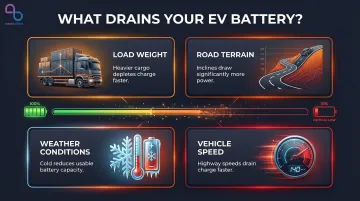
A diesel tank depletes at a relatively predictable rate. An EV battery doesn't — and route planning has to account for that variability at every stop.
Why Electric Truck Routing Demands a Different Approach
The Core Challenge: Battery Performance Is Not Static
Unlike a diesel tank that depletes predictably, an EV battery drains faster under heavy loads, on inclines, in cold weather, and at highway speeds. Research shows that consumption decreases by 0.132 kWh/km for every 10°C increase in outside temperature—meaning a route that works in summer can fail in winter.
What goes wrong without EV-specific planning:
- Drivers compensate by over-charging, wasting shift time
- Dispatchers assign routes that exceed real-world range
- Charging stops are added ad hoc, disrupting delivery windows
- Operational costs inflate as energy consumption exceeds projections
Battery variability is only part of the challenge. Regulatory changes are reshaping where and when electric trucks can operate—and that demands an entirely different planning layer.
Regulatory Pressure Makes This Non-Optional
Low-emission zones in major cities are tightening access for ICE vehicles. Municipalities in the Netherlands have designated zero-emission zones where only electric trucks, buses, coaches, and vans may enter. London's Ultra Low Emission Zone (ULEZ) grants EVs exemptions from fees that apply to diesel vehicles.
The scheduling advantage:
EVs' low noise output enables operations during hours banned for ICE trucks. In Stockholm, zero-emission zone designations remove the night traffic ban for HGVs over 3.5 tonnes. That opens new scheduling windows—but capturing them requires routing engines that can model alternative shift patterns, not just optimize a standard delivery sequence.
How to Optimize Electric Truck Routes: A Step-by-Step Process
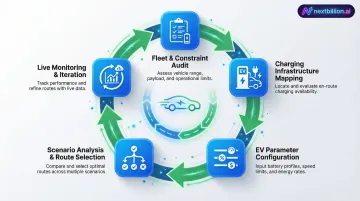
Electric truck route optimization runs as a repeatable planning cycle—not a one-time setup. Each iteration draws on accurate vehicle data, infrastructure mapping, constraint modeling, and live performance feedback.
Step 1: Audit Fleet and Operational Constraints
Gather vehicle-level data for each electric truck:
- Battery capacity (kWh) and real-world range under load
- Charge rate capabilities (AC vs. DC)
- Vehicle-specific road restrictions (height, weight, axle limits)
Capture operational data:
- Delivery time windows and depot start/end points
- Average cargo weight per route
- Shift duration and driver hour regulations
Complete, accurate inputs here determine whether route models reflect real-world behavior or produce plans that break down on the road.
Step 2: Map and Integrate Charging Infrastructure
Identify all available charging stations along or near planned route corridors:
- Charger type (Level 2 vs. DC fast charger)
- Charging speed (kW output) and operator network
- Real-time availability and known reliability issues
Critical assessment:
Flag coverage gaps, especially in secondary delivery zones or rural areas. Determine whether depot-based overnight charging is sufficient for route length or if en-route charging is required.
Step 3: Define EV-Specific Routing Parameters and Constraints
Configure the routing engine with EV-specific inputs:
- Minimum acceptable state-of-charge at each stop
- Maximum energy consumption thresholds per route segment
- Preferred charging windows aligned with driver break schedules
- No-go zones where charger access is unavailable
Where capable platforms make a difference:
Tools like NextBillion.ai's route optimization API support 50+ hard and soft constraints, including vehicle-specific parameters, battery state modeling, and charging stop sequencing. This lets planners enforce energy safety margins without artificially narrowing viable routes.
Step 4: Run Scenario Analysis and Select Routes
Generate and compare multiple route scenarios against key performance indicators:
- Total energy consumed
- Number and duration of charging stops
- Estimated delivery completion time
- Cost per mile and on-time delivery probability
Run sensitivity tests:
Simulate the same route under different conditions—summer vs. winter temperatures, full load vs. partial load—to understand where routes are fragile and where margin exists.
Step 5: Monitor Performance and Iterate
Once routes are live, track real-world outcomes against planned metrics:
- Actual state-of-charge at each stop vs. predicted
- Charging dwell time vs. planned
- On-time delivery rate
Feed this data back into consumption models to improve prediction accuracy. Identify recurring deviations—such as route segments that consistently drain more battery than expected—and adjust routing parameters accordingly.
Each completed cycle produces tighter models and more reliable routes. Over time, this feedback loop is what separates consistently efficient EV operations from fleets that are perpetually reacting to range and charging surprises.
Key Factors That Affect Electric Truck Route Optimization
Cargo Weight and Load Sequencing
Heavier loads increase energy draw significantly. Research shows an increase of +0.0183 kWh/km per additional tonne (+0.18 kWh/km per 10 tonnes). Routes should be planned to drop heavier deliveries first—reducing load weight and extending effective range across the shift.
Urban vs. highway impact:
High payloads in urban driving use 30% more energy than low payloads, while high payloads in motorway driving use only 10% more energy. The stop-and-go nature of urban routes penalizes heavy loads significantly more than steady-state highway driving.
Terrain and Road Gradient
Inclines dramatically increase energy consumption. A variation in altitude of 100 metres results in a difference in energy consumption of 0.15 kWh/km. Flat routes are more energy-efficient but not always available.
Real-world comparison:
Research measured consumption at 1.77 kWh/km on a 117 km route with slight incline (730 metres altitude) and 2.7 kWh/km on a steeper 69 km section (2,664 metres altitude). EV route optimization must incorporate elevation data to avoid planning routes that look short on a map but drain batteries heavily on uphill segments.
Temperature and Weather Conditions
Cold weather reduces battery efficiency, and HVAC use further depletes charge. Under extremely cold temperatures (0°F), additional HVAC energy consumption leads to an average of approximately 50% range loss, with a maximum of 59% in urban driving conditions.
Seasonal planning:
Route planners need to factor seasonal energy consumption models into planning assumptions rather than using a single fixed range figure year-round. Vehicles with Temperature Control Units (TCU) add another 0.092 kWh/km on top of base consumption — model this separately when building cold-weather route plans.
Charging Station Type and Wait-Time Risk
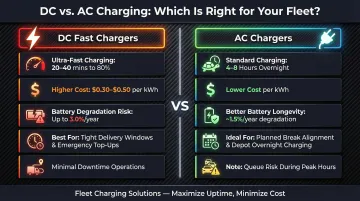
DC fast chargers:
- Allow partial top-ups during tight delivery windows
- Cost more per kWh than depot AC charging — US public DC fast charging typically runs $0.30–$0.50/kWh
- Can degrade battery longevity—vehicles relying heavily on DC fast charging above 100 kW experienced degradation averaging up to 3.0% per year, compared with 1.5% for AC or lower-power charging
AC chargers:
- Cheaper per kWh but require longer dwell times
- Ideal when aligned with planned breaks
- Better for long-term battery health
- Queue risk at public chargers during peak delivery hours must be factored into scheduling buffers
Time-Window Constraints and Shift Structure
Delivery time windows, driver hour regulations, and noise-restriction zones all interact with charging requirements. In some urban areas, EVs' low noise output enables operations during hours banned for ICE trucks. These scheduling opportunities only pay off when the routing engine can model alternative shift patterns — not just optimize a standard single shift.
Common Mistakes and Misconceptions in EV Route Planning
Treating EV Routing as Standard Routing with Charging Stops Added
Treating charging as an afterthought is the most prevalent EV routing mistake. Charging is not a pit stop—it's a scheduling constraint that must be embedded into the optimization model from the start, not layered on top of an existing diesel route plan. Routes designed for ICE trucks and then "adapted" for EVs routinely underperform because they don't account for energy dynamics from the first stop.
Using Static Range Figures Instead of Dynamic Consumption Models
Electric truck range specifications provided by manufacturers are tested under controlled conditions. Real-world range varies based on load, terrain, speed, and temperature.
As NACFE research notes:
"Stating kWh/mi consumption as a single value is problematic. Actual behavior shows the value varies depending on vehicle speed, weight, and environmental conditions." Teams that plan against nameplate range rather than modeled real-world consumption regularly produce routes that either strand vehicles or force unnecessary charging stops that erode productive run time.
Underestimating the Complexity of Mixed Fleets
Many operators run a combination of EVs and ICE trucks. When planning tools treat all vehicles interchangeably, the results are predictable:
- EV trucks get assigned to routes that exceed their real-world range
- ICE trucks sit idle on short urban legs where EVs would be more cost-effective
- Charging access at the route level goes unaccounted, creating day-of scrambles
- Efficiency gains from EV adoption go unrealized because assignments ignore vehicle capability
Route planning that segments by vehicle type, range profile, and local charging infrastructure is what separates operators who scale their EV fleets from those who stall.
Frequently Asked Questions
What makes electric truck route optimization different from standard truck routing?
Electric truck routing must model energy consumption dynamically based on load weight, terrain, and temperature—not just distance or time. It incorporates charging stop scheduling as a hard constraint and accounts for variables that directly affect battery range, making it a fundamentally different planning problem than diesel routing.
How do you account for charging time within delivery schedules?
Align charging stops with mandatory driver break periods or low-demand time windows. Treat charging duration as a hard scheduling input in constraint-based planning—building it into the route from the start, not appended as a buffer—so routes remain executable under real conditions.
What data inputs are needed to build an EV-optimized route?
Core inputs required include:
- Vehicle battery specs and real-world range
- Depot and charging station locations with charger output speeds
- Cargo weights and delivery time windows
- Terrain and elevation data
- Historical energy consumption per route segment
Missing any of these forces planners to estimate rather than calculate, which leads to range shortfalls and missed delivery windows.
How does cargo weight affect electric truck range and route planning?
Heavier payloads increase energy draw per mile, shortening effective range. Planners should sequence deliveries to drop heavier loads first, reducing energy consumption progressively across the shift and maximizing the distance achievable on a single charge.
Can route optimization software handle a mixed fleet of EVs and ICE trucks simultaneously?
Capable route optimization platforms can model vehicle-specific constraints across mixed fleets, assigning routes based on vehicle type, range, and local infrastructure. This requires the software to support per-vehicle constraint configuration rather than applying a uniform routing profile to all vehicles.
What KPIs should fleet managers track to measure EV route optimization performance?
Key metrics to monitor:
- On-time delivery rate
- Actual vs. predicted state-of-charge at each stop
- Average charging dwell time per route
- Energy cost per mile
- Battery health trends correlated with charging behavior
Together, these reveal whether your optimization model reflects real-world performance and where recalibration is needed.