Introduction
Unlike standard parcels, ice begins degrading the moment it leaves the facility—making route sequencing a direct determinant of product quality, not just cost. In perishable food distribution, an estimated 8–23% loss in quality occurs during the distribution process due to frequent exposure to increased temperatures when vehicles stop for deliveries. The result is revenue loss measured in melted inventory and customer chargebacks.
Fleet planners and operations managers at ice distribution companies face a combination of extreme demand volatility, multi-stop complexity, and perishability that manual planning simply can't handle at scale.
Seasonality sharpens that pressure considerably. Approximately two-thirds of all bagged ice sales occur between Memorial Day and Labor Day, forcing distributors to flex capacity dramatically. Arctic Glacier, for example, runs up to 1,500 trucks in summer and pulls back to 400 in winter.
This article breaks down how ice delivery route optimization works, what drives its effectiveness, and where the common planning mistakes occur.
TL;DR
- Route optimization sequences and assigns ice delivery stops across vehicles and time windows to cut costs while protecting product integrity
- Manual planning fails at scale; optimization software cuts planning from hours to seconds and handles multi-stop constraint complexity automatically
- Key inputs: customer locations, delivery volumes, vehicle capacities, time windows, and depot configurations
- Primary benefits include reduced fuel and labor costs, higher stop counts per route, and on-time delivery consistency
- Delivers the most value for operations running 20+ daily stops, multiple vehicles, or significant seasonal demand swings
What Is Ice Delivery Route Optimization?
Ice delivery route optimization is the systematic use of algorithmic planning tools to determine which vehicle serves which customer stops, in what order, within what time constraints—with the goal of minimizing total operating cost while ensuring product arrives intact and on time.
Effective optimization delivers fewer vehicle miles, reduced driver hours, maximum stop throughput per route, and a delivery schedule that customers and facilities can rely on. When a grocery chain expects delivery between 6–8 AM and a convenience store requires service before noon, the route plan must respect both windows without inflating costs.
Standard route planning arranges stops efficiently by geography. Ice delivery route optimization adds product-specific constraints that change what "efficient" means in this context:
- Vehicle load limits by weight and volume
- Narrow customer time windows
- Product exposure duration thresholds
A geographically short route that overloads a vehicle or violates a customer's receiving window fails on every operational measure that matters.
Why Route Optimization Is Critical for Ice Distribution
Perishability Destroys Revenue
Ice deteriorates in transit, meaning a delayed or poorly sequenced route doesn't just frustrate customers — it destroys inventory and erodes margin. Quality loss compounds across loading, transit, and unloading: temperature abuse is additive at every phase. The financial consequence extends beyond product loss: major retailers enforce strict delivery compliance, with Kroger charging a 3% chargeback on purchase order value for late deliveries.
Seasonal Demand Volatility Breaks Static Plans
Ice demand is heavily weather-dependent, with summer volumes capable of requiring 3–4x the winter fleet size. Arctic Glacier's fleet scales from 400 trucks in winter to 1,500 in summer to manage this volatility. Quarterly or monthly static route plans become operationally irrelevant when demand can double in a matter of weeks. Frequent replanning capability, weekly or even daily master route refreshes, is non-negotiable.
Multi-Stop Complexity Compounds Error
Ice distributors serve a wide mix of accounts, each with different order sizes, receiving windows, and dock requirements:
- Supermarkets and grocery chains with strict compliance windows
- Convenience stores and gas stations requiring frequent, small drops
- Restaurants, event venues, and industrial accounts with variable demand
Manual sequencing across 40–80 stops introduces compounding error. A single misplaced stop early in a route can cascade into late deliveries, overtime charges, and compliance penalties.
Unoptimized Routing Exposes Cost
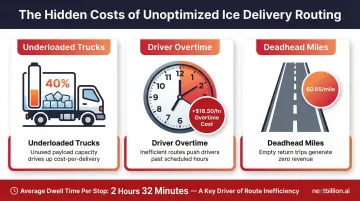
Without algorithmic planning, three cost patterns emerge repeatedly:
- Underloaded trucks making unnecessary runs
- Drivers incurring overtime from inefficient stop sequences
- Excessive deadhead miles adding up across the fleet
Fuel alone runs around $0.65 per mile for deadhead trips. Refrigerated carriers also average 2 hours and 32 minutes of dwell time per stop, compounding fuel burn and temperature abuse risk on every route.
How Ice Delivery Route Optimization Works
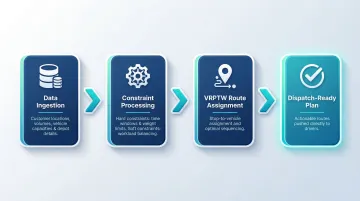
The system ingests delivery orders, customer addresses, time window requirements, vehicle load capacities, driver shift parameters, and depot locations. It then runs an optimization algorithm to generate the most efficient route assignments and stop sequences across the available fleet.
What goes into the system:
- Customer coordinates and delivery volumes
- Vehicle capacity limits (weight and cubic volume)
- Driver availability and shift windows
- Depot start and end locations
- Customer-specific access requirements (e.g., dock hours, vehicle size restrictions)
- Priority tiers for high-value accounts
Constraint Processing
The optimizer evaluates hard constraints (non-negotiable parameters like vehicle weight limits, mandatory delivery time windows, and driver hours-of-service caps) alongside soft constraints such as minimizing backtracking, balancing route workloads, and reducing idle time between stops.
NextBillion.ai supports 50+ configurable hard and soft constraints, giving ice distributors with complex multi-depot networks the flexibility to build precise, enforceable route plans at scale. This means planners can embed operational realities—like grocery chains that only accept deliveries before 7 AM or event venues with weekend-only access—directly into the optimization logic.
Route Assignment and Sequencing
Once constraints are processed, the algorithm assigns stops to specific vehicles and sequences them using Vehicle Routing Problem (VRP) methodology, optimizing for a defined objective (typically minimizing total distance, delivery time, or fuel cost) while ensuring all hard constraints are satisfied.
For ice delivery, the most relevant variant is VRPTW (VRP with Time Windows), which extends basic capacity constraints by adding strict delivery time windows for each customer—critical for retail compliance. The result is a set of route plans that a dispatcher can act on immediately, without manual adjustment.
Dynamic Replanning
Even a well-structured plan encounters friction once drivers are on the road. Rush orders arrive, stops cancel, traffic shifts, and weather events disrupt volume forecasts. Route optimization platforms that handle real-world conditions support dynamic replanning: re-sequencing active routes in real time, updating driver assignments, and pushing revised ETAs to customers without rebuilding the day's plan from scratch.
Arctic Glacier shifted from creating master routes monthly or quarterly to replanning master routes every 1–2 weeks, allowing them to continually fine-tune delivery productivity and cost-effectiveness during the highly volatile summer peak season.
Key Factors That Affect Ice Delivery Route Optimization
Delivery Time Windows
Grocery chains, event venues, and commercial accounts typically enforce strict receiving hours—narrow windows compress route flexibility and can force suboptimal sequencing. Tight clustering of time windows in a geographic area can limit how many stops one vehicle can realistically serve. Analytical research indicates that discrete, non-overlapping time window constraints and vehicle capacity limits can diminish or even eliminate expected efficiency gains from integrating pickup and delivery operations.
Vehicle Capacity and Load Composition
Packaged ice comes in varied formats—bagged ice, block ice, and bulk loose ice—each with different weight-to-volume profiles. Mixed loads require careful capacity planning so vehicles are neither overloaded (compliance risk) nor underutilized (cost inefficiency). A truck that maxes out on volume before reaching weight capacity wastes payload potential and increases cost per delivered unit.
Seasonal and Demand Variability
Summer peaks can multiply daily stop counts and order volumes rapidly. Effective optimization requires frequent route replanning—weekly or even daily master route refreshes rather than quarterly—as well as real-time fleet visibility to manage the expanded fleet.
Route optimization platforms that connect directly to telematics systems address this gap. NextBillion.ai integrates with fleet telematics platforms like Samsara and Geotab, giving dispatchers live route visibility as demand shifts. Optimized routes flow directly into driver applications, cutting manual data entry and the lag between replanning and execution.
Depot and Distribution Network Structure
Multi-depot operations require the optimizer to assign each delivery to the most cost-efficient origin facility, not just sequence stops geographically. Poorly configured depot assignments inflate mileage by routing trucks past better-positioned warehouses. The Isochrone API enables logistics planners to generate dynamic travel-time and travel-distance polygons from multiple candidate depot locations simultaneously. This lets planners compare coverage zones and quantify the incremental coverage gained by adding new facilities.
Road Access and Vehicle Restrictions
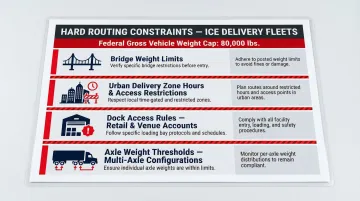
Refrigerated ice trucks are often heavy vehicles subject to bridge weight limits, urban delivery restrictions, and dock access rules at retail facilities. Federal limits cap maximum gross vehicle weight at 80,000 pounds, with single axles limited to 20,000 pounds and tandem axles to 34,000 pounds. New York City uses weigh-in-motion technology to automatically issue $650 violations to overweight trucks.
These restrictions must be embedded as hard routing constraints before dispatch. Discovering them mid-route means compliance violations, unplanned detours, and lost delivery windows. Key constraints to encode include:
- Bridge weight limits by corridor
- Urban delivery zone hours and access restrictions
- Dock access rules at specific retail or venue accounts
- Axle weight thresholds for multi-axle configurations
Common Misconceptions and Limitations
Misconception—Shortest route equals best route: In ice delivery, a geographically shorter route may still be operationally wrong if it overloads a vehicle, violates a customer's receiving window, or extends in-vehicle time to the point where product quality degrades. Effective optimization balances multiple objectives simultaneously, not just mileage.
Misconception—Optimization is only for large fleets: Even a 5–10 truck operation serving 30–60+ stops per day reaches a complexity level where manual sequencing reliably produces suboptimal results. According to a Paragon Routing case study, a produce processor running 50 trucks cut delivery cost-per-case from $2.40 to $1.92 (a 20% reduction) while eliminating 10 trucks from its fleet. The break-even point for route optimization software is lower than most operators expect, particularly for those with mixed customer types and variable time windows.
Limitation—Data quality determines output quality: Route optimization is only as effective as the inputs it receives. Inaccurate addresses, vague time windows, and misconfigured vehicle profiles will produce suboptimal routes no matter how advanced the solver. To keep outputs reliable, distributors should:
- Maintain clean customer master data with validated coordinates
- Confirm time windows with customers on a regular cadence
- Accurately configure vehicle capacity profiles (both weight and volume) in the system
Frequently Asked Questions
How do you optimize delivery routes?
Route optimization works by inputting stop locations, time windows, vehicle capacities, and depot details into optimization software. The platform sequences stops and assigns vehicles to minimize cost while meeting all delivery requirements—generating actionable route plans in seconds.
How much does route optimization software cost?
Pricing models vary—some vendors charge per API call, which scales unpredictably with volume, while others use per-vehicle or per-route fixed pricing. NextBillion.ai offers pay-as-you-go and asset-based pricing tied to fleet size, so costs stay predictable regardless of API call volume.
What makes ice delivery different from other perishable goods distribution?
Ice has extreme time and temperature sensitivity—it degrades in transit, not just in storage—combined with dramatic seasonal demand swings (summer volumes can be 3–4x winter levels) and high-volume, multi-stop distribution to diverse customer types. These factors create optimization constraints not present in most other perishable delivery contexts.
How does seasonal demand affect ice delivery route planning?
Summer demand can require several times the winter fleet capacity, making fixed seasonal route plans unworkable. Effective planning means replanning master routes weekly or more frequently and scaling vehicle and driver assignments dynamically as volumes shift.
Can route optimization software handle multi-depot ice distribution networks?
Advanced platforms assign deliveries to the most cost-efficient origin depot, balance load across facilities, and optimize inter-depot logistics—essential for distributors running regional warehouse networks. NextBillion.ai's Isochrone API extends this with multi-depot coverage analysis and depot location planning for network-level decisions.
What data is needed to start optimizing ice delivery routes?
Essential inputs include accurate customer delivery addresses, time windows, order volumes and formats, vehicle load capacities, depot locations, and driver shift schedules. Missing or inaccurate data in any of these categories will constrain what the optimization can achieve—so auditing inputs before launch is worth the effort.