Introduction
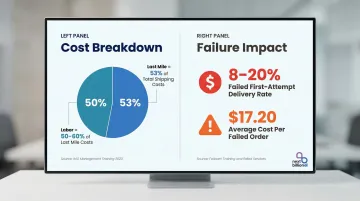
Last mile delivery has become the defining competitive battleground in modern logistics — and the most expensive. It accounts for 53% of total shipping costs, with labor alone consuming 50-60% of those expenses.
It's also the segment customers judge most harshly. A missed delivery window or a late shipment erases the goodwill built across the entire order journey.
E-commerce order volumes keep climbing, reaching 22.37 billion parcels in 2024 — a 3.4% increase from 2023. Consumer expectations have reset around same-day and next-day delivery as the baseline standard. Legacy carriers are struggling to keep pace, creating space for a new generation of last mile providers and technology platforms to emerge.
This blog covers two distinct categories businesses must understand to build or scale delivery operations in 2026: last mile carriers (companies that physically execute deliveries, like FedEx and Amazon Logistics) and last mile technology providers (software and API platforms that power route optimization, dispatch, and visibility, like Onfleet and NextBillion.ai). Each plays a different role — and knowing which you need, or how to combine both, is what separates efficient operations from expensive ones.
TLDR
- Last mile delivery is the final step from a local hub to the customer's door, accounting for 53% of total shipping costs
- Two provider types dominate: carriers that handle physical deliveries and software platforms that optimize routing and dispatch
- Selection depends on your delivery model, volume, geographic coverage, and whether you manage your own fleet or outsource
- Route optimization, real-time visibility, integration flexibility, and scalability are the criteria that matter most
- This guide profiles six leading companies across both categories with feature breakdowns for different use cases
What Is Last Mile Delivery?
Last mile delivery is the final movement of goods from a distribution hub or fulfillment center to the end customer's address. Despite the name, "last mile" can be a literal mile in dense urban areas or dozens of miles in rural regions — with urban deliveries averaging $10 per package while rural deliveries can reach $50.
The market is massive and growing. The global last mile delivery market was valued at $143.1 billion in 2023 and is projected to reach $258.68 billion by 2030, growing at an 8.8% CAGR — driven by e-commerce expansion and rising consumer delivery expectations.
Those expectations pull in opposite directions: 80% of consumers want a same-day delivery option, yet 90% are willing to wait 2-3 days to avoid shipping costs. Balancing speed against cost is the defining operational challenge in last mile logistics.
Failed first-attempt deliveries range from 8-20%, costing an average of $17.20 per failed order. That failure rate compounds fast at scale — which is exactly why picking the right carrier partners and route optimization tools can make or break your delivery operation.
Top Last Mile Delivery Companies & Providers in 2026
The companies below were selected based on market presence, technology capability, delivery network reach, customer trust, and suitability for different business models. The list spans both physical carrier networks and software infrastructure providers.
FedEx
FedEx operates one of the world's largest logistics networks, serving 220+ countries and territories with a full spectrum of last mile options from ground to express to same-day. The company handles 3.7 billion U.S. parcels annually and maintains 100% continental U.S. residential coverage.
What sets FedEx apart for last mile is its FedEx Delivery Manager tool, which gives consumers control over delivery preferences, scheduling flexibility, and real-time tracking — all free of charge. The breadth of service levels (FedEx Ground, Home Delivery, SameDay Local) allows businesses to balance cost and speed based on customer promise requirements. FedEx achieved a 95.3% on-time performance rate during the 2025 peak season, demonstrating reliability at enterprise scale.
| Criteria | Details |
|---|---|
| Key Service Types | Ground, Express, SameDay City, Home Delivery, FedEx Freight |
| Pricing Model | Weight- and distance-based; additional residential and fuel surcharges apply; quote through FedEx account portal |
| Best Fit | Enterprise e-commerce and retail brands needing broad national and international coverage with multiple speed tiers |
Amazon Logistics
Amazon Logistics is the in-house delivery arm of Amazon, now one of the largest parcel networks in the U.S. The network delivered 6.3 billion packages in 2024, capturing 28.2% U.S. market share. It operates through a mix of Amazon-owned vans, 4,400 Delivery Service Partners (DSPs) employing over 390,000 drivers, and Amazon Flex independent contractors.
Amazon Logistics differentiates through deep route optimization algorithms built at massive scale, same-day and next-day delivery infrastructure linked directly to fulfillment center proximity, and increasingly open Seller Flex and Buy Shipping programs that let third-party marketplace sellers access its network. Amazon is investing $4 billion to expand same-day/next-day delivery to over 4,000 rural towns by 2026.
| Criteria | Details |
|---|---|
| Key Service Types | Same-day, next-day, 2-day via FBA/DSP network; Amazon Flex for flexible crowdsourced delivery |
| Pricing Model | Integrated into Amazon seller/FBA fee structure; not independently accessible as a standalone carrier for non-Amazon businesses in most cases |
| Best Fit | Amazon marketplace sellers and FBA-enrolled businesses seeking fast Prime-eligible delivery without managing carrier relationships |
OnTrac
OnTrac is a regional parcel carrier purpose-built for residential e-commerce, operating a 7-day-a-week network with no weekend surcharges. Following the LaserShip merger, OnTrac now covers over 75% of the U.S. population across 35 states and Washington D.C., with coast-to-coast delivery available in as few as four days.
OnTrac positions itself as a cost-effective alternative to national carriers for e-commerce brands, with dedicated account support, visual proof of delivery (vPOD), SMS notifications, and API integrations with multi-carrier software. The network includes 102 locations and 18 sort centers, making it a strong carrier diversification option for DTC and retail brands shipping small parcels at volume.
| Criteria | Details |
|---|---|
| Key Service Types | Ground, same-day, next-day, transcontinental (East-West network) |
| Pricing Model | Personalized rate cards; quote-based via account team; no standard weekend surcharges |
| Best Fit | DTC and e-commerce brands shipping small parcels regionally who want faster delivery windows and lower costs than national carriers |
Onfleet
Onfleet is a last mile delivery management software platform designed for businesses that operate or manage their own delivery fleets. Used across retail, grocery, pharmacy, cannabis, and courier verticals, Onfleet provides route optimization, auto-dispatch, driver app, electronic proof of delivery (ePOD), and customer-facing tracking.
Key differentiators include machine-learning-powered predictive ETAs, branded customer tracking experience, built-in driver chat, and robust analytics dashboard. Onfleet offers a 14-day free trial and task-based pricing that scales with delivery volume rather than fleet size, serving over 1,000 customers globally.
| Criteria | Details |
|---|---|
| Key Features | Route optimization, auto-dispatch, ePOD (photo, signature, barcode), real-time tracking, predictive ETAs, driver chat |
| Pricing Model | Task-based: Launch at $599/month (2,500 tasks), Scale at $1,299/month (5,000 tasks), Enterprise from $2,999/month |
| Best Fit | Businesses managing in-house or contracted delivery fleets across retail, grocery, pharmacy, and courier operations |
DispatchTrack
DispatchTrack is an AI-driven last mile delivery platform focused on improving ETA accuracy, customer scheduling, and route optimization. It's particularly well-suited for big and bulky delivery verticals like furniture, appliances, and building materials where scheduled delivery windows and first-attempt success rates are critical.
DispatchTrack's standout capability is its claimed 98% ETA accuracy powered by AI, combined with automated customer scheduling, confirmation, and rescheduling workflows. Compliance logging features make it attractive for regulated industries and enterprise operations requiring detailed audit trails. DispatchTrack was recognized in the 2024 Gartner Market Guide for Last-Mile Delivery.
| Criteria | Details |
|---|---|
| Key Features | AI route optimization, automated customer scheduling/confirmation, real-time tracking, compliance logs, delivery analytics |
| Pricing Model | Not publicly listed; custom pricing via demo/sales inquiry |
| Best Fit | Enterprises in furniture, appliances, building supplies, food and beverage, and field services that require high ETA accuracy and appointment-based delivery workflows |
NextBillion.ai
NextBillion.ai is an AI-powered route optimization and mapping API platform built for logistics and transportation businesses that need enterprise-grade routing intelligence without high per-API-call pricing. The platform serves customers including DoorDash, Zepto, and Meesho across global markets.
NextBillion.ai's key differentiators for last mile operations:
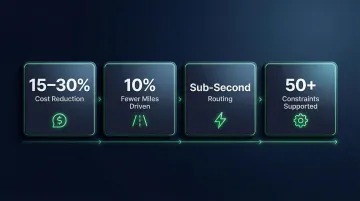
- Supports 50+ hard and soft route constraints — time windows, vehicle capacity, driver skills, load types, and service times
- Computes large-scale distance matrices with no restrictive size limits
- Delivers sub-second routing responses for real-time dispatch decisions
- Handles truck-compliant routing with vehicle-specific road restrictions
- Integrates with Samsara, Geotab, Motive, and Netradyne out of the box
- Offers per-vehicle or per-order pricing instead of per-API-call billing that penalizes growth
AI route optimization reduces last-mile delivery costs by 15-30% and decreases miles driven by 10%. NextBillion.ai's API-first architecture allows logistics software developers and fleet operators to embed this intelligence without redeveloping their existing stack or facing runaway API costs as volume grows.
| Criteria | Details |
|---|---|
| Key Features | 50+ route constraints, large distance matrix, custom map editing, fleet system integrations (Samsara, Geotab, Motive), on-premise deployment option |
| Pricing Model | Predictable fixed-fee monthly pricing; per-vehicle or per-order model (not per-API-call); 24x7 support from solution engineers |
| Best Fit | Logistics tech companies, fleet operators, food delivery platforms, and on-demand delivery businesses that need to embed scalable route optimization into their own products or operations without outrageous API costs |
How to Choose the Right Last Mile Delivery Partner
The most common selection mistake is choosing a provider based on brand recognition or lowest quote rather than fit for your specific delivery model. A national carrier may be overkill for a regional DTC brand, while a software platform without the right API flexibility can limit long-term scale.
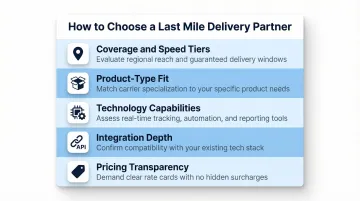
Evaluate providers on these dimensions:
- Coverage and speed tiers — Match geographic reach and delivery speed options to your customer promise
- Product-type fit — Small parcel vs. big and bulky vs. regulated goods require different handling capabilities
- Technology capabilities — Route optimization, real-time visibility, electronic proof of delivery, customer notifications
- Integration depth — Compatibility with existing OMS/WMS/ERP systems; API flexibility for custom workflows
- Pricing transparency — Total cost including surcharges, minimums, and SLA penalty policies
For businesses building or managing their own delivery operations, the underlying routing and mapping technology layer is the most overlooked differentiator. Route optimization quality directly determines driver productivity, fuel costs, and on-time delivery rates.
45% of fleets currently use AI route optimization, yet 35% of businesses cite high costs and 16% cite tech stack complexity as barriers to adoption. Closing that gap often comes down to choosing the right technology layer.
NextBillion.ai is one example of an API-first platform built for this use case — supporting 50+ route constraints, large-scale distance matrices, and sub-second response times, with per-vehicle pricing that avoids the runaway costs of per-API-call models.
Conclusion
In 2026, last mile delivery success depends on the right combination: a physical delivery partner with operational reach and the technology infrastructure to power route planning, dispatch, and customer communication.
Evaluate providers on operational fit and scalability, not just headline pricing. Test integrations, audit SLA track records, and assess support quality before committing to a long-term partner.
The difference between a good and great last mile operation often comes down to optimizations that don't show up in a sales pitch:
- Route sequencing that saves 10 minutes per driver per day
- ETAs accurate to within minutes instead of hours
- Failed delivery rates below 5% instead of above 15%
Are you building or optimizing last mile delivery operations? Explore NextBillion.ai's route optimization API to embed enterprise-grade routing intelligence into your platform with predictable, fixed-fee pricing and 24x7 support from solution engineers who understand logistics.
Frequently Asked Questions
What is last mile delivery and why is it so expensive?
Last mile delivery is the final leg of the logistics journey — from a local hub to the customer's door. It's the most expensive segment due to high labor intensity, multiple individual stops, unpredictable traffic, and low package density versus long-haul freight. Last mile accounts for 53% of total shipping costs, with labor making up 50-60% of that figure.
What is the difference between a last mile delivery carrier and a last mile delivery software provider?
Carriers like FedEx, UPS, and OnTrac physically transport and deliver packages using their own vehicle networks. Software providers like Onfleet, DispatchTrack, and NextBillion.ai provide the technology — route optimization, dispatch, tracking, ePOD — that businesses use to manage delivery operations, whether they run their own fleet or outsource to carriers.
How does route optimization improve last mile delivery performance?
Route optimization computes the most efficient delivery sequence given real-world constraints — traffic, time windows, vehicle capacity, and driver schedules. The results: 15-30% cost reductions, 10% fewer miles driven, lower fuel costs, and higher on-time rates.
What should I look for when choosing a last mile delivery company in 2026?
Focus on geographic coverage, delivery speed options that match your SLA commitments, technology capabilities (real-time tracking, ePOD, customer notifications), system integrations, and pricing transparency including surcharges. Test the provider's SLA track record and support quality before committing.
How is AI changing last mile delivery in 2026?
AI is pushing ETA accuracy to 98% in some platforms, enabling dynamic re-routing around real-time exceptions, and supporting demand forecasting for micro-fulfillment placement. AI routing cuts delivery times by 25% and fuel consumption by 20% — measurable gains that go straight to the bottom line.
Can businesses embed last mile route optimization into their own logistics software?
Yes. API-first platforms like NextBillion.ai allow logistics software developers and fleet operators to integrate advanced route optimization directly into their own products via APIs. These platforms support custom constraints, large-scale distance matrices, and predictable pricing models (per-vehicle or per-order rather than per-API-call) that make it viable for businesses of all sizes to build routing intelligence into their applications.