The right API integration platform eliminates manual data entry, enables real-time visibility across your entire delivery chain, and scales capacity without forcing you to rebuild your tech stack from scratch. More importantly, it prevents the cost blowouts that plague generic integration tools when delivery volumes spike.
This article evaluates the top API platforms purpose-built for delivery management in 2026 — platforms that offer delivery-specific logic like route optimization, multi-stop dispatch, and proof-of-delivery APIs, not just system connectivity.
TLDR
- Connecting OMS, routing engines, driver apps, and notifications through a single API layer eliminates tool-switching and reduces integration overhead
- Look for platforms that handle real-time tracking, route optimization, dispatch automation, and fleet integrations out of the box
- Per-API-call pricing breaks down fast at scale — per-vehicle or per-order models are far more predictable for growing operations
- Top platforms covered: NextBillion.ai, Onfleet, Bringg, Shipday, and Dispatch — each suited to different fleet sizes and integration needs
What Is API Integration for Delivery Management?
API integration in delivery management connects disparate systems — OMS, TMS, ERP, driver apps, and carrier networks — so order, location, and status data flows automatically without manual re-keying. Instead of dispatchers toggling between five dashboards and copying data by hand, a well-integrated API layer keeps everything synchronized in real time.
Common integration types in delivery logistics serve different roles across the delivery lifecycle:
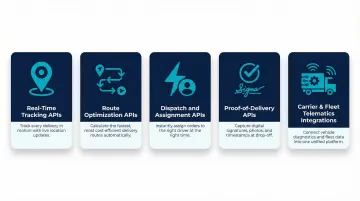
- Real-time tracking APIs — Pull GPS coordinates and status updates from driver apps and telematics devices
- Route optimization APIs — Calculate multi-stop routes with constraints like time windows, vehicle capacity, and driver skills
- Dispatch and assignment APIs — Automatically assign orders to drivers based on availability, location, and workload
- Proof-of-delivery APIs — Capture signatures, photos, and delivery confirmation data
- Carrier/fleet telematics integrations — Pull vehicle location and driver status from platforms like Samsara or Geotab
The global last-mile delivery market reached $143.10 billion in 2023 and is forecast to hit $258.68 billion by 2030, driven largely by the need to orchestrate complex, multi-carrier delivery networks through tighter API integration across every layer of the stack.
Top API Integration Platforms for Delivery Management in 2026
These platforms were evaluated on delivery-specific functionality — not general iPaaS breadth — with emphasis on route optimization capability, integration depth, scalability for high-volume operations, pricing model transparency, and proven use in logistics environments.
NextBillion.ai
NextBillion.ai is an AI-powered mapping and route optimization API platform founded in 2020, purpose-built for high-volume delivery, logistics, and fleet operations. The platform serves enterprise customers including DoorDash, Zepto, Meesho, and Curri globally. Its API-first architecture covers routing, navigation, maps, and optimization with 50+ hard and soft constraints.
Key differentiators:
- Sub-second routing response times for high-throughput operations
- Per-vehicle or per-order pricing — no per-API-call charges
- Large-scale distance matrix computation without the 25×25 limits common to Google Maps
- Truck-compliant routing with vehicle-specific load and road restrictions
- Cloud-agnostic and on-premise deployment options
- Native integrations with fleet telematics platforms including Samsara, Geotab, and Motive
| Feature Category | Details |
|---|---|
| Key Features | Route optimization with 50+ constraints, real-time navigation, large-scale distance matrix, custom map editing, truck-compliant routing, fleet telematics integrations |
| Pricing Model | Per-vehicle or per-order pricing; predictable flat-fee monthly plans — no per-API-call charges |
| Best For | Last-mile delivery platforms, food and on-demand delivery, logistics software providers, fleet management companies needing scalable route optimization APIs |
Onfleet
Onfleet is a widely adopted last-mile delivery management platform with a REST API that allows businesses to programmatically create tasks, manage drivers, and trigger customer notifications. Used across food, retail, pharmacy, and courier verticals, it's a go-to for mid-market operations seeking quick integration.
Key differentiators:
- Clean, well-documented API with webhooks for real-time event triggers
- Auto-dispatch and in-app driver communication built in
- Proof-of-delivery module with photo and signature capture
- Faster OMS and e-commerce stack integration than enterprise orchestration platforms
| Feature Category | Details |
|---|---|
| Key Features | Task creation and auto-dispatch API, real-time driver tracking, webhooks, proof of delivery (photo/signature), customer SMS notifications |
| Pricing Model | Launch: $619/mo (2,500 tasks); Scale: $1,349/mo (5,000 tasks); Enterprise: $3,099/mo (10,000+ tasks). 14-day free trial available. |
| Best For | SMB to mid-market delivery operations, pharmacy and grocery delivery, courier fleets needing quick API integration with existing storefronts |
Bringg
Bringg is an enterprise delivery orchestration platform that provides a connectivity layer between retailers, logistics providers, and customers. It offers API and pre-built connector support for multi-carrier management, delivery slot booking, and real-time visibility at scale.
Key differentiators:
- Strong focus on enterprise retail and CPG delivery workflows
- Pre-built integrations with major 3PLs and carriers
- Delivery hub model for orchestrating owned fleets and crowdsourced delivery from a single API layer
| Feature Category | Details |
|---|---|
| Key Features | Multi-carrier orchestration, delivery slot booking API, real-time tracking, 3PL and carrier connector library, white-label customer experience |
| Pricing Model | Custom enterprise contracts; pricing detailed in service orders with fixed annual portions and variable monthly arrears |
| Best For | Large retailers, CPG brands, and enterprises managing complex multi-carrier and owned-fleet delivery networks |
Shipday
Shipday is a local delivery management platform with a REST API built for restaurants, couriers, grocery stores, and small delivery businesses. It enables real-time driver tracking, dispatch automation, and order management through lightweight API calls.
Key differentiators:
- Fast onboarding designed for non-enterprise development teams
- Mobile driver app with live tracking included out of the box
- API endpoints for order creation, driver assignment, status updates, and customer notifications
- Low barrier to entry for teams building their first delivery API stack
| Feature Category | Details |
|---|---|
| Key Features | Order and dispatch API, real-time driver tracking, customer SMS/email notifications, route planning, proof of delivery, mobile driver app |
| Pricing Model | Basic: $0/mo (300 orders, 10 drivers); Professional: $39/mo (300 orders + $0.04/add'l); Business AI: $349/mo (1,000 orders + $0.25/add'l). Free tier available. |
| Best For | Restaurants, local couriers, grocery and retail businesses needing a straightforward delivery API with fast time-to-integration |
Dispatch (DispatchOne)
Dispatch is an industrial last-mile delivery platform offering an API that connects ERP, TMS, and CRM systems to a managed network of professional drivers. It focuses on B2B industrial delivery verticals like automotive, HVAC, electrical, and building products.
Key differentiators:
- Deep ERP integration with Oracle, SAP, and Infor out of the box
- Automated route optimization across multi-branch operations
- Real-time driver and delivery visibility from dispatch through proof of delivery
- Customers report a 7% reduction in delivery costs and a 16% boost in NPS scores
| Feature Category | Details |
|---|---|
| Key Features | ERP/CRM/TMS integration API, real-time driver tracking, automated dispatch, proof of delivery, multi-branch delivery management |
| Pricing Model | Starter: $0/mo (5 vehicles, 500 deliveries, $2.50/delivery); Professional: $750/mo (15 vehicles, $1.50/delivery); Enterprise: Custom. Free trial available. |
| Best For | Industrial distributors, multi-branch operations in automotive, HVAC, electrical, and building products needing API-connected delivery management |
Key Features to Look For in a Delivery Management API Platform
Not all delivery management APIs are built for the operational realities of logistics. Here are the feature categories that separate delivery-purpose-built platforms from generic iPaaS tools:
Real-time tracking and ETA:
- GPS tracking with 1-meter accuracy
- Predictive ETA algorithms that factor traffic, weather, and historical patterns
- Automated customer notifications for status updates
Route optimization with delivery-specific constraints:
- Time windows, vehicle capacity, driver skills
- Dynamic rerouting when new orders arrive mid-route
- Multi-stop sequencing that minimizes mileage and drive time
Dispatch automation with event-driven webhooks:
- Automatic driver assignment based on location and availability
- Event triggers for delivery completion, delays, or exceptions
- Integration with existing order management workflows
Pre-built connectors and integration flexibility:
- Compatibility with OMS, ERP, and fleet telematics (Samsara, Geotab)
- Carrier API connectors for 3PL orchestration
- SDK support for mobile apps (iOS, Android)
Scalability and pricing model:Per-API-call pricing becomes unsustainable as order volumes grow. McKinsey research shows that combining real-time visibility with AI-driven automation can reduce logistics waste by up to 40% — but that efficiency gain disappears if unpredictable API costs eat into the savings. Per-vehicle or per-order pricing models make cost forecasting far more reliable at scale.
How We Chose the Best API Integration Platforms for Delivery Management
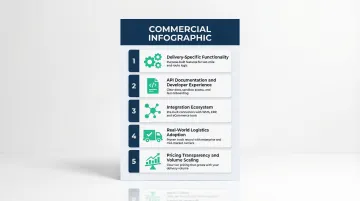
We assessed each platform against five criteria focused on delivery operations — not general integration capability:
- Delivery-specific functionality: Does it handle delivery logic natively, not just generic B2B data movement?
- API documentation and developer experience: Are the docs complete, current, and usable without constant support tickets?
- Integration ecosystem: Does it connect to the ERPs, fleet platforms, and carrier networks delivery teams actually use?
- Real-world logistics adoption: Is it deployed in production by logistics or delivery companies — not just piloted?
- Pricing transparency and volume scaling: Is pricing predictable as order or API call volumes grow?
The most common mistake is choosing a generic iPaaS tool — MuleSoft, Boomi, Zapier — that can technically connect systems but lacks delivery-specific logic. Multi-constraint route optimization, driver assignment rules, real-time ETA recalculation: these aren't features generic platforms include out of the box. The resulting custom development eliminates the time and cost advantages of buying a pre-built solution in the first place.
Conclusion
Not every delivery operation needs the same integration platform. A regional fleet running 50 vehicles has different constraints than a retail network managing multi-carrier handoffs across time zones. That said, one pattern holds consistently: delivery-native platforms outperform generic integration tools once operational complexity grows beyond basic dispatch.
The right fit depends on your scale:
- Enterprise fleets need AI-powered route optimization with hard constraints like time windows, vehicle capacity, and driver hours
- Local or regional operators benefit most from lightweight dispatch automation with predictable per-route pricing
- Retail and e-commerce networks require multi-carrier orchestration with real-time ETA visibility across handoffs
Evaluate platforms not just on current needs but on pricing scalability, depth of delivery-specific constraints, and the quality of ongoing technical support.
For logistics businesses looking for route optimization APIs with per-vehicle pricing, sub-second routing, and hands-on integration support, NextBillion.ai offers a free trial and hands-on support from solution engineers to help teams integrate and go live quickly.
Frequently Asked Questions
What is API integration in logistics?
API integration in logistics connects software systems — such as OMS, TMS, ERP, and driver apps — through APIs so that order, location, and status data flows automatically across the delivery chain without manual data entry or re-keying.
What are API integration platforms?
API integration platforms are centralized tools that manage connections between multiple software systems through APIs. They provide pre-built connectors, monitoring, and workflow automation so businesses can integrate faster without writing custom code for every connection.
What are the different types of integration in logistics?
The main types include: real-time tracking and visibility integrations, route optimization and dispatch integrations, carrier and fleet telematics integrations, ERP/OMS data sync integrations, and proof-of-delivery and customer notification integrations.
How much does it cost to build a custom API?
Costs vary based on complexity and scope. Medium-complexity projects typically range from $120,000 to $300,000, while high-complexity enterprise systems exceed $1,000,000. Purpose-built delivery API platforms reduce both development cost and deployment time compared to building routing, tracking, and dispatch logic from scratch.
How do API integration platforms improve last-mile delivery?
They improve last-mile delivery by:
- Eliminating manual handoffs between systems
- Enabling real-time driver tracking and accurate ETA updates
- Automating dispatch and customer notifications
- Allowing dynamic route optimization to cut delivery costs
What should I look for when choosing a delivery management API platform?
Prioritize delivery-specific features (route optimization, dispatch, proof of delivery), pricing model (per-vehicle vs per-API-call), ease of integration with existing ERP/fleet systems, scalability for volume growth, and quality of developer documentation and support.