Introduction
The US non-emergency medical transportation (NEMT) market is projected to grow from $6.58 billion in 2023 to $13.43 billion by 2031, reflecting a 9.3% annual growth rate. Yet despite this expansion, NEMT providers face crushing margin pressure: administrative overhead alone consumes 17-18% of all Medicaid NEMT expenditures, leaving providers to run operations on margins as thin as 15-25%.
The reimbursement structure makes this worse. Medicaid pays only for "loaded" miles—not the empty miles driven to pickups or returns to base—so every routing inefficiency, delayed reassignment, or missed appointment erodes profitability directly.
Fuel, labor, and compliance costs continue rising, but reimbursement rates don't keep pace. For most NEMT operators, dispatch inefficiency isn't a back-office problem; it's where margins actually disappear.
Dispatch costs are not fixed. They're a function of decisions—how trips are assigned, routes sequenced, cancellations handled, and documentation captured. This article examines where those costs accumulate and where AI automation creates the most leverage to reclaim margins.
TL;DR
- NEMT dispatch costs accumulate across fuel waste, idle time, manual labor, no-shows, and billing errors—not as a single line item
- Deadhead miles, manual reassignment delays, and compliance-related reimbursement denials erode margins at scale—often without showing up on any single report
- AI automation reduces dispatch costs by standardizing decisions that dispatchers previously made inconsistently under pressure
- Route intelligence, real-time assignment logic, and workflow automation deliver the highest impact when combined—not applied in isolation
- Providers typically see measurable ROI within 6–12 months across fuel, labor, and billing categories
How NEMT Dispatch Costs Typically Build Up
NEMT dispatch costs don't appear as a single, visible budget line. They accumulate incrementally across dozens of daily micro-decisions: which driver gets which trip, how routes are sequenced, how late pickups are handled, whether cancellations are absorbed or recovered.
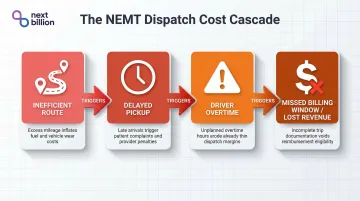
The cost build-up is compounding in nature. Each failure cascades into the next:
- An inefficient route causes a delayed pickup
- The delayed pickup triggers driver overtime
- Overtime pushes past the billing window cutoff
- A missed billing window turns an operational error into lost revenue
The chain repeats with every unoptimized run.
Most of these costs stay hidden until volume or stress exposes them. A 5-vehicle fleet can absorb manual dispatch errors through workarounds and extra effort. A 50-vehicle fleet cannot.
What worked at small scale becomes a serious financial liability as operations grow. Without specialized software, denial rates regularly exceed 20%, and miscommunications compound as trip volumes increase.
Key Cost Drivers in NEMT Dispatching
NEMT dispatch costs stem from two compounding sources: the structural complexity of the trips themselves (wheelchair requirements, appointment windows, multi-load routing) and the operational breakdowns that mismanage them (manual decision-making, reactive coordination, disconnected systems). Unlike standard transportation, NEMT carries more constraints per trip — which means poor dispatch logic is more expensive per mistake.
The four primary cost driver categories are:
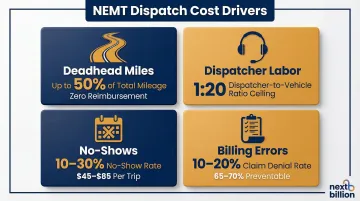
- Deadhead miles — empty miles driven to pickups or back to base due to inefficient sequencing
- Dispatcher labor — hours consumed by manual assignments, reassignments, and phone-based coordination
- No-shows and cancellations — driver and vehicle costs incurred with no billable trip to offset them
- Billing errors and claim denials — revenue lost when documentation gaps trigger Medicaid rejections
These drivers are interconnected, not independent. Which one dominates depends on fleet size and trip density. Smaller fleets often bleed most on labor and no-shows. Larger fleets experience disproportionate cost from deadhead accumulation and compliance gaps that scale with volume.
Deadhead Miles: The Silent Profitability Drain
Deadhead miles—empty miles driven to pickups or returning to base—represent massive uncompensated mileage. In some paratransit operations, deadhead miles contribute up to 50% of total revenue miles.
Because Medicaid only reimburses for loaded miles, every deadhead mile hits providers with direct fuel loss of approximately $0.55 to $0.75 per mile, depending on vehicle MPG and diesel prices.
No-Shows: The $45-$85 Per-Trip Cost Nobody Budgets For
NEMT no-show rates typically range between 10% and 30%. Each no-show costs an NEMT provider between $45 and $85 in wasted driver time, fuel, and lost capacity.
No-shows aren't just a patient behavior problem — they're a dispatch response problem. Providers without automated reminders or predictive flagging absorb these losses with no recourse.
No-show losses compound quickly at scale — but they're recoverable with the right systems. Billing errors are a different problem: they convert trips you already completed into net losses.
Billing Errors: When Documentation Gaps Turn Profitable Trips Into Losses
Across the US, 10-20% of Medicaid NEMT claims are denied on first submission. Of these denials, 65-70% are completely preventable, stemming primarily from documentation gaps such as missing patient signatures, incomplete trip logs, and inaccurate timestamps.
Reworking a single denied claim costs between $25 and $125 in administrative staff time. For NEMT trips that only reimburse $30-$50, a single denial instantly turns a profitable trip into a loss.
Dispatcher Labor: The 1:20 Ratio That Limits Scale
In manual or legacy paratransit operations, the standard dispatcher-to-vehicle ratio is approximately 1 to 20. When dispatchers are forced to handle manual scheduling, real-time tracking, and customer calls simultaneously, their attention is diffused, leading to capacity constraints and errors.
A large share of dispatcher labor time is consumed by status checks—calling drivers, estimating ETAs, monitoring vehicle locations. Each of these manual tasks is a ceiling on scale — and a direct target for AI-driven automation.
AI Automation Strategies That Reduce NEMT Dispatch Costs
Not all dispatch costs come from the same place—and not all automation tools address the same problems. The strategies below are organized by where in the dispatch cycle they reduce cost, so providers can target the right intervention for the right inefficiency.
Strategies That Reduce Costs by Changing Dispatch Decisions
These approaches reduce dispatch costs by altering decisions made before or during trip assignment—upstream choices about how routes are structured, vehicles matched to trips, and what rules govern scheduling.
AI-Powered Route Optimization with NEMT-Specific Constraints
Standard GPS routing ignores the constraints that make NEMT expensive: wheelchair vehicle requirements, appointment arrival windows, multi-load sequencing, and patient-specific service needs.
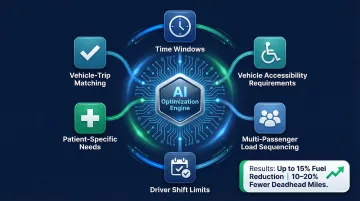
AI route optimization engines built for constraint-dense environments eliminate the manual guesswork that dispatchers apply inconsistently. Platforms like NextBillion.ai's optimizer, which supports 50+ hard and soft constraints, can handle:
- Time windows for pickup and drop-off
- Vehicle accessibility requirements (wheelchair lifts, stretcher capacity)
- Multi-passenger load sequencing
- Driver shift constraints and service times
This constraint-aware routing results in tighter routes, fewer deadhead miles, and more trips per vehicle per shift. AI route optimization can slash fuel consumption by up to 15% and reduce travel times by 20%, with deadhead miles reduced by 10-20% for most users.
Trip Consolidation and Multi-Load Scheduling Decisions
One of the highest-leverage pre-dispatch decisions is whether overlapping trips can be consolidated into a shared vehicle run without violating appointment windows. AI can evaluate this at a scale no human dispatcher can, assessing hundreds of trip combinations in seconds to identify optimal multi-load opportunities.
Proactive Demand-Based Vehicle Assignment
Instead of assigning the nearest available driver reactively, AI systems can pre-position vehicles based on predicted demand patterns. This reduces the reactive scramble that generates overtime and idle miles simultaneously, allowing providers to smooth demand across shift schedules rather than absorbing surge capacity costs.
Eliminating Over-Specification in Vehicle Assignment
A common hidden cost is assigning a wheelchair-accessible van to a trip that only requires a standard sedan. AI that accounts for patient need alongside vehicle type can systematically prevent this mismatch, which wastes higher-cost vehicle capacity on lower-acuity trips.
NextBillion.ai's route optimization engine supports vehicle attribute matching through multi-dimensional capacity constraints and skills-based parameters. Vehicles can be tagged with specific accessibility attributes such as wheelchair lifts and stretcher tie-downs, ensuring patients are automatically assigned only to vehicles that meet their documented medical or mobility needs.
Strategies That Reduce Costs by Changing How Dispatch Is Managed
These strategies reduce cost by tightening what happens between trip assignment and billing close—faster responses to disruptions, fewer no-shows absorbed as sunk cost, and less dispatcher time spent on status tracking.
Automated Real-Time Reassignment on Disruption
When a driver cancels, traffic delays a pickup, or a patient isn't ready, the cost impact depends entirely on how fast the system responds. Manual reassignment can take 10–20 minutes and relies on a dispatcher being available.
AI systems handle reassignment in seconds without human escalation. Reaction time for transferring a trip and visualizing it for the driver is reduced from 45 seconds to less than 10 seconds. This speed prevents idle vehicles and cascading delays, with automated scheduling resulting in a 30% drop in missed trips.
Automated No-Show Management with Predictive Alerts
No-shows are only partially a patient behavior problem—they're also a dispatch response problem. Automated reminder systems send multi-channel alerts at strategic intervals: 24–48 hours before pickup and again 2 hours before.
SMS messages boast a 98% open rate, and structured reminder systems can drop no-show rates by 20% to 50%. Platforms that can predict high-risk no-show trips using historical patterns allow dispatchers to pre-fill those slots, recovering capacity before it's wasted.
| Reminder Strategy | Expected Reduction | Operational Benefit |
|---|---|---|
| Manual phone calls | ~39% reduction | High labor cost, prone to error |
| Automated SMS/Voice | ~29% reduction | Low cost, highly scalable |
| 3-1-0 Framework (3 days, 1 day, day-of) | 20-50% reduction | Maximizes attendance, allows proactive reassignment |
Real-Time Fleet Visibility to Eliminate Dispatcher Overhead
A large share of dispatcher labor time in manual operations is consumed by status checks—calling drivers, estimating ETAs, monitoring where vehicles are.
GPS-integrated dispatch platforms that surface live location and trip status eliminate this overhead. One dispatcher can manage significantly more concurrent trips when the system automatically tracks vehicle positions and updates ETAs based on real-time traffic conditions.
Automated Trip Documentation and Timestamp Capture
Dispatch cost doesn't end when the trip ends. Incomplete pickup/drop-off documentation generates billing denials and audit exposure that are expensive to resolve.
Automated timestamp capture at each trip milestone—triggered by driver app check-ins or GPS geofencing—protects reimbursement integrity without adding dispatcher workload. Purpose-built NEMT platforms using GPS-verified timestamps and electronic proof of delivery typically achieve clean claim rates above 95%, compared to denial rates exceeding 20% for manual systems.
Strategies That Reduce Costs by Changing the Context Around Dispatch
These approaches address the operational environment and system architecture surrounding dispatch. In many cases, the surrounding setup is the real cost driver, not the dispatch process itself.
Broker and Payer System Integration
A significant source of dispatch overhead is the back-and-forth between NEMT providers and Medicaid brokers. Manual trip acceptance, eligibility checks, and authorization workflows create delays that compound across every shift.
Direct API integration with broker systems—MAS, MTM, Modivcare—automates these handoffs and removes the administrative cost embedded in each trip cycle. Dispatchers shift from managing paperwork to managing routes.
Driver App Adoption as a Dispatch Cost Lever
Dispatch cost is partly a function of how much coordination burden falls on the dispatcher versus the driver. Mobile apps that push assignments, capture signatures, and communicate ETAs without dispatcher intervention shift that burden directly to the driver.
The impact compounds quickly: AI-driven platforms that automate trip assignments and route suggestions can cut administrative tasks by 50% within 90 days, freeing dispatchers to handle exceptions rather than routine coordination.
Phased Automation Rollout to Avoid Implementation-Driven Cost Spikes
How automation is introduced matters as much as what's automated. Providers that roll out too broadly at once often see a temporary cost increase from configuration errors and staff confusion.
A pilot-first approach—starting with one route cluster or contract—limits disruption and creates a measurable baseline before full deployment. It also ensures the system is configured correctly for your specific constraints before scaling fleet-wide.
Conclusion
NEMT dispatch costs are not reduced by cutting spend across the board. They are reduced by identifying where variance, delay, and manual decision-making allow costs to accumulate, then applying automation at those precise points. Dispatchers are not the problem—inconsistent dispatch logic and reactive workflows are.
AI automation works best when matched to the specific constraint profile of NEMT operations. Multi-stop, accessibility-sensitive, reimbursement-dependent trips demand a different level of optimization intelligence than standard logistics.
Standard GPS routing finds the shortest path between two points. NEMT requires constraint-aware engines that account for appointment time windows, vehicle accessibility requirements, multi-passenger load sequencing, and driver shift constraints—all at once.
Providers who invest in automation built specifically for NEMT—such as NextBillion.ai's route optimization platform, which supports 50+ operational constraints—achieve lasting cost reduction without degrading service quality. The financial case is clear: quality NEMT software delivers ROI exceeding 1,000% in the first year for most providers, with payback typically occurring within three to six months.
Frequently Asked Questions
What are the biggest hidden dispatch costs NEMT companies face?
Three cost sources are consistently underestimated: deadhead miles (up to 50% of total mileage with zero reimbursement), manual reassignment overhead (10–20 minutes per disruption), and billing denials from incomplete documentation. That last category is particularly costly—65–70% of denials stem from preventable documentation errors.
How much can AI automation realistically reduce NEMT dispatch costs?
Industry case studies report fuel savings of 15-30%, labor efficiency gains worth $18,000-$25,000 annually per 10-vehicle fleet, and denial reduction savings of $10,000-$50,000. Results depend on current baseline inefficiency and which automation capabilities are deployed—providers with the highest manual overhead see the fastest returns.
Does AI dispatching work for small NEMT fleets or only large ones?
Both scale well, but for different reasons. Small fleets typically see faster ROI because manual dispatch costs more per trip at low volume; large fleets gain more from compound efficiency across higher throughput. At a typical $500/month software cost, recovering just 20 additional trips per month covers it.
How does AI route optimization for NEMT differ from standard GPS routing?
Standard GPS finds the shortest path between two points. NEMT-specific optimization must simultaneously account for appointment time windows, vehicle accessibility requirements (wheelchair lifts, stretcher capacity), multi-passenger load sequencing, and driver shift constraints. That requires a constraint-aware engine, not a simple mapping tool.
How long does it typically take to see ROI from AI dispatch automation?
Most providers see measurable ROI within 6–12 months. Fuel and labor savings tend to surface first, while billing accuracy improvements compound over a longer horizon. Providers with significant manual overhead often reach payback on the shorter end of that range.
Will automating dispatch eliminate the need for human dispatchers?
Automation handles routine assignment, rerouting, and documentation tasks, freeing dispatchers to focus on exceptions, patient relations, and complex situations. Most providers maintain dispatch staff but redeploy their capacity toward higher-value activities—improving service quality while managing higher trip volumes with the same team size.