Introduction
Enterprises processing millions of routing requests daily can no longer rely on static algorithms or rule-based systems. Suboptimal static routing wastes 15-22% of fuel, while failed first-time deliveries cost an average of $17.20 per order — critical metrics when last-mile delivery accounts for 53% of total shipping costs. Those numbers make the routing API you choose a direct lever on margin.
AI-based routing at the API level reduces fuel spend, improves on-time delivery rates, and enables dynamic re-routing under real-world conditions. With 55% of supply chain leaders planning to increase investment in AI-based tools for end-to-end visibility, the platform you select now will shape how efficiently you scale through 2026 and beyond. This guide breaks down the top options — and what separates them at enterprise scale.
TL;DR
- AI routing APIs optimize routes in real time using ML models trained on live traffic, vehicle constraints, and historical fleet data
- Enterprise-scale APIs need low latency, large matrix support, and pricing that scales without punishing growth
- Top 2026 options include NextBillion.ai, Google Route Optimization API, HERE Technologies, GraphHopper, and Locus Dispatcher
- NextBillion.ai leads on deep customization, sub-second response times, and predictable per-vehicle pricing
- Evaluate on AI/ML capability, scalability, constraint depth, uptime SLAs, and cost sustainability
What Is AI-Based Traffic Routing for Large-Scale APIs?
AI-based traffic routing refers to systems that use machine learning models to evaluate millions of routing combinations at once — factoring in live traffic, vehicle attributes, road conditions, and operational constraints — then return optimized routes at high throughput and low latency.
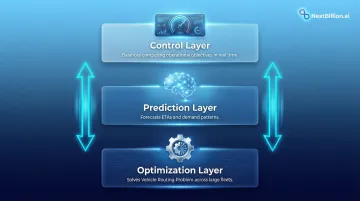
These systems operate across three interdependent technical layers:
- Optimization layer: Solves variants of the Vehicle Routing Problem (VRP) to generate route plans across large fleets
- Prediction layer: Uses ML to forecast ETAs and anticipate demand patterns before they materialize
- Control layer: Applies decision logic to balance and prioritize competing operational objectives in real time
Why Scale Introduces Unique Demands
Traditional routing APIs break down under enterprise volumes due to critical limitations:
- Matrix size caps: Most platforms limit distance matrix requests to 25×25 elements, including Google Maps Platform, making large-fleet optimization impractical at scale
- Pricing models that balloon costs: Per-call pricing becomes prohibitively expensive at enterprise volumes
- Constraint limitations: Inability to handle 50+ simultaneous constraints across thousands of stops
- Latency spikes: Under high concurrent request volumes, many APIs experience degraded performance
Each platform covered below was selected specifically because it addresses one or more of these bottlenecks at production scale.
Best AI-Based Traffic Routing APIs for Large-Scale Operations in 2026
These platforms were evaluated on AI/ML routing capability, scalability under high request volumes, constraint handling depth, real-time traffic integration, pricing model transparency, and enterprise support quality.
NextBillion.ai
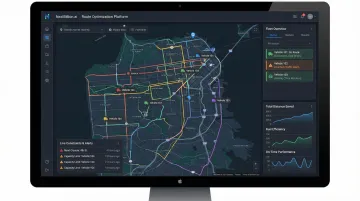
NextBillion.ai is an API-first routing platform built by ex-Grab engineers, purpose-designed for enterprise logistics. The platform covers last-mile, middle-mile, field service, and fleet management use cases globally, serving customers like DoorDash, Meesho, and Geotab.
What separates it at enterprise scale:
- Sub-second response times with no 25×25 matrix size limit for complex multi-vehicle, multi-destination scenarios
- Handles 50+ hard and soft routing constraints simultaneously
- AI learns from fleet performance history to improve route quality over time
- On-premise deployment with Kubernetes support for data-sensitive environments
- Cloud-agnostic integration embeds into existing tech stacks without infrastructure changes
Three pricing models cover different operational profiles: per-vehicle, per-order, or per-API-call, with fixed-fee monthly plans that don't escalate unpredictably as request volume grows.
| Feature Category | Details |
|---|---|
| Key AI/ML Features | Learns from historical fleet data, dynamic re-optimization, multi-constraint ML-based routing engine |
| Scalability & Deployment | No matrix size cap, cloud-agnostic, on-premise/Kubernetes, sub-second latency |
| Pricing Model | Flexible: per-vehicle, per-order, or per-API-call; predictable fixed-fee monthly plans available |
Google Route Optimization API
Part of Google Cloud Fleet Routing, this API is widely adopted by small-to-mid-sized delivery businesses and leverages Google's global traffic data for real-time ETA accuracy and live traffic integration.
Where it hits a ceiling at enterprise scale:
The 25-waypoint-per-request cap is a hard blocker for large-fleet optimization. The platform also lacks truck routing profiles and custom objective functions — two requirements that surface quickly in complex logistics environments.
Pricing scales on a tiered volume basis — $30.00 per 1,000 events up to 100,000 monthly events, dropping to $2.10 per 1,000 events at 5,000,000+ — but the per-shipment model compounds costs at enterprise volumes. Verified G2 reviews flag that it "becomes expensive when running large operations with long routes," and customer support is consistently rated inadequate for enterprise needs.
| Feature Category | Details |
|---|---|
| Key AI/ML Features | Predictive and real-time traffic, dynamic re-optimization, what-if scenario analysis |
| Scalability & Deployment | Limited by 25-waypoint cap; cloud-only; no on-premise option |
| Pricing Model | Tiered per-event pricing; $30.00 per 1,000 events (up to 100k/month) down to $2.10 per 1,000 (5M+/month) |
HERE Technologies
HERE Technologies provides an enterprise-grade location platform with routing and tour planning APIs, serving automotive, logistics, retail, and public sector customers globally with high-quality geolocation data.
Scale specs and practical tradeoffs:
Real-time traffic accuracy and ETA precision are HERE's clearest strengths. Asynchronous requests support up to 6,000 jobs and 150 vehicle types — well beyond the 250-job synchronous ceiling. Truck routing, however, carries practical distance constraints that limit some use cases.
Transaction-based pricing makes cost forecasting difficult at scale. HERE uses a Freemium model tied to transaction volume, which can produce billing surprises as usage grows. Gartner Peer Insights reviews flag a cluttered UI when managing multiple data domains and a steep learning curve for advanced features.
| Feature Category | Details |
|---|---|
| Key AI/ML Features | Live traffic, dynamic re-planning, EV routing, predictive ETAs |
| Scalability & Deployment | Asynchronous API supports 6,000 jobs; synchronous limited to 250 jobs; cloud deployment |
| Pricing Model | Transaction-based; Freemium tier up to 250,000 transactions/month, then tiered pricing |
GraphHopper
GraphHopper is an open-source-rooted routing API provider used by logistics, tourism, and food delivery platforms. It does not offer an end-user application — purely API-driven, built on OpenStreetMap data for global coverage.
Capabilities and scale constraints:
GraphHopper supports vehicle profiles from scooters to trucks, multiple objective functions, and solid global data coverage via OpenStreetMap. Official 2026 pricing tiers break down as follows:
- Basic — €69/month: 5,000 credits/day, max 30 locations/2 vehicles
- Standard — €199/month: 15,000 credits/day, max 80 locations/10 vehicles
- Premium — €479/month: 50,000 credits/day, max 200 locations/20 vehicles
- Custom — available for larger scale on request
Credit-based pricing makes cost forecasting difficult at enterprise volumes, and advanced features like job relations or real-time fleet learning are absent. The free tier is restricted to non-commercial use. Third-party assessments note that credit consumption patterns can catch teams off-guard as operations scale.
| Feature Category | Details |
|---|---|
| Key AI/ML Features | Traffic-aware optimization, multiple objective functions, elevation and road-surface data |
| Scalability & Deployment | Premium plan: 200 locations/20 vehicles per request, 10 requests/sec; custom tier available |
| Pricing Model | Credit-based: Free (non-commercial), Basic €69/mo, Standard €199/mo, Premium €479/mo; custom for large scale |
Locus Dispatcher
Locus Dispatcher is an enterprise-grade route optimization platform focused on high-volume, geographically distributed logistics environments. It uses deep learning models to generate routes across thousands of daily stops for large fleet operators.
Large-scale positioning:
The platform delivers continuous adaptation as traffic, failed deliveries, or new orders occur during the day, recalculating routes without full replanning. Vendor-reported metrics claim the platform has optimized over 1.5 billion deliveries across 360+ enterprise clients globally. Locus is positioned as an API-first SaaS platform that integrates with existing logistics management systems including TMS, WMS, OMS, CRM, and ERP solutions.
However, Locus is primarily an end-to-end platform rather than a pure API, which may limit embedding into custom tech stacks. Pricing is enterprise-only, requiring direct vendor contact for quotes.
| Feature Category | Details |
|---|---|
| Key AI/ML Features | Deep learning route generation, real-time recalculation, predictive ETA adaptation |
| Scalability & Deployment | Built for thousands of daily stops; SaaS platform with API integration options |
| Pricing Model | Enterprise pricing; contact vendor for quotes |
How We Chose the Best AI Traffic Routing APIs
Common Evaluation Mistakes
Two selection mistakes account for most failed API deployments. The first is defaulting to familiar brand names — Google Maps being the common culprit — without testing performance at actual production volumes. The second is evaluating only on initial cost, ignoring how pricing behaves as request volumes scale.
Both lead to the same outcome: a painful migration. Average platform migration projects incur losses of $315,000, and 57% of IT leaders spent more than $1 million on migrations in the last year.
Our Evaluation Criteria
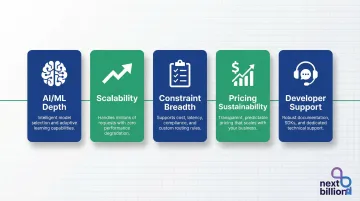
We evaluated each platform across five dimensions:
- AI/ML depth: Learns from historical execution data over time versus applying static optimization rules
- Scalability: Handles enterprise matrix sizes and concurrent requests while maintaining sub-second response times
- Constraint breadth: Supports 50+ hard and soft constraints — time windows, vehicle capacity, hazmat rules, hours-of-service, priority stops, skill matching, and custom objective functions
- Pricing sustainability: Stays economically viable as volumes scale 2×–5×; per-call and transaction-based models frequently create budgeting problems at scale
- Developer support: Offers real documentation, responsive technical support, and dedicated solution engineering — not just a knowledge base
Architectural Alignment Matters
The right routing API must align with your operational architecture. Whether you need cloud-agnostic deployment, on-premise control for data sovereignty, or deep API customization matters as much as routing accuracy. Run your evaluation against your actual technical environment — the API that scores best on a generic benchmark may perform poorly once your constraints, fleet size, and integration requirements enter the picture.
Conclusion
At enterprise scale, the differences between routing APIs aren't subtle. The 25-waypoint caps, per-call pricing models, and shallow constraint handling found in many popular platforms become hard ceilings — ones that force expensive migrations precisely when your operation is growing fastest.
When evaluating platforms, assess total cost of ownership at 2×–5× your current volume — not just today's pricing. Test constraint depth and latency against real operational scenarios with actual fleet profiles, not toy data sets.
The results of getting this right are concrete. DHL's dynamic routing algorithm cut costs by up to 20% versus standard optimization by incorporating daytime-dependent, road-specific travel times — the kind of constraint depth that separates purpose-built platforms from generic APIs.
Those differentiators — no waypoint caps, 50+ hard and soft constraints, per-vehicle pricing instead of per-call billing — are exactly what NextBillion.ai is built around. For teams scaling logistics platforms who need that depth without unpredictable API costs, NextBillion.ai offers 24×7 engineering support and a free trial to test against your actual use case. Request a demo to see how it performs against your specific fleet complexity.
Frequently Asked Questions
Can AI do route optimization?
Yes. AI-powered route optimization uses machine learning models to evaluate millions of routing combinations simultaneously — factoring in live traffic, vehicle attributes, delivery windows, and operational constraints. AI-based systems improve over time by learning from historical fleet performance, continuously refining travel-time estimates and service duration predictions.
Which AI is best for API integration?
It depends on scale and use case. NextBillion.ai is purpose-built for enterprise logistics teams that need deep API customization, large matrix computation beyond 25×25 limits, and pricing that stays predictable at volume. Google Route Optimization API is a reasonable starting point for teams already in Google Cloud with simpler, lower-volume needs.
What makes a routing API "large-scale"?
A large-scale routing API must deliver on two dimensions — throughput and complexity. Key requirements include:
- High concurrent request handling with low latency
- Distance matrix support beyond typical 25×25 limits
- Pricing that stays sustainable as volumes grow
- High uptime SLAs for production logistics environments
How does real-time traffic data improve AI routing at scale?
Real-time traffic integration allows the routing engine to recalculate routes dynamically as conditions change — preventing cascading delays across large fleets when congestion occurs. AI goes further by predicting future congestion patterns rather than just reacting to current conditions — enabling proactive rerouting that maintains service levels and cuts fuel waste.
What is the difference between per-call and per-vehicle pricing for routing APIs?
Per-API-call pricing generates a separate charge for every optimization request, matrix calculation, and re-routing event — costs that balloon fast at enterprise volumes. Per-vehicle or per-order pricing ties costs to the operational unit instead, making it far more predictable and sustainable as your fleet grows.